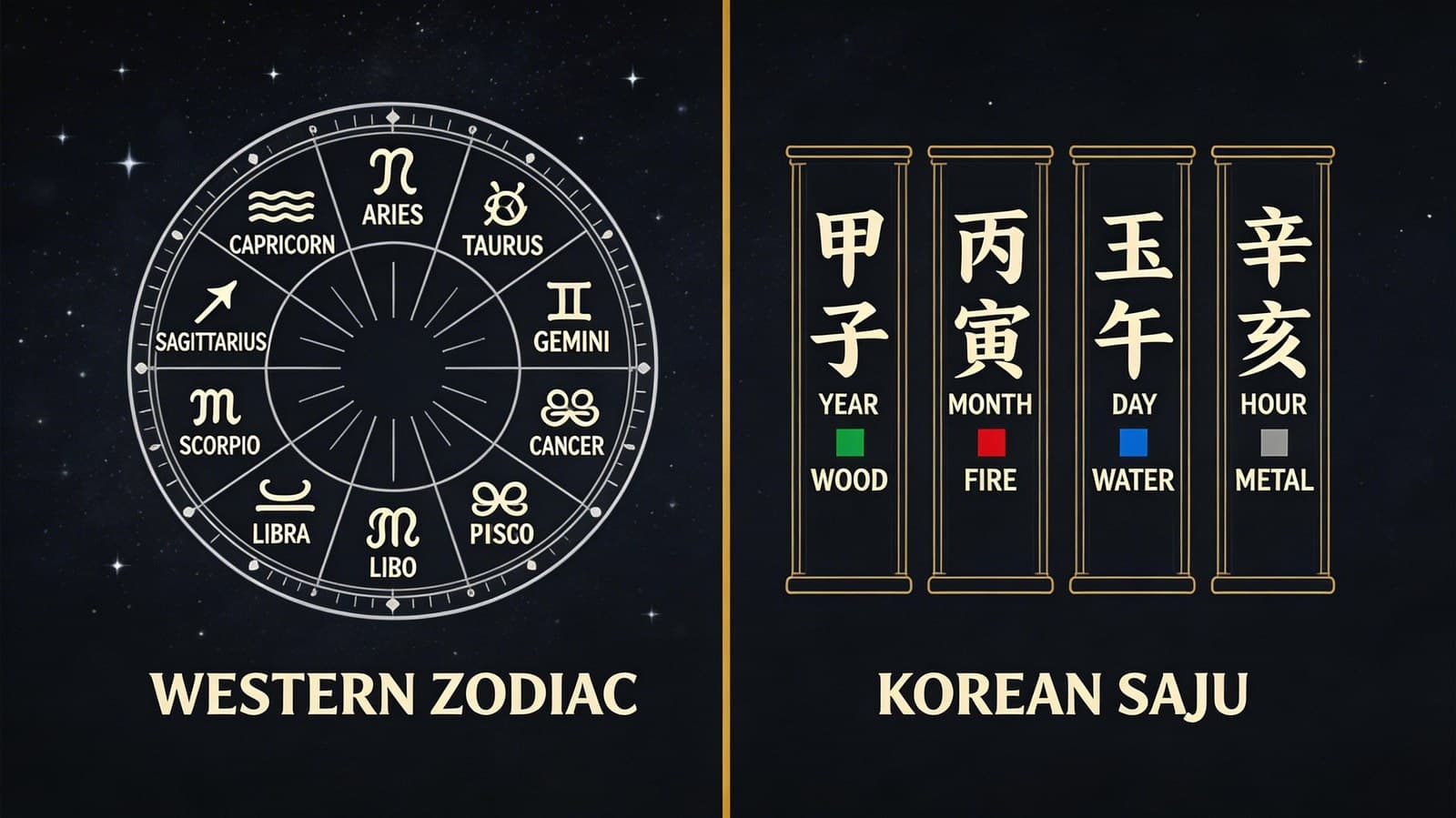
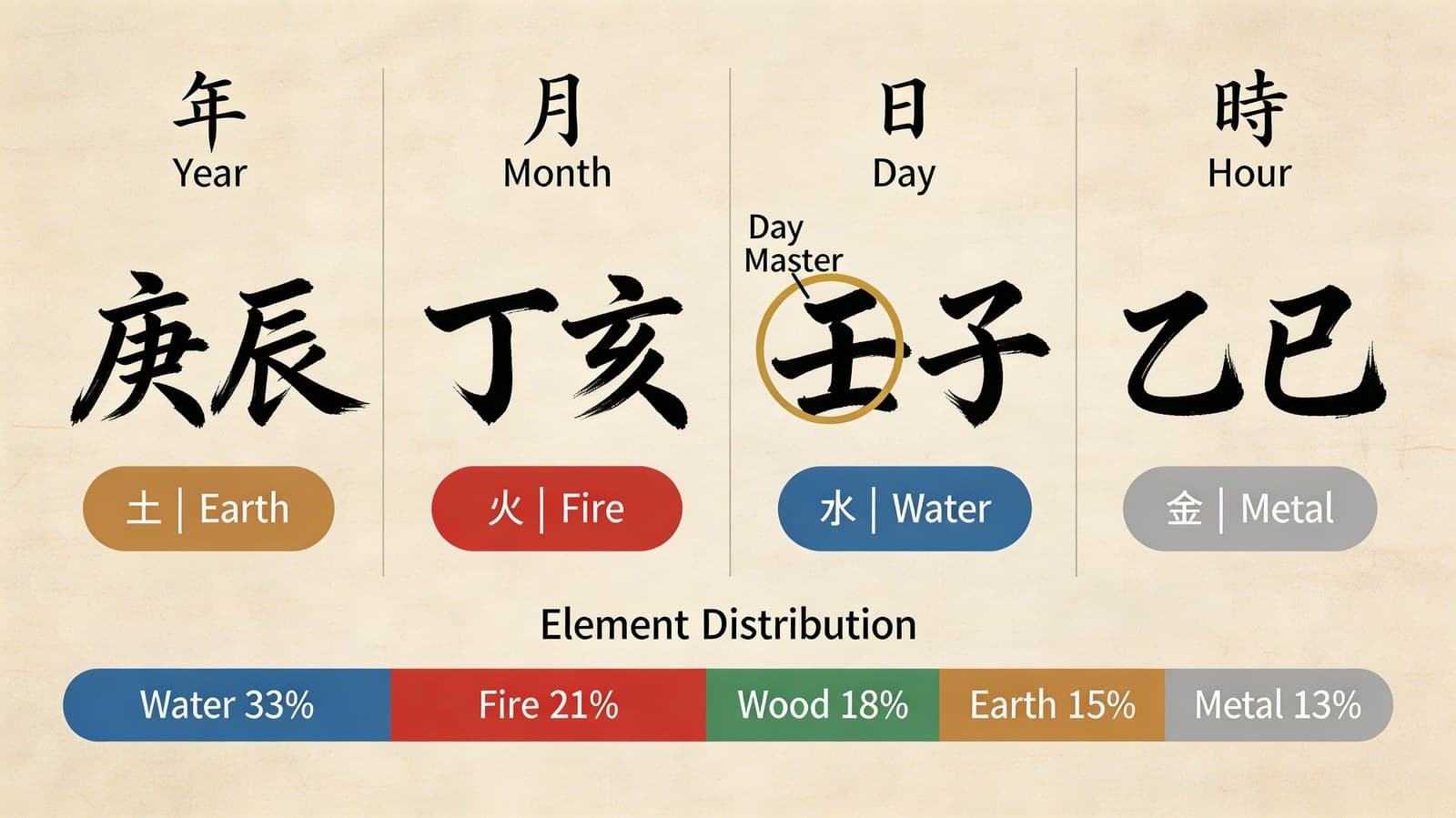
I typed my birth date into ChatGPT and asked for a Saju reading. The response was eloquent — poetic, even. Something about "the quiet strength of deep water meeting earth." Beautiful sentence.
The chart it was reading from was wrong.
Not slightly off. Wrong year pillar. Which meant wrong ten gods. Which meant the entire interpretation — all that beautiful language — was built on someone else's foundation.
The Two Halves of a Four Pillars Reading
Here's a thing most people don't think about when they ask AI for a BaZi or Saju reading: there are two completely different tasks happening at once.
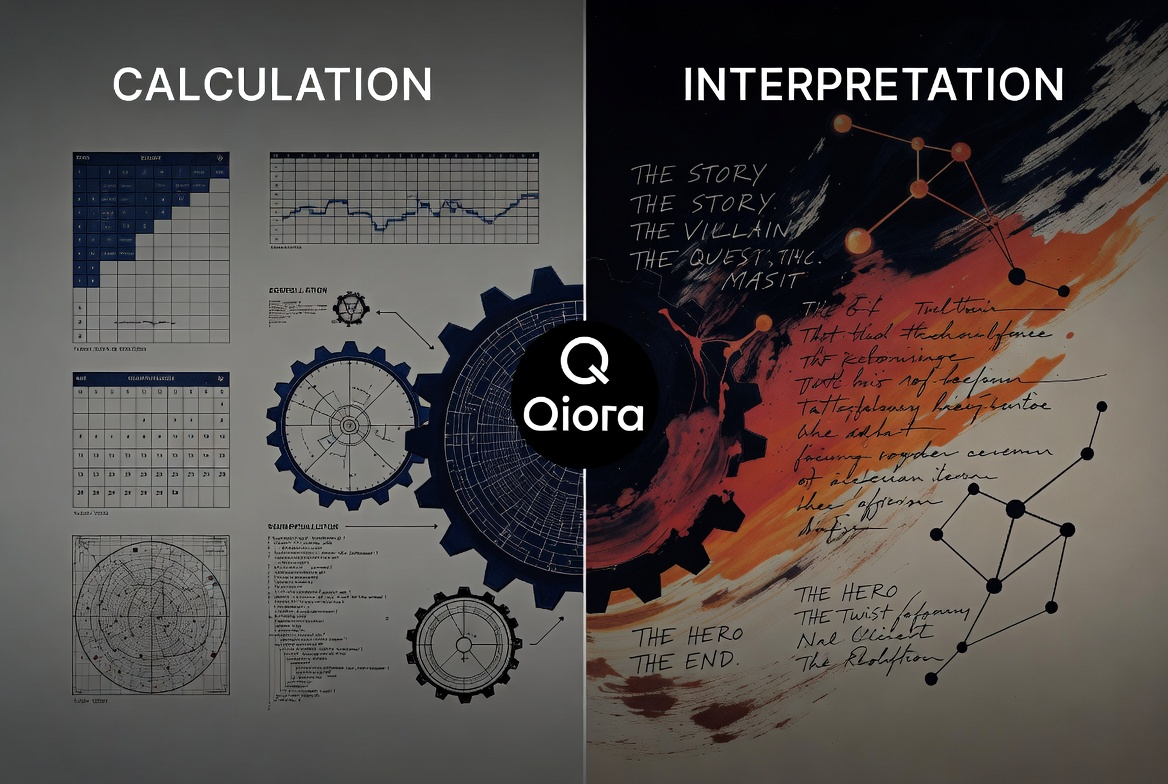
The first is calculation — converting your birth year, month, day, and hour into the eight characters that form your Four Pillars chart. This is math. Lookup tables. Astronomical precision.
The second is interpretation — reading the story those eight characters tell. The tensions, the harmonies, the patterns that make your chart yours. This is language. Narrative. Pattern recognition.
AI is spectacular at one of these and terrible at the other.
Guess which is which.
Why AI Gets the Chart Wrong
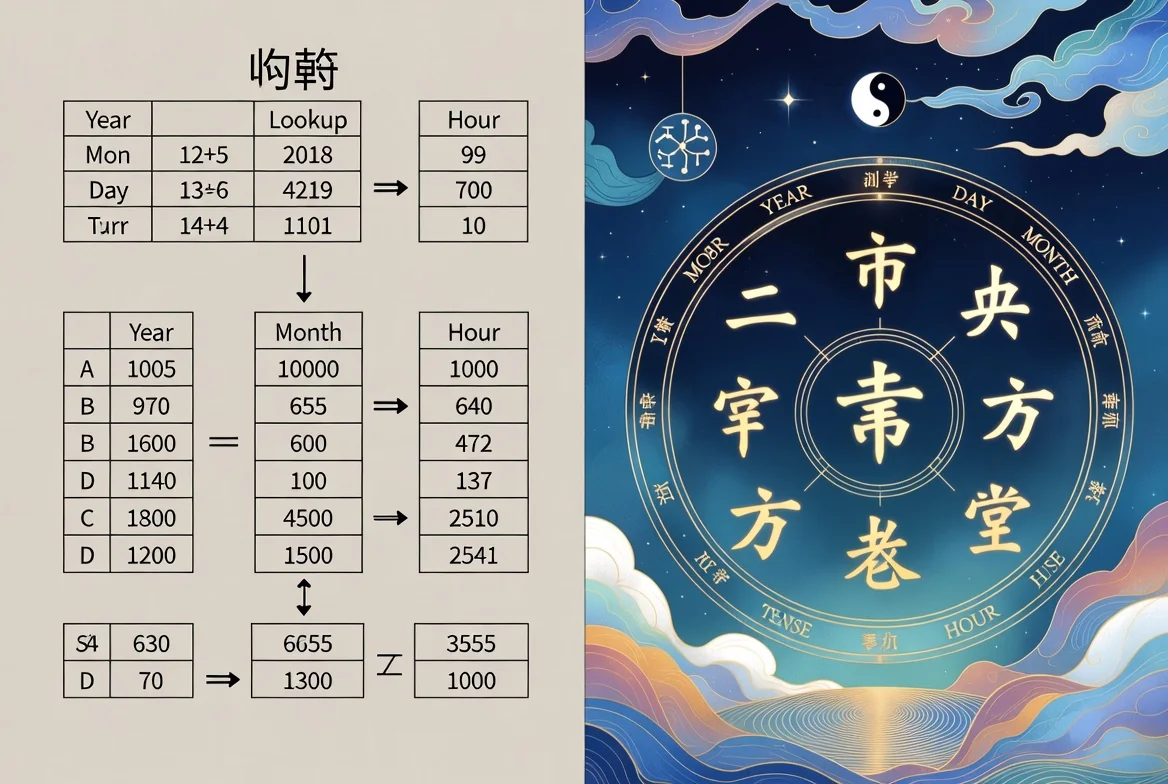
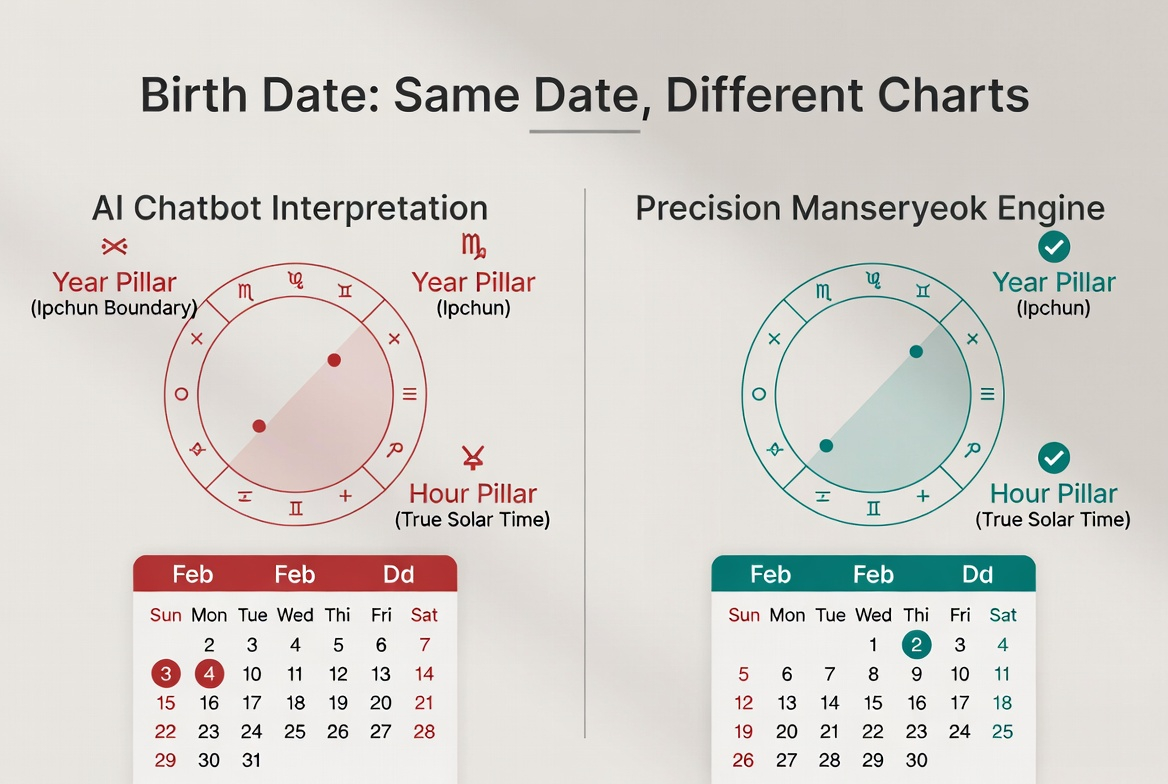
The manseryeok — the perpetual calendar behind every Four Pillars chart — isn't a simple date conversion. The new year doesn't start on January 1st. It starts at Ipchun, the Beginning of Spring, which shifts every year — sometimes February 3rd, sometimes the 4th, occasionally drifting by hours. Miss that boundary and your entire year pillar flips.
Month boundaries depend on exact solar term positions that vary by minutes across decades. And the hour pillar? Traditional practice uses true solar time — your actual local noon based on longitude, not whatever timezone your government assigned. Born at 1:58 PM in Seoul? Depending on the date, that could be one hour block or the next. Different pillar. Different reading.
I've tested this across ChatGPT, Claude, and Gemini — fed them all the same birth dates and compared the output against hand-verified calculations. The failure modes are remarkably consistent. The Ipchun boundary trips up almost everyone. True solar time is ignored entirely. The distinction between Chinese BaZi and Korean Saju calendar conventions? Blurred or nonexistent.
The frustrating part is how convincing the wrong answers look. Four pillars, eight characters, neatly formatted. If you don't know what to check, it reads as authoritative. A confident diagnosis based on someone else's blood test.
Where AI Actually Shines
But here's the twist.
Give that same AI a correct chart — accurate eight characters, proper ten gods, verified elemental balance, current luck cycles — and something clicks. It can hold the tension between opposing forces in your chart and explain why that pressure might show up as both anxiety and drive. It can articulate what it feels like to have four Earth elements pressing down on a single Water day master — not just what it means on paper, but how it lands in a life.
Why? Because interpretation is a language task. Finding patterns, making connections, translating abstract symbols into human narrative. That's what large language models were built for.
Calculation is something else entirely. Lookup tables. Astronomical data. Conditional logic branching across centuries. No amount of eloquence helps you nail the exact minute a solar term falls in a given year.
Two problems. Two tools.
How Qiora Splits the Problem
Qiora's manseryeok engine handles the math. Every Ipchun boundary. Every solar term down to the minute. True solar time by longitude. Hidden stem ratios sourced from traditional texts, not approximated. Deterministic code — the same input always produces the same output, because birth charts don't have room for "probably."
Once the chart is locked, the interpretation layer takes over. AI with proper context: accurate ten gods, verified elemental weights, current luck cycles, and classical analytical frameworks. The model doesn't have to guess what your chart says. It just has to explain what it means.
Each part doing what it's best at. Oh, absolutely.
The Third Layer: What No Calculator Can Fully Solve
Now — I should be honest about something. Because credibility matters more than marketing.
Between "pure calculation" and "pure interpretation" there's a third layer. Think of it like cooking. A recipe can tell you the exact weight of flour, the precise oven temperature, the timing down to the minute. That's calculation. But how much salt — that's where chefs diverge. Not because one of them can't measure. Because they're working from different philosophies of what the dish should taste like.
Saju has the same thing. The eight characters in your chart are facts — they don't change. But the system for reading those characters? That's where schools of thought split. One tradition asks "is the day master strong or weak?" Another asks "what does this chart need seasonally?" A third starts with the overall structural pattern and works backward. Same eight characters. Different starting questions. Sometimes different conclusions.
Two masters with fifty years of experience between them can look at the same chart and reach different readings — not because one made a math error, but because they're working within different traditions of the same art. No calculator resolves that. It's not a math problem. It's a perspective.
Qiora's approach is to be transparent about which perspective we use. Our engine is built on three classical texts: Jaopyeongjinjeon for structural analysis, Jeokcheonsu for the subtler dynamics between elements, and Gungtonggam for seasonal context — what your chart needs based on when you were born. These are the classical canon that both Chinese BaZi and Korean Saju draw from. Within this framework, our engine is precise. But we'd rather say "this is the system we chose and why" than pretend there's one universally agreed-upon methodology. There isn't. Anyone who tells you otherwise is selling certainty they don't have.
Make of that what you will.

A Better Foundation for Your Birth Chart
Traditional Saju masters spend years memorizing the manseryeok. Grunt work — foundational, unglamorous, the scales-before-sonatas of the craft. But nobody goes to a master for their calendar math. They go for the reading. The moment when someone looks at the interplay between your pillars and says something that makes you sit up straighter.
We didn't build Qiora to replace that moment. We built it to make sure it's standing on solid ground — and to be upfront about where the ground is firm, where it's our best interpretation of the terrain, and where the map is still being drawn.
Your birth chart is the one thing about you that never changes. Getting it right seemed like a reasonable place to start.
Saju readings are meant for self-reflection and personal growth — not as a substitute for professional financial, medical, or legal advice. Your choices always shape your life more than any chart can.