
Battle of Fates Is Great TV. But It Gets Saju Completely Backwards.
The Hulu hit turned Korean fortune-telling into a survival competition. But saju — the BaZi-based system at the heart of the show — was never designed to prove anything to anyone.
The most widely used English translation of saju might also be its most damaging. 'Four Pillars of Destiny' sounds poetic — but it's wrong in a way that actually matters.
I want to find the person who first translated 사주팔자 (sajuphalja in Korean) as "Four Pillars of Destiny" and ask them one simple question.
Did you actually read the characters?
Because I've been sitting with this translation for a while now, and the more I look at it, the more it bothers me. Not in a pedantic, well-actually way. In a this fundamentally misrepresents an entire tradition of thought kind of way. The word "destiny" doesn't just add a poetic flourish. It smuggles in a whole worldview — one that saju, at its core, actively rejects.
So let's take this apart. Slowly. Because it deserves to be taken apart.
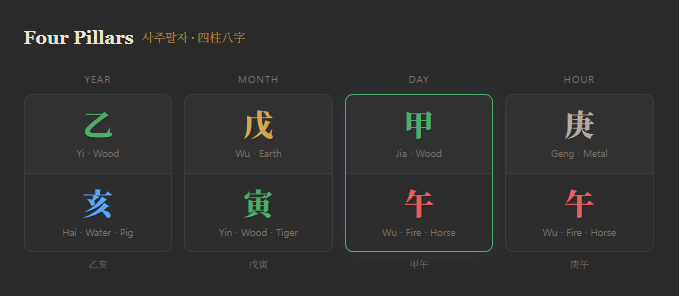
四柱八字. Four characters. Let's go through them one by one.
四 means four. 柱 means pillar or post — the structural kind, the thing that holds a roof up. 八 means eight. 字 means character, or written sign.
That's it. Four pillars. Eight characters. There is no 運 (fate). No 命 (life decree). No 定 (predetermined). No 天意 (heaven's will). The name of the system itself is purely structural — it's describing a framework, the way you might name a spreadsheet by its number of columns.
Someone looked at "four pillars, eight characters" and heard "destiny." That's not translation. That's projection.
To be fair, the BaZi community — largely Chinese and Taiwanese practitioners writing for Western audiences in the 1980s and 90s — needed a hook. "Four Pillars of Destiny" sounds like something from a fantasy novel, which is probably why it spread. It has weight. It has drama. It sells books.
But what it doesn't have is accuracy.
Here's the problem with "destiny" as a frame: once you accept it, every reading becomes a verdict.
You go in asking what does my chart say? and you walk out thinking so that's what's going to happen. The word has already done its damage before the reading even starts. Destiny is, by definition, something you don't choose — something that arrives whether you want it or not. It's the ending of a story you didn't write.
And if saju is the map to your destiny, then the only thing left to do is... what, exactly? Brace yourself? Plan your outfit for the inevitable?
This isn't just a translation quibble. It shapes how people use the system. I've talked to people who consulted a saju practitioner, got told their financial luck was weak, and basically gave up on a business idea. Not because the reading was wrong — but because they heard "destiny" and stopped fighting. The map became a verdict. The framework became a cage.
That's not what this tradition is for.
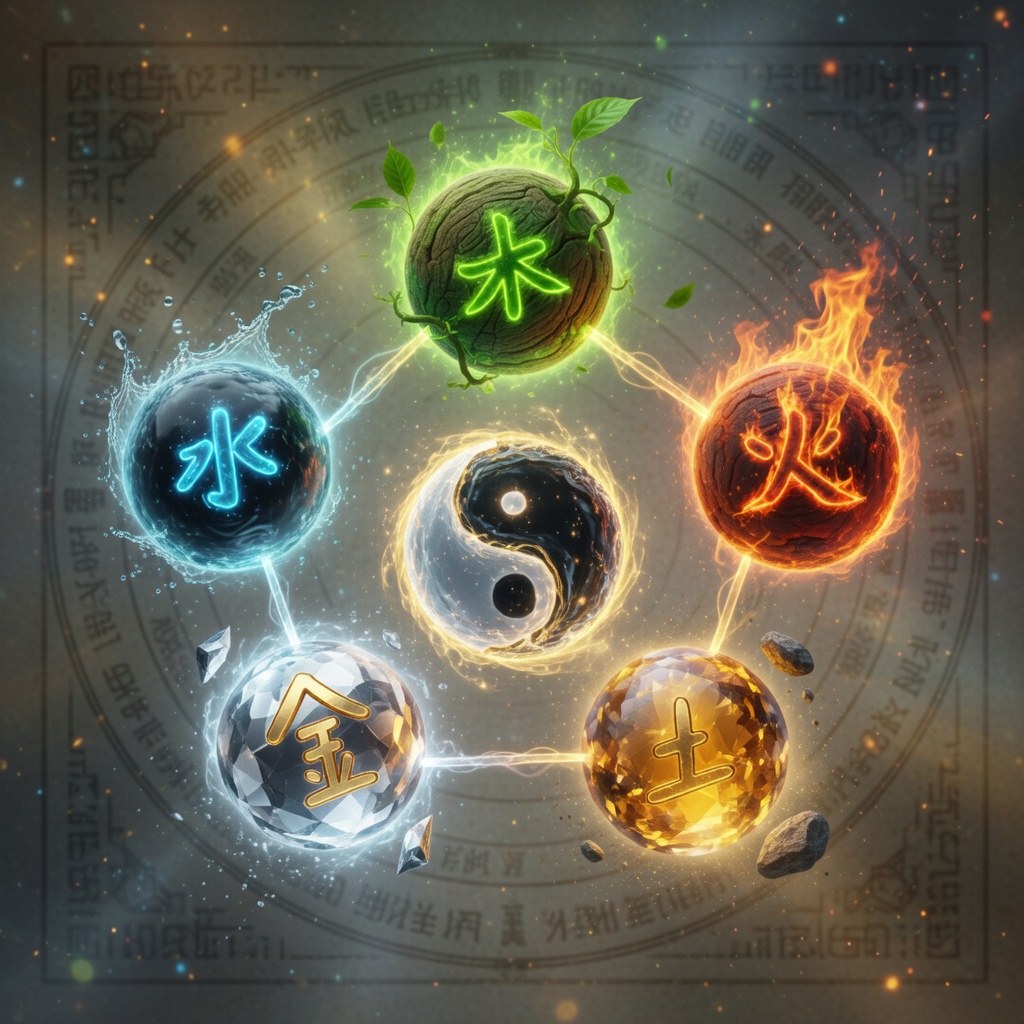
The foundational texts of mínglǐxué (命理學) — Zǐpíng Zhēnquán (子平眞詮), Dītiānsuǐ (滴天髓), Qióngtōng Bǎojiàn (窮通寶鑑) — don't spend much time on fate. They spend almost all of their time on how energy moves.
The whole architecture of the system — ten heavenly stems, twelve earthly branches, sixty-year cycles, daymaster strength, the interplay of the five elements — is a model of dynamic balance, not predetermined outcome. Strong water this year. Weak wood next. Use fire to counter. Anticipate when metal will arrive. The entire vocabulary is about response, timing, leverage.
知時 — knowing the time. That phrase shows up again and again in classical texts. Not "know your fate." Know your timing.
A good practitioner of saju doesn't read your chart and tell you what will happen. They read your chart and tell you what kind of energy is coming, so you can decide what to do with it. That is a completely different proposition. One treats you like a passenger. The other treats you like a captain who finally has access to the weather forecast.
Make of that what you will.
Here's the simplest argument against the destiny frame, and it's the one nobody in the "Four Pillars" community seems to want to confront head-on:
Thousands of people share your exact birth chart.
Same year, same month, same day, same hour. Different people, different families, different countries, different everything. If the chart determines destiny, why do their lives look nothing alike? One of them is a surgeon. Another drives a truck. One is rich. One isn't. Some are deeply unhappy in ways that have nothing to do with what any chart would predict.
The saju framework accounts for this — it has to, because the classical scholars weren't naive. They understood that the chart describes tendencies, natural affinities, recurring patterns of energy. Not a fixed story. They also understood that culture, environment, personal will, and accumulated choices all shape how those tendencies express themselves.
Destiny, as a concept, has no mechanism for this. It just shrugs and says: must've been their destiny too.
This is where I want to make a distinction — not just between good and bad translation, but between two genuinely different ways of using this system.
The Western BaZi tradition, for all its rigor, arrived at "destiny" because it was translating an ancient system for an audience that expected mysticism. Tarot has destiny. Astrology has fate. So BaZi gets destiny too. The whole thing got sorted into the fortune-telling cabinet, and that's where it's been sitting ever since.
Korean saju took a different path. Not because Koreans are inherently wiser, but because saju in Korea became genuinely popular in a day-to-day sense — not just as a system for divination, but as a kind of cultural language for understanding personality, compatibility, and timing. Millions of people casually reference their 일간 (daymaster) the way a Westerner might reference their Myers-Briggs type. It became a tool for self-understanding first, and a predictive tool second.
That's the version worth preserving. And that's what K-Saju, as a concept, is trying to name.
Not fortune-telling dressed up in hanbok. Self-discovery built on 500 years of empirical observation about how people with certain energy profiles tend to move through the world — and what they can do about it.
So what should it be called?
Four Pillars of Wisdom gets closer. Four Pillars of Self is interesting. Even just K-Saju — used without a subtitle, allowed to define itself — is more honest than a word that treats your life as a sentence already written.
I'm not asking to retire "Four Pillars of Destiny" from every book and website that uses it. That ship has sailed, and I'm not the kind of person who spends energy on battles with no upside.
But I do think it matters — especially right now, when more and more people are discovering saju through apps and social media and asking, sincerely, what is this actually for? — to be clear about what we're saying.
This isn't a system that tells you what will happen.
It's a system that shows you what you're working with.
This is the frame we built Qiora around — the idea that your birth chart is closer to a terrain map than a prophecy. Useful for knowing where the mountains are, where the rivers run, which passes open in which seasons. Absolutely not a script.
We're not the first people to make this argument. But we might be saying it more directly than most.
Your 사주 doesn't tell you who you're going to be. It tells you something about who you already are — the natural contours of how you engage with the world, the kinds of challenges that tend to find you, the types of energy you work best with and against. What you do with that information is entirely up to you.
Destiny would like you to believe otherwise.
We respectfully disagree.
Takes less than a minute · No signup required
Saju readings are meant for self-reflection and personal growth — not as a substitute for professional financial, medical, or legal advice. Your choices always shape your life more than any chart can.
The Hulu hit turned Korean fortune-telling into a survival competition. But saju — the BaZi-based system at the heart of the show — was never designed to prove anything to anyone.

More people are getting saju readings than ever. But not all readings are created equal — and the gap between a good one and a bad one is wider than you think.
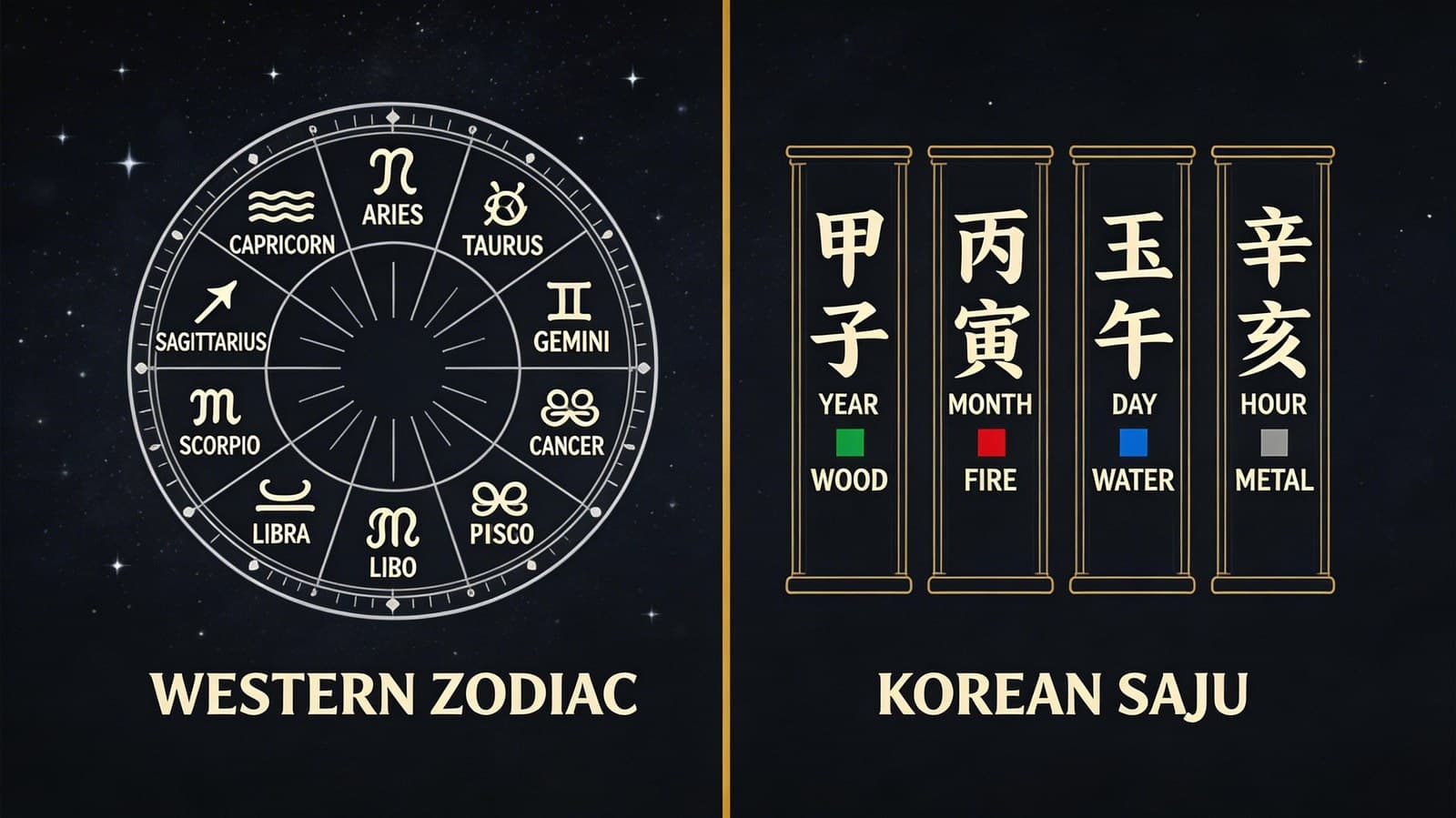
Western astrology and Korean saju both start at your birth moment — but they're asking completely different questions. One groups you with millions. The other finds just you.