Who Called Saju 'Four Pillars of Destiny'? I'd Like a Word.
The most widely used English translation of saju might also be its most damaging. 'Four Pillars of Destiny' sounds poetic — but it's wrong in a way that actually matters.
Saju didn't originate in Korea — it came from China, where it's called BaZi. But what Korea did with it over 500 years is a completely different conversation. And honestly, the more interesting one.
Let's get the awkward part out of the way.
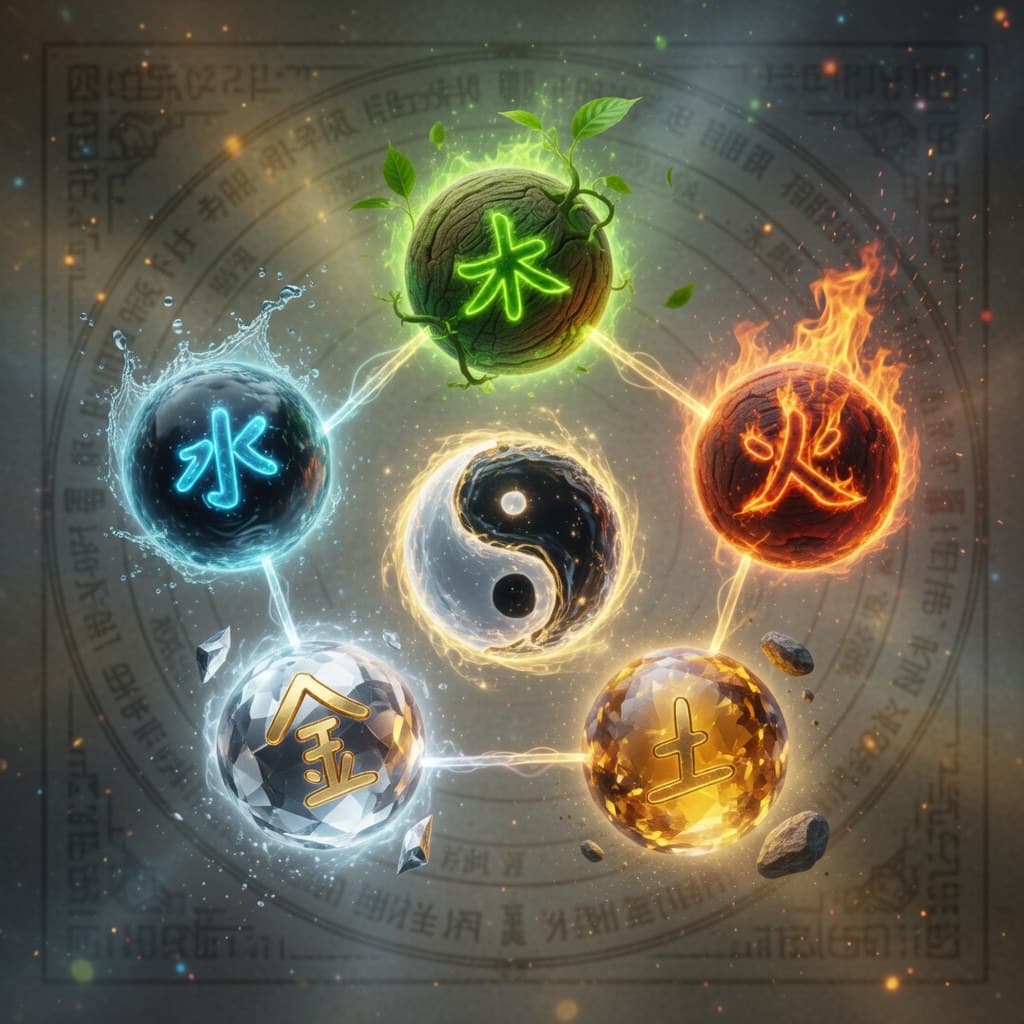
Saju — the Korean system of reading your destiny through the year, month, day, and hour of your birth — didn't originate in Korea. It came from China, where it's called BaZi (八字, literally "eight characters"). The Four Pillars of Destiny framework was formalized during the Tang and Song Dynasties, roughly a thousand years ago, by scholars like Li Xuzhong and Xu Ziping. Korea adopted it, Japan adopted it, Vietnam adopted it. This is just historical fact, and pretending otherwise would be silly.
Okay. Now that we've said that.
What Korea did with this system over the past 500 years is a completely different conversation. And honestly, it's the more interesting one.
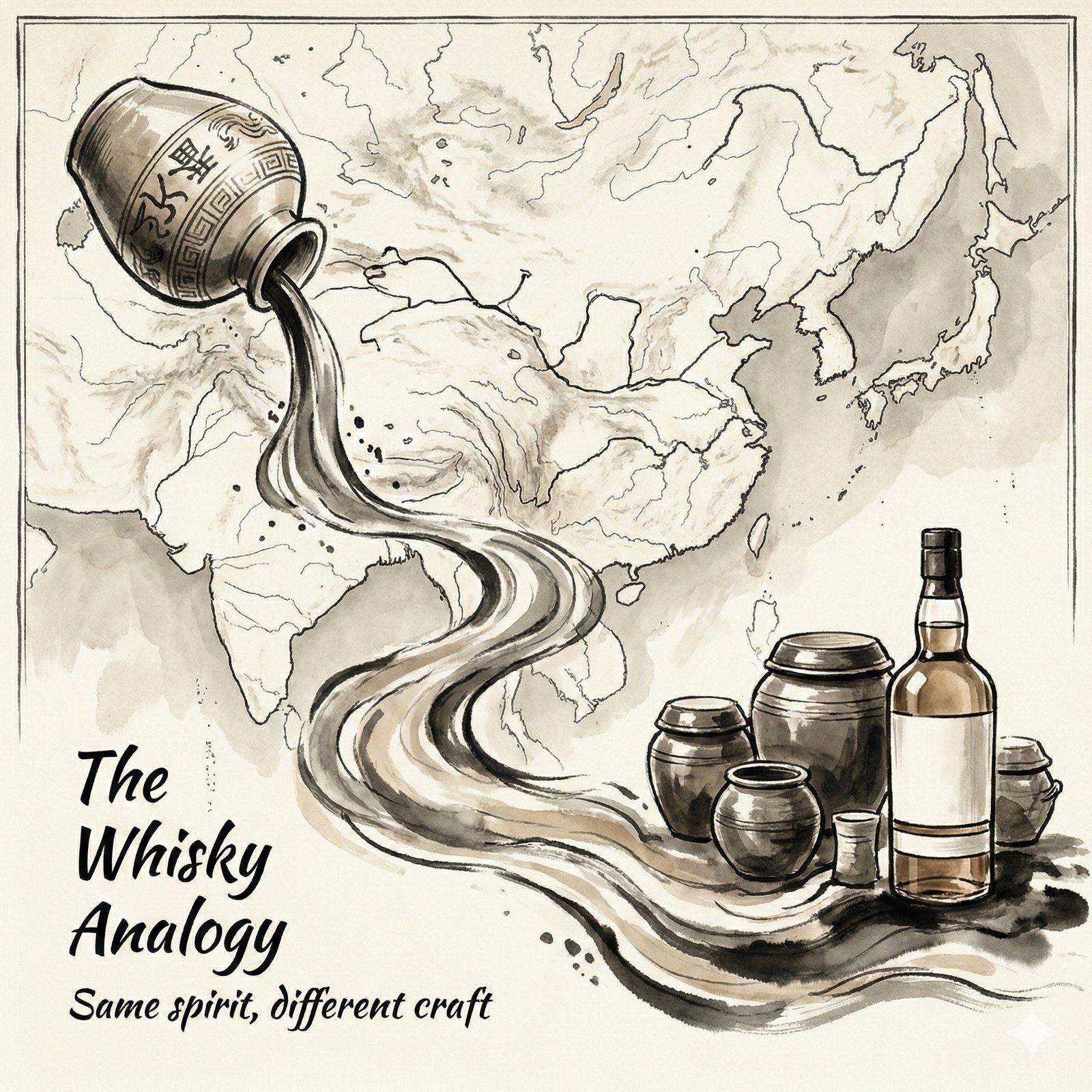
I like to think of it the way I think about whisky. Distillation was invented in the Middle East. The Scots got hold of it and turned it into Scotch. The Japanese borrowed from the Scots and created Japanese whisky, which now regularly beats Scotch at international competitions. Nobody calls Japanese whisky "fake Scotch." It's its own thing. The technique traveled. The craft became local.
Korean Saju is like that. The cosmic algebra — Heavenly Stems, Earthly Branches, Five Elements, the Ten Gods — all of that is shared with BaZi. But the philosophy layered on top, the rituals built around it, the way it's actually used in people's daily lives? That's where Korea went its own way. And in some cases, went much, much further.
Take Tojeong Bigyeol, for instance.
This is a divination text that China simply doesn't have. It's attributed to a Joseon-era scholar named Yi Ji-ham, though historians are pretty skeptical he actually wrote it (the book showed up suspiciously long after he died — make of that what you will). What matters is the system itself: it takes only three of your four pillars, skips the birth hour entirely, runs them through a unique numerical formula, and produces 144 possible hexagram combinations that map out your year, month by month.
Not the I Ching's 64 hexagrams. Its own set of 144. Built from scratch.
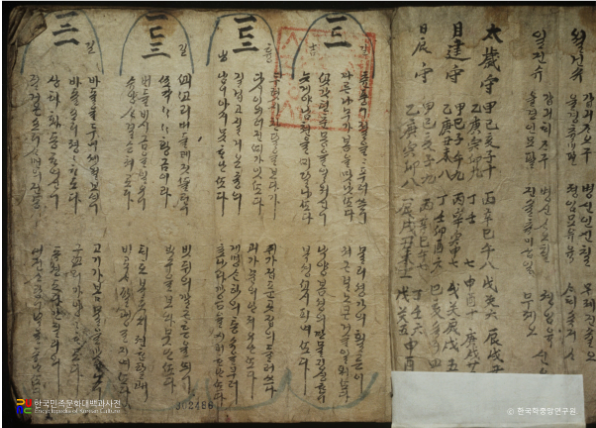
Every Lunar New Year, millions of Koreans check their Tojeong Bigyeol. My grandmother did it. My parents did it. I've done it. It's as much a part of Korean New Year as eating tteokguk (rice cake soup). You're supposed to take it with a grain of salt, and everyone says that, and then everyone checks it anyway. That's the charm.
But the bigger difference — the one that's harder to quantify — is in the feel of the whole thing.
If you've ever had a BaZi reading, you know the vibe: analytical, almost clinical. You sit down, the practitioner examines your birth chart, and they give you an assessment — your wealth luck is strong this decade, your health sector looks concerning next year, this month is good for signing contracts. It's efficient. It's practical. There's a reason BaZi is sometimes called "Chinese astrology for business people."
Korean Saju readings are... not that.
They're warmer. Messier. More emotional. A good Korean Saju master will spend half the session just listening to you — your worries about your job, your complicated relationship with your mother, that business idea you can't stop thinking about at 2 a.m. The birth chart analysis is there, absolutely, but it's wrapped in something that feels a lot more like therapy than a report card.
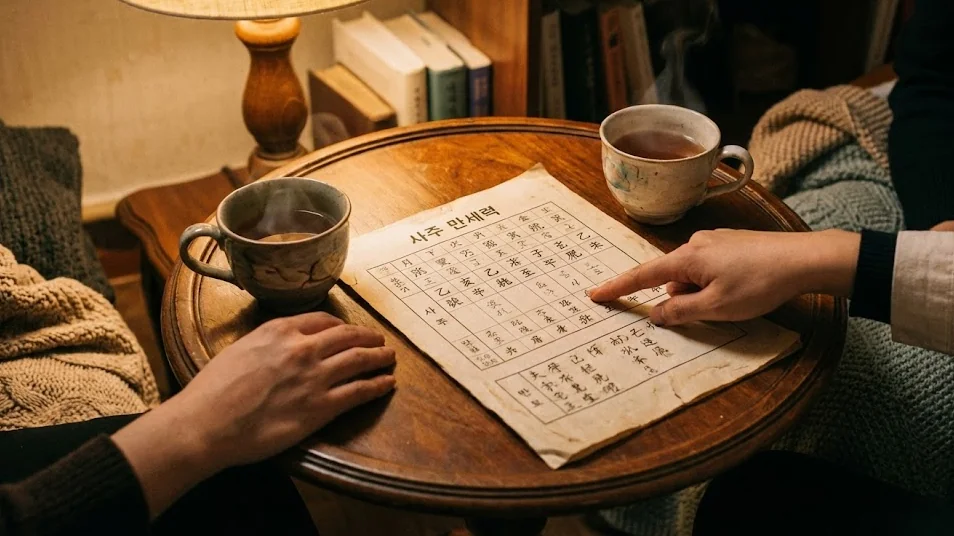
There's a Korean concept called jeong (정) — a deep, almost untranslatable emotional bond and warmth. It's what makes Korean hospitality feel different from Japanese politeness or Chinese generosity. And it's baked into the Korean fortune telling experience. Your reader isn't just decoding symbols. They're sitting with you.
One of Korea's biggest TV shows right now, Mueoseideun Mulleobossal ("Ask Me Anything"), is literally this — two hosts who aren't even fortune tellers comforting people by talking through their life problems with birth charts as the backdrop. It's been running for years. People cry on it. A lot.
Then there's the compatibility thing. Gunghap.
Every culture with a birth chart system does some form of compatibility reading. BaZi has it. Western astrology has synastry. But Korea made it into infrastructure. During the Joseon Dynasty, you literally could not get married without exchanging sajudanja — formal documents containing each person's birth data — and having them analyzed. This wasn't a fun date activity. This was a legal-adjacent step in the marriage process.
And the analysis was thorough. Not just "oh, your Fire element clashes with their Water." Korean compatibility readings examine how your Day Pillars interact, whether your Ten God structures complement or undermine each other, and — this is the part that gets wild — how your respective Luck Cycles will sync or diverge over the next 30 years. It's relationship forecasting on a timeline most Western astrology or BaZi compatibility tools wouldn't even attempt.
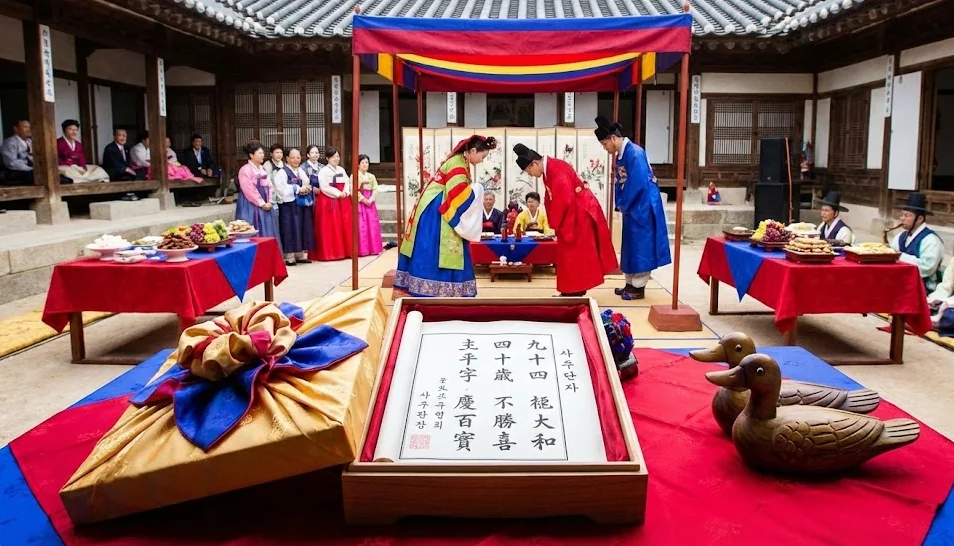
Is it still done today? Oh, absolutely. Parents still check. Couples check. Sometimes they check at a Saju café in Hongdae while splitting a matcha latte, which is maybe the most Korean sentence I've ever written.
I should also mention the naming thing, because it's one of those details that surprises everyone who isn't Korean.
When a Korean baby is born, many families take the birth chart to a naming master. The master identifies which of the Five Elements is weak or missing in the child's chart, and then carefully selects Chinese characters for the name that compensate. The stroke count matters. The elemental association of each character matters. The phonetic balance matters.
Your name, in Korean tradition, isn't just what people call you. It's a correction — a small, daily act of rebalancing your cosmic equation.
Adults change their legal names for the same reason. It's not weird here. It's maintenance.
And look, I'd be leaving out a major piece of the story if I didn't mention the digital side.
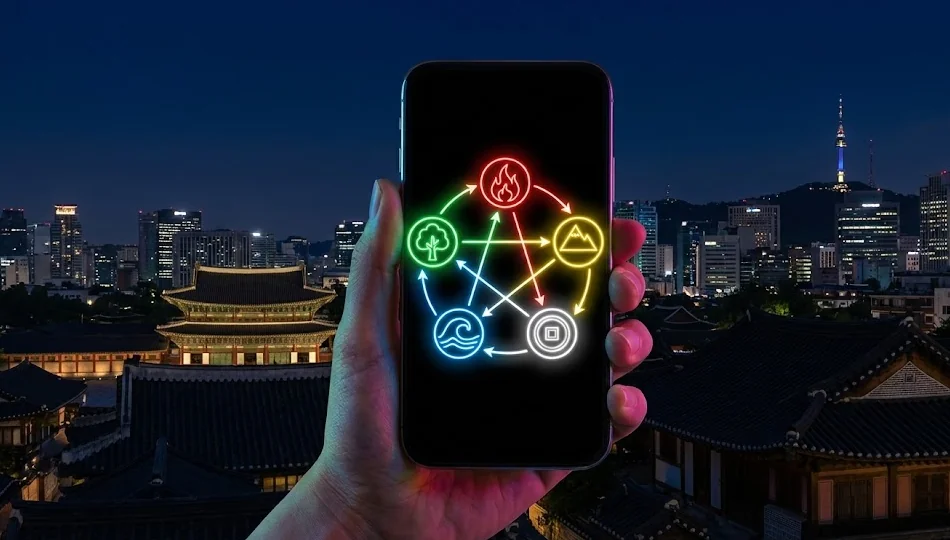
Korea's fortune telling market is estimated at around ₩1.4 trillion — roughly a billion US dollars. The app Jeomsin has over 19 million downloads. Saju cafés are now on tourist itineraries alongside Gyeongbokgung Palace and Myeongdong shopping. There are English-language Saju reading services popping up all over.
China's BaZi consultation scene is still overwhelmingly in-person. Korea, meanwhile, has gone full digital — AI-powered daily readings, algorithm-generated annual reports, real-time video consultations with masters, even Saju-based outfit recommendations (yes, really). Whether you think that's brilliant or absurd probably says something about your own chart.
The point is: Korea didn't just inherit this tradition. It ran with it. And it's still running.
So when we talk about "K-Saju," we're not claiming Korea invented the Four Pillars of Destiny. We're saying Korea built something around them that doesn't exist anywhere else — a blend of Confucian moral philosophy, deeply personal counseling culture, unique homegrown systems like Tojeong Bigyeol, and a digital ecosystem that's years ahead of the rest of the world.
The math is shared. The meaning is Korean.
That's what we're building at Qiora. Not another fortune telling app — the world has enough of those. We're building a self-discovery tool grounded in the depth and warmth of the Korean Saju tradition, with the algorithmic precision to actually get the details right. Because your birth chart contains 518,400 possible combinations. You're not a zodiac sign. You're one of a kind.
But you probably already knew that.
Takes less than a minute · No signup required
Saju readings are meant for self-reflection and personal growth — not as a substitute for professional financial, medical, or legal advice. Your choices always shape your life more than any chart can.
The most widely used English translation of saju might also be its most damaging. 'Four Pillars of Destiny' sounds poetic — but it's wrong in a way that actually matters.

The Hulu hit turned Korean fortune-telling into a survival competition. But saju — the BaZi-based system at the heart of the show — was never designed to prove anything to anyone.

Most people open a compatibility report, read the summary, and close it. The summary is the least useful part. Here is what the rest of it is actually telling you.