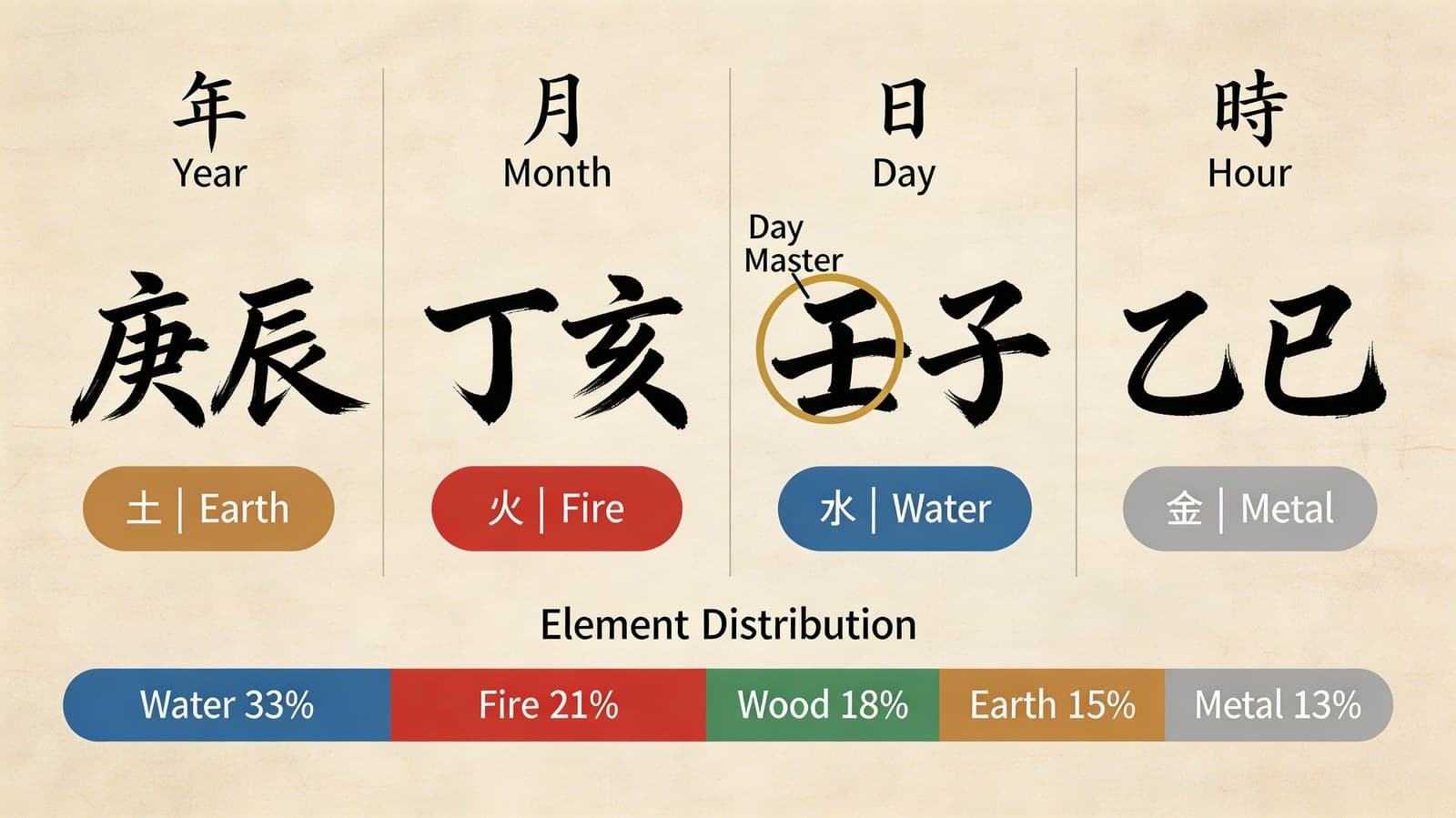
Try K-Saju Yourself: What Battle of Fates Contestants Are Actually Reading
The masters on Battle of Fates aren't reading your energy. They're reading a chart — eight characters derived from your birth data. Here's how to see yours in under a minute.
The show's tagline asks: can anyone truly read your fate? It's a better question than the show is equipped to answer. Here's what a saju practitioner actually thinks.
Is my fate predetermined? Can anyone truly read it?
That's the show's tagline. And I want to give it a real answer, because the show itself can't — not in a competition format, not with judges and elimination rounds and a studio audience.
Let me get the awkward part out of the way first: I've been studying saju for close to thirty years, and I'm currently involved in building a saju app. I am not a neutral observer. You should factor that in.
That said, I've been thinking about this question — whether saju "works," and what that would even mean — for most of my adult life. And the honest answer is more interesting than either "yes, absolutely" or "no, it's entertainment."
The show's setup implies a simple test: the practitioner says something true about a stranger, the stranger confirms it, the judges award points. If it happens enough times, saju works. If it doesn't, it doesn't.
The problem is that this isn't really how you'd test a system designed to describe elemental tendencies and long-term life cycles. It's a bit like testing a nutritionist by having them guess someone's blood type from across the room. Adjacent enough to feel relevant. Not actually the thing.
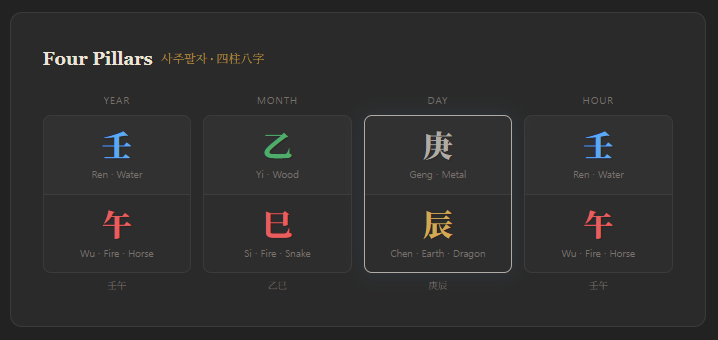
What saju describes — at its most honest — is not specific events but structural tendencies. A chart heavy in Metal and Earth with a weak day master often looks a certain way: methodical, detail-oriented, quietly under pressure, not someone who makes fast emotional decisions. A chart with strong Fire and scarce Water often looks different: expressive, fast-moving, sometimes running ahead of their own thinking.
These are tendencies, not facts. Descriptions of elemental makeup, not predictions of what happens Tuesday.
Testing whether a practitioner can sense "this person has had financial difficulties" in a five-minute reading is testing something — but not really that.

Watch the ones who hesitate.
There are contestants on Battle of Fates who go fast — intuitive, almost theatrical, confident in a way that reads well on camera. And there are practitioners who slow down, who ask a question or two before they say anything, who seem to be genuinely working through something rather than performing certainty.
The second group is more interesting, because what they're demonstrating isn't psychic ability. It's pattern recognition built over years of reading charts and then watching what actually happened to the people in those charts. The distinction between that and what the shamans on the show are doing — practitioners like Lee So-bin, whose 2008 MC Mong prediction became internet legend — is worth understanding separately.
Saju practitioners who've been doing this for decades have seen, say, several hundred charts with a particular structural feature — a strong 편관 (biased authority) configuration without the right elemental support — and watched how those cases tended to play out. Not because the system mandated it, but because the pattern held enough times to become informative.
That's not mysticism. It's experience with a complex pattern language. A radiologist reading an X-ray does something structurally similar — pulling from accumulated pattern recognition to identify what's present. The domain is different. The epistemic mechanism is not entirely unlike.
Does that make it reliable? Partially. Does it make it provable in a game-show format? No.
Here's the counterargument, and it deserves its own space.
A lot of what looks like accurate saju reading could be explained by cold reading — the well-documented set of techniques by which someone appears to know things about you through educated guessing, careful observation, and responsive adjustment based on your reactions.
"You've experienced a significant loss that changed your direction." True of almost everyone over thirty. "You have difficulty trusting people, but once you trust someone, you go all in." True of most humans. "There's something about your relationship with authority that's complicated." Also quite broad.
The show's format makes this worse, not better, because it rewards visible emotional response — which means practitioners who are skilled at cold reading have a structural advantage over practitioners who are technically better at chart analysis but less theatrically effective.
I'm not saying everyone on the show is cold reading. I don't know that. I'm saying the format can't distinguish between them, and any honest assessment of what the show proves has to acknowledge this.

Here's where I land, after close to thirty years of watching people engage with this system:
Saju is a very old, very refined pattern language for describing human temperament and life cycles. The best practitioners use it the way a good therapist uses a framework — not as a set of truths, but as a structured way of asking better questions. The chart gives them a vocabulary. The conversation is where anything useful actually happens.
For some people, seeing their elemental chart described in terms they haven't heard before produces genuine recognition — that's exactly how I've always felt about this. For others, it's too abstract to land. Neither reaction means the system works or doesn't work. It means it's a tool, and tools fit some hands better than others.
What it definitely isn't is what Battle of Fates presents it as: a talent competition where accuracy is the metric and speed is the advantage.
The show is good television. The question it's actually asking — whether the forces shaping a human life are legible, if you know how to read them — is genuinely worth sitting with.
But the answer isn't in the elimination results. It's in whether, when you look at your own chart, something in there feels true.
If you're skeptical, that's fine. Healthy, even. The parts of saju that are most worth engaging with reward skepticism — because they don't ask you to believe anything. They ask you to look at a structural description and notice whether it corresponds to your experience.
That's a different kind of claim than "your lucky number is seven" or "you will meet a tall stranger." It's closer to "here's a framework; does it describe something real about you?" You're the one who knows the answer.
At Qiora, you can pull your chart for free. See your day master, your elemental balance, your current luck period.
Takes less than a minute · No signup required
Saju readings are meant for self-reflection and personal growth — not as a substitute for professional financial, medical, or legal advice. Your choices always shape your life more than any chart can.
The masters on Battle of Fates aren't reading your energy. They're reading a chart — eight characters derived from your birth data. Here's how to see yours in under a minute.
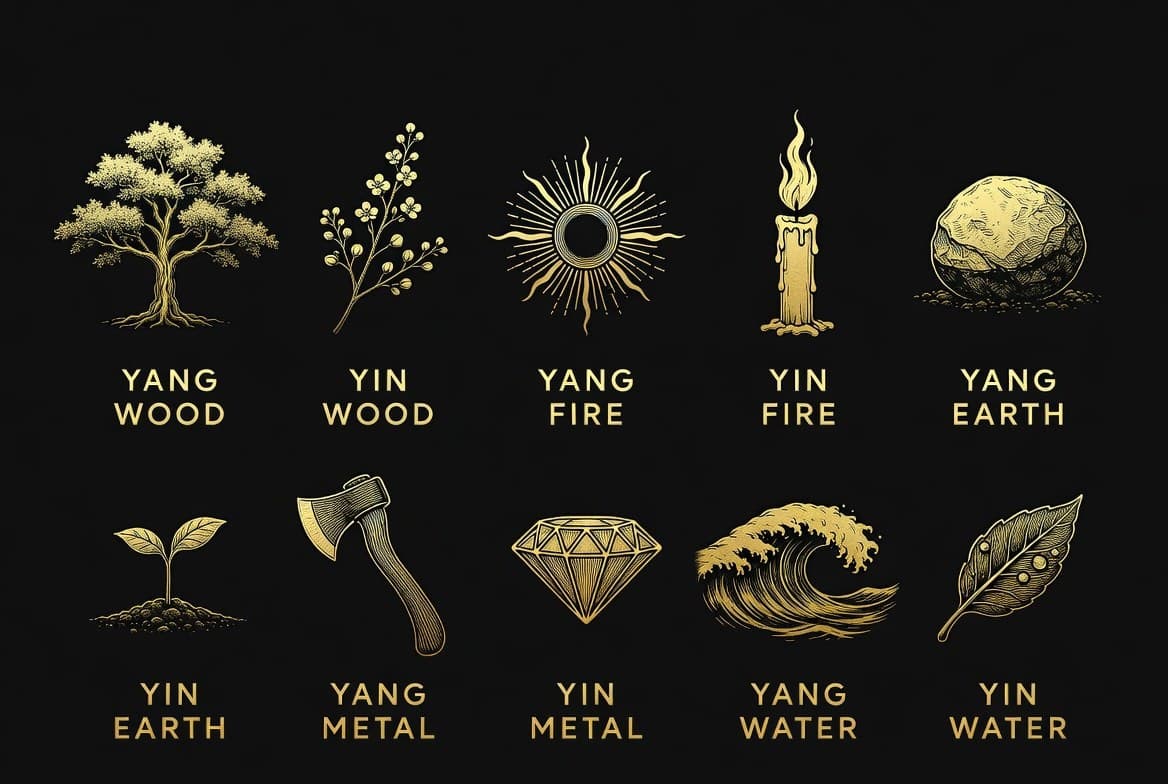
Battle of Fates contestants keep talking about water types, fire types, metal energy. But nobody on the show tells you how to find yours. Here's what they're actually looking at.
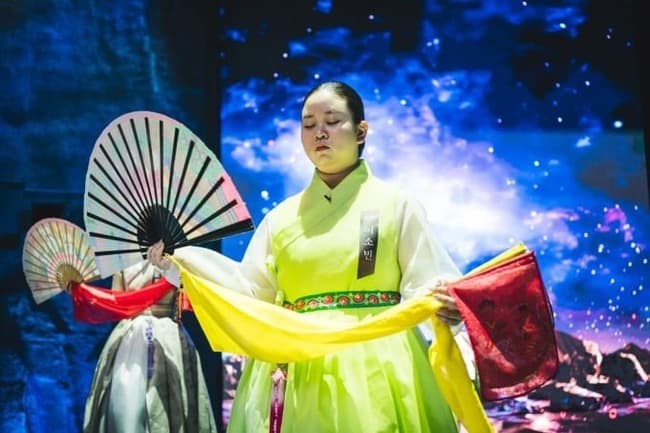
Lee So-bin's 2008 prophecy became legend. But what the shamans on Battle of Fates do and what saju masters do are two very different things — and that difference matters.