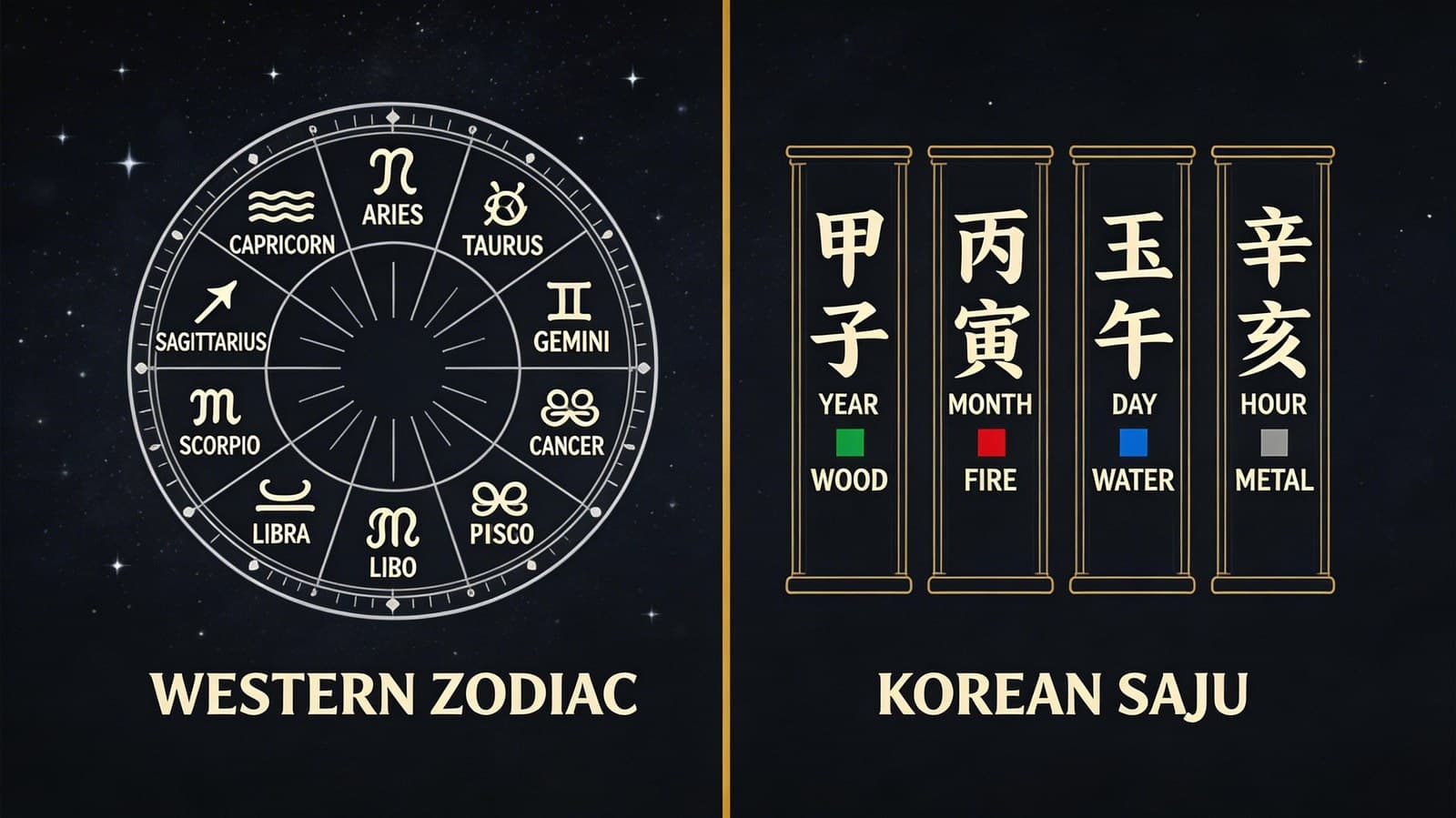
If you've been watching Battle of Fates and thinking "I want to know what my chart says" — good. That's the right instinct.
There are saju cafés all over Seoul where you can walk in, give a stranger your birth data, and walk out forty minutes later with a reading. The masters on Battle of Fates are working from the same raw material. The difference is you don't need a café, a stranger, or a countdown clock. You need your birth date, birth time, and about sixty seconds.
Here's what you're looking at when you pull up a K-Saju birth chart, and how to read what comes back.
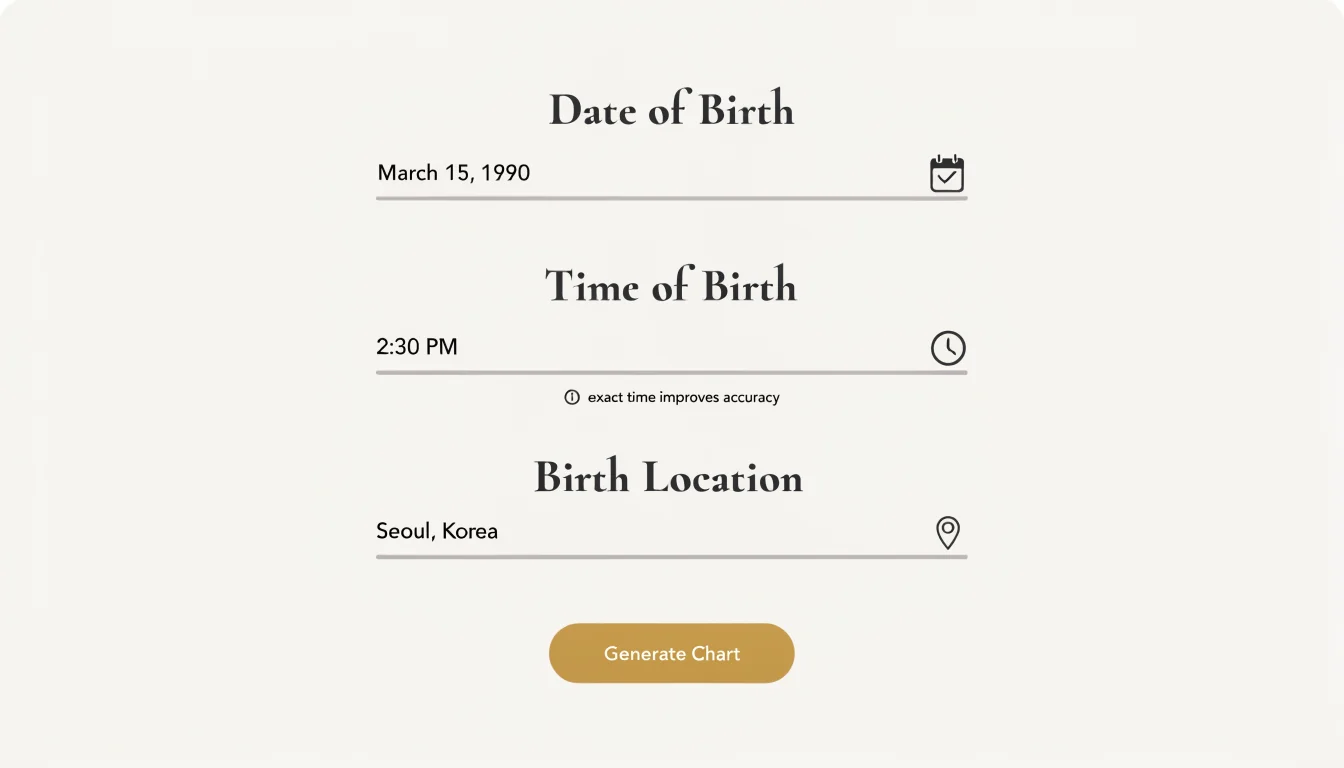
What You Need to Get Started
Three things: birth date (solar calendar), birth time, and birth location.
The birth time matters more than people expect. Saju divides the day into twelve two-hour periods, each corresponding to a different pillar. If you were born at 11:58 PM versus 12:02 AM, you get a different hour pillar — which can change your chart meaningfully. If you genuinely don't know your birth time, you can still run a partial reading from the first three pillars, but the hour pillar adds a layer you'd want eventually.
Birth location matters for solar time correction. Saju runs on true solar time, not the administrative time zone on your birth certificate — Seoul and Busan are in the same zone but positioned differently enough that it can shift the hour pillar. A good calculator handles this automatically.
The Chart That Comes Back
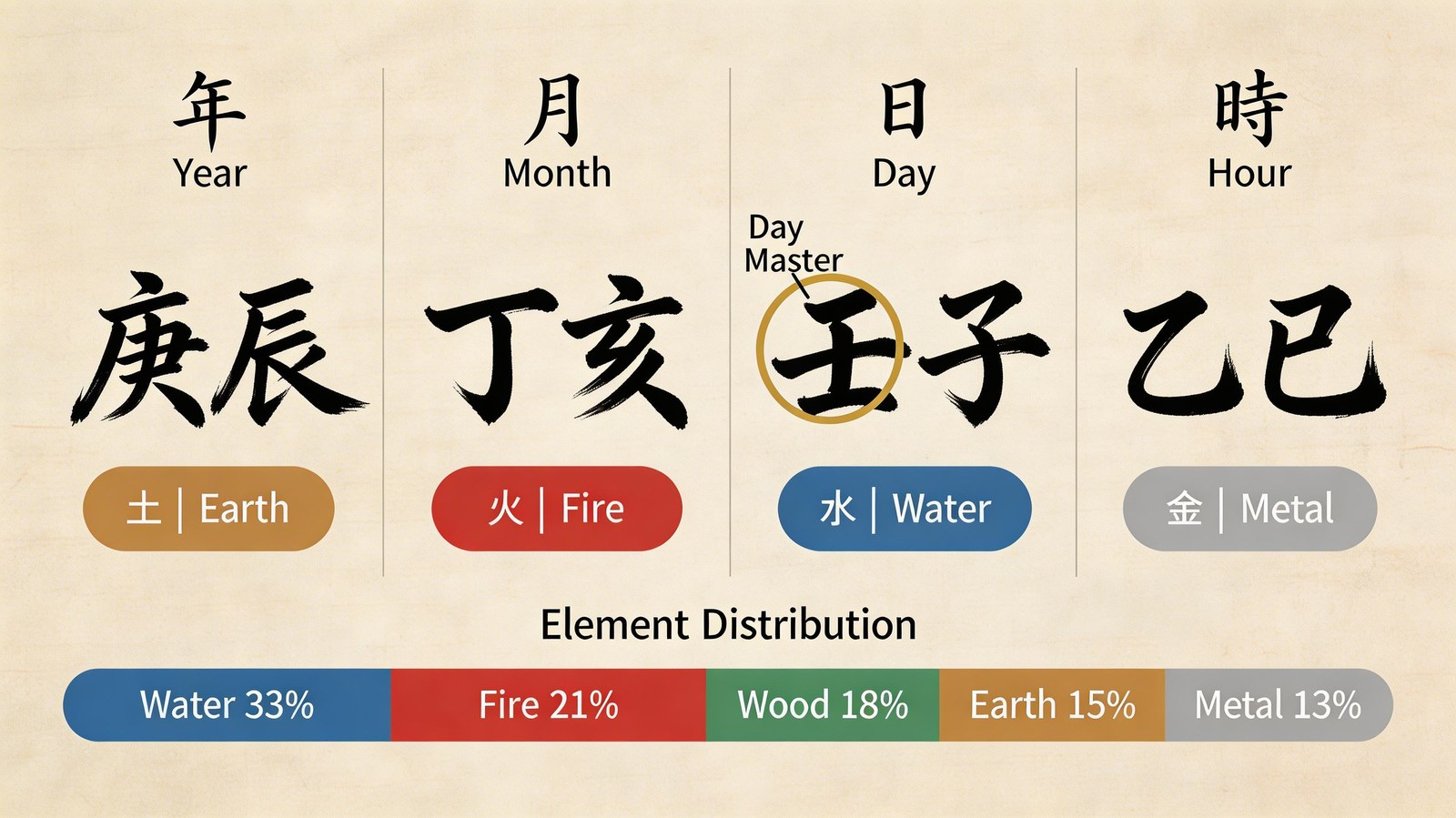
Once you enter your data, you get four pillars — year, month, day, hour — each with two characters: a heavenly stem on top, an earthly branch below.
Eight characters total. That's your saju palja (사주팔자). That's what the masters are looking at.
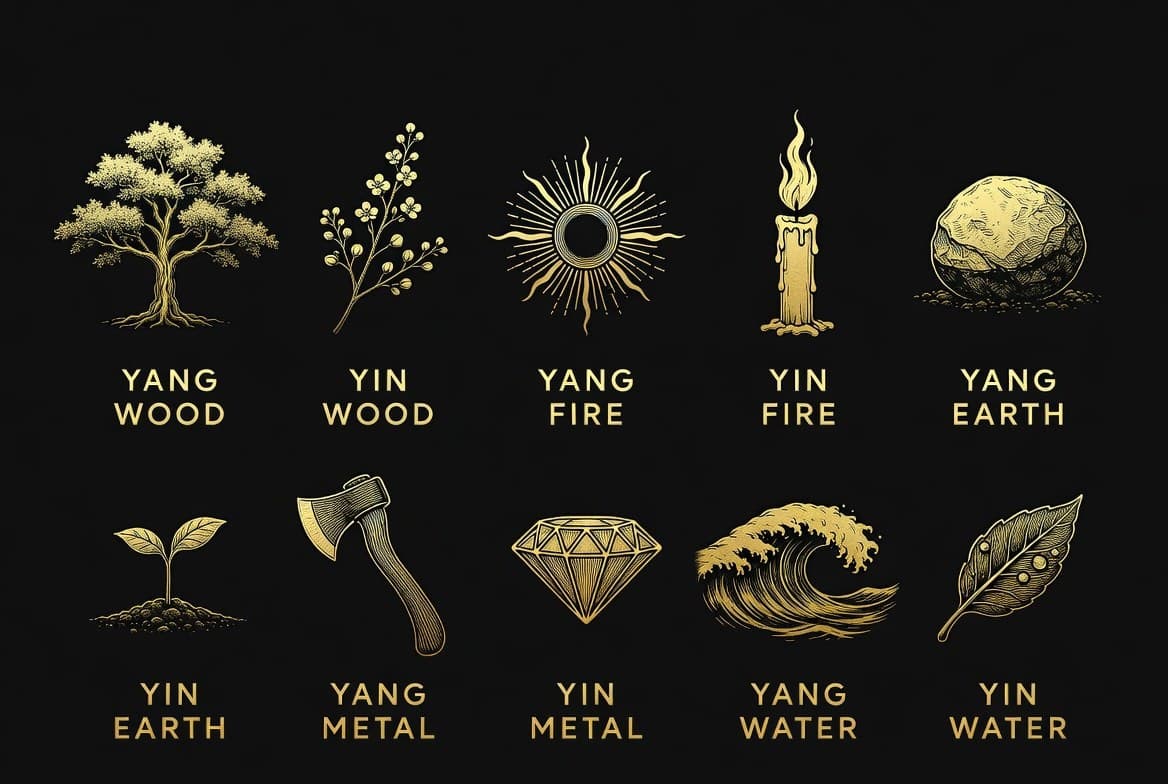
The most important character in the whole chart is the heavenly stem of your day pillar. This is your day master (ilgan, 일간) — the element that represents your core self. Everything else in the chart is read in relationship to it. There are ten possible day masters — here's what each one means.
When a Battle of Fates contestant says "this person is Metal energy" or "strong Water," they've started here. They've identified the day master and they're building outward.
Your chart will also show you the five-element breakdown — how much Wood, Fire, Earth, Metal, and Water you carry across all eight characters. Which elements dominate, which are barely present, and what that imbalance means.
The Piece Most Charts Don't Show You
A lot of free saju tools stop at the birth chart. Here's your eight characters, good luck.
That's like handing someone a map and not telling them where they currently are.
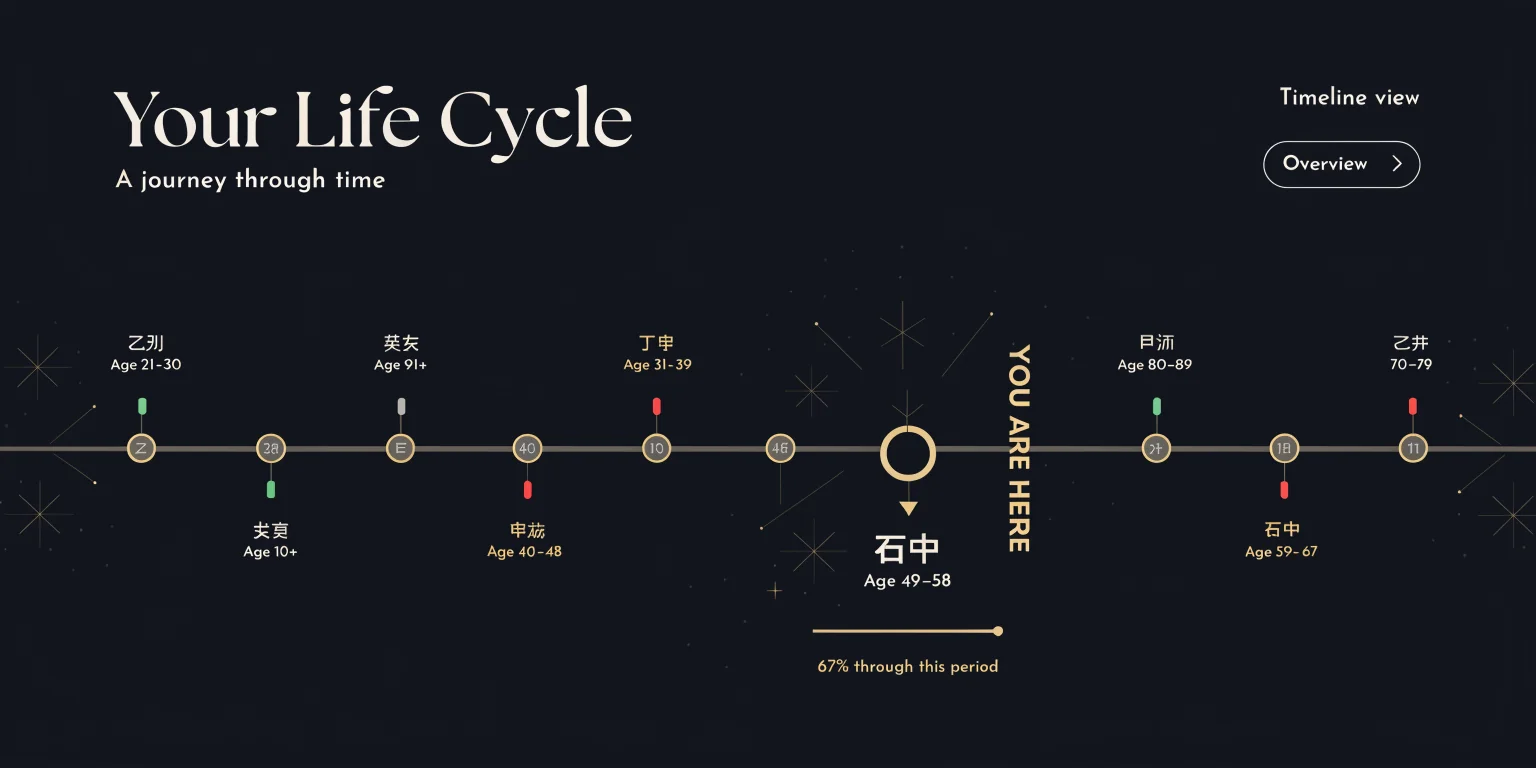
The part that makes saju practically useful is the time layer. Your fixed birth chart describes your elemental nature. But on top of that sit two moving cycles: the daewoon (대운), a decade-long luck period, and the sewoon (세운), the current year. These cycles bring different elements into contact with your fixed chart — some supportive, some abrasive.
Knowing which cycle you're in changes how you read what's happening in your life right now. Not "am I lucky or unlucky" — more like "what does this particular season ask of me."
The masters on Battle of Fates read this layer too — when they have time, which in a competition format is almost never. Why the competition format fundamentally misrepresents saju is a longer conversation. Your chart will show it to you without the clock running.
What to Actually Do With What You Find
Pull up your chart. Find your day master first. Then look at whether your chart is element-heavy in one direction or relatively balanced.
Heavy charts — lots of one element — tend to have a particular flavor. Someone with four Earth characters often reads as steady, patient, sometimes immovable. Someone with almost no Fire can feel like they're perpetually warming up to things that come easily to others. Neither is good or bad. It's just the elemental mix you're working with.
Then look at your current major luck period. What element does it bring? Ally or friction with your day master?
Start there. You don't need to understand every layer to get something out of it. The chart is a starting point. Go as deep as you want.

The Same System, Without the Pressure
Battle of Fates puts its practitioners in a room with a stranger and a countdown clock. The whole point is pressure: can you read someone, right now, under conditions designed to make reading hard?
It makes good television. It's also a somewhat absurd way to demonstrate what saju actually is.
The system was designed for the opposite of that. For slow reading, for return visits, for the kind of conversation that takes months or years to fully absorb. The masters who've spent decades with it tend to be the quietest ones on the show — because they know how much they can't say in five minutes.
Your chart doesn't expire. It doesn't need to be performed for judges.
Saju readings are meant for self-reflection and personal growth — not as a substitute for professional financial, medical, or legal advice. Your choices always shape your life more than any chart can.