
How Do the Five Elements Shape the Way You Love? 5 Types Explained
The five elements shape love as five instincts: Wood grows, Fire expresses, Earth stays, Metal defines, and Water feels.
Two calculators can read the same birth certificate and disagree on half your chart. Here are the six corrections Qiora Saju applies before building it.
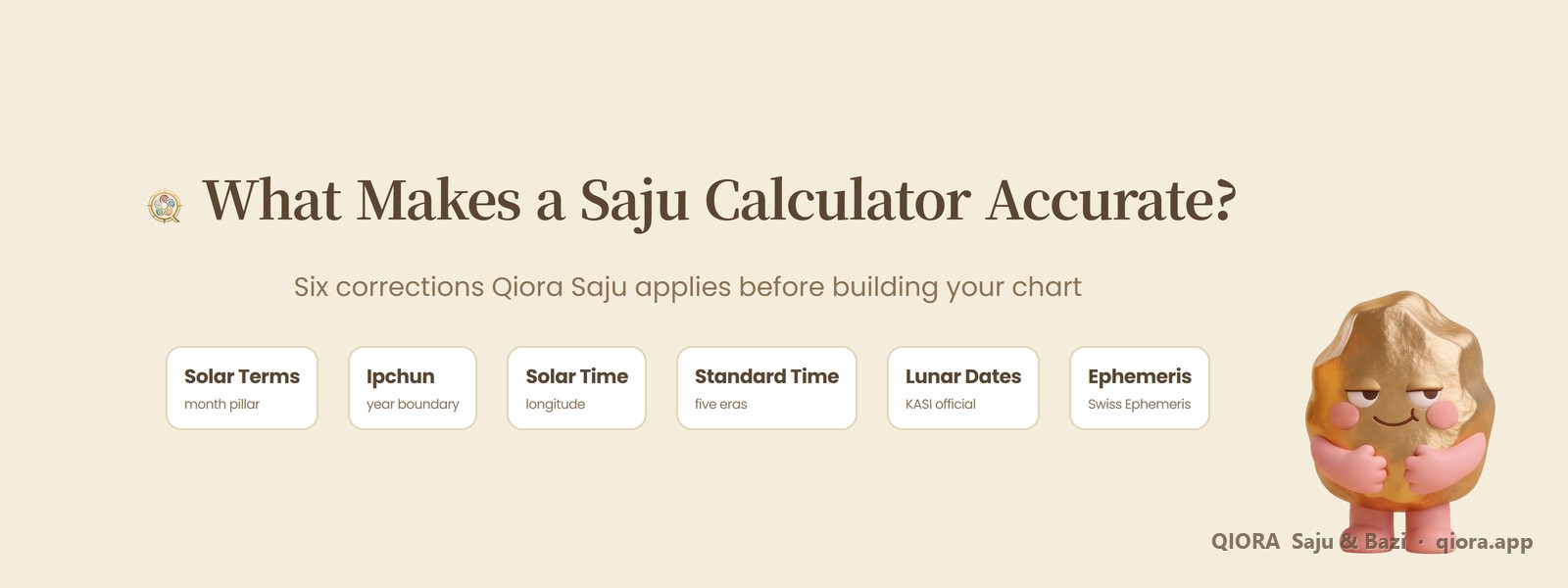
An accurate Saju calculator does not use the time written on a birth certificate as it stands. Before it assigns the four pillars, Qiora Saju corrects for the 24 solar terms, the Ipchun (立春) year boundary, true solar time, the standard time Korea actually kept on the birthdate, lunar-to-solar conversion, and the astronomical data all of those calculations read from.
Here is what those corrections are worth, run through the engine.
Busan, 11:10 at night, 3 February 1957.
| Without corrections | Qiora | |
|---|---|---|
| Year | 丙申 | 丙申 |
| Month | 辛丑 | 辛丑 |
| Day | 丙午 | 丁未 |
| Hour | 己亥 | 庚子 |
Four of the eight characters differ, and one of them is the day master, the character a reading treats as "you." This person comes out as 丙 fire in one calculator and 丁 fire in the other. One of them is wrong.
The cause is thirty minutes. From 1954 to 1961 Korea kept a standard time half an hour off from today's. Those thirty minutes pushed the birth past the 11pm boundary of the hour of the Rat, which rolled the date forward a day, which changed the day pillar along with the hour.
There are six places where a chart can drift like that.
The Saju month does not follow the calendar month. It follows the 24 solar terms, or jeolgi (節氣), which mark where the sun actually sits along its yearly path. Each term is a moment rather than a date, so the Saju month can turn over in the middle of an ordinary March.
The first month, Inwol (寅月), runs from Ipchun to Gyeongchip (驚蟄). Two people born in the same calendar month, hours apart on either side of a term, end up with different month pillars. Qiora holds a solar term table covering 1900 through 2200 and reads the month pillar from the interval the birth moment falls inside.
Born on February 3? Your Saju year is still the previous one. The Saju year turns at Ipchun, which falls around February 4, not on January 1 and not at Lunar New Year.
Put a 3 February 1958 birth into Qiora and the year pillar comes back as 丁酉, which is 1957. The calendar had already turned; the sun had not. Qiora applies the Ipchun boundary to every year pillar.
The time written on a birth certificate is clock time. The hour pillar needs sun time.
What separates them is longitude. A standard time is set for one meridian, and almost nobody is born standing on it. A birth in Busan, at 129.075°E, sees a sun running 6.3 minutes ahead of the standard meridian.
Qiora goes a step further here. Rather than fixing that meridian at today's value, it derives the meridian from the standard time in force at the moment of birth. Korea's meridian in 1958 was 127.5°E; today it is 135°E. Hard-code the modern value and every older birth gets the wrong correction.
This is where those thirty minutes came from. Korea changed its standard time five times.
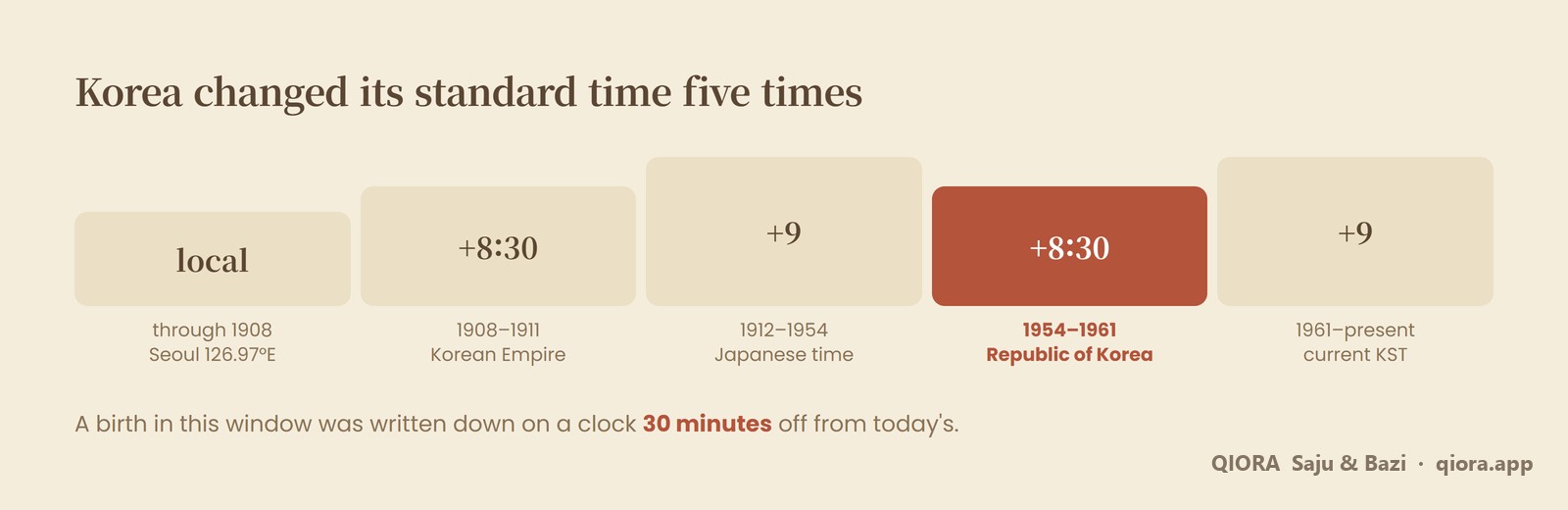
| Period | Standard time |
|---|---|
| Through 1908 | Local mean time, Seoul at 126.97°E |
| 1908 to 1911 | UTC+8:30, Korean Empire |
| 1912 to 1954 | UTC+9, Japanese standard time |
| 1954 to 1961 | UTC+8:30 |
| 1961 to present | UTC+9 |
Qiora looks up the standard time in force on the birthdate instead of applying today's UTC+9 backward across all five eras. Where daylight saving was running on the date, Qiora strips that out too.
Plenty of Korean birthdays are recorded on the lunar calendar. When they are, the whole chart rests on one conversion being right. Qiora uses the official lunar calendar data of the Korea Astronomy and Space Science Institute (KASI, 한국천문연구원), covering 1900-01-01 through 2049-12-31, and runs the conversion locally with no external lookup.
That data is the national reference. Qiora ran on its own conversion table at one point, checked it against KASI, found disagreements, and threw it out.
All five corrections above read from an ephemeris, a table of astronomical positions. Qiora runs on Swiss Ephemeris, the same library professional astrology software is built on.
Birthplace settles the rest. A recorded time belongs to whatever clock was on the wall, so Qiora resolves the IANA time zone from the birth coordinates. A birth in Lima gets converted on Lima's clock, not on Seoul's.
Qiora Saju builds the chart free from a birth date, time and place, with all six corrections applied. See your own Four Pillars chart.
The five elements shape love as five instincts: Wood grows, Fire expresses, Earth stays, Metal defines, and Water feels.

If life only seems to move when one person is beside you, it may not be your imagination. Saju calls this kind of relationship a generating connection.

Most people open a compatibility report, read the summary, and close it. The summary is the least useful part. Here is what the rest of it is actually telling you.