
How to Read a Gunghap Report: Five Axes, Two Directions
Most people open a compatibility report, read the summary, and close it. The summary is the least useful part. Here is what the rest of it is actually telling you.
The five elements shape love as five instincts: Wood grows, Fire expresses, Earth stays, Metal defines, and Water feels.

Qiora Saju Love Q&A · Part 1
The five elements shape love by giving it five basic instincts. Wood grows toward a partner, Fire makes affection visible, Earth stays and builds trust, Metal sets clear boundaries, and Water senses what has not yet been said. Your chart carries all of these as possibilities, but its stronger and weaker elements influence which instinct comes first, which one you rely on under pressure, and which one may take conscious practice.
Qiora is starting a series on reading love through Saju. We will look at attraction, communication, conflict, absence, compatibility, and timing, not as a collection of dating rules, but as patterns that become easier to recognize once you know what your chart is emphasizing.
Saju (사주), Korea's four pillars system, builds a birth chart from the year, month, day, and hour of birth. Those four pillars contain eight characters. Within them are the five elements (오행): wood, fire, earth, metal, and water. The framework shares its roots with Chinese BaZi and wuxing theory, but in Korean practice it has developed its own familiar language and habits of reading.
Almost nobody carries the five evenly. Most charts lean, with two or three elements prominent and one or two thin or missing. The usual starting point is the day stem (日干), the character that stands for you in your own chart, but it is only a starting point. With 518,400 possible chart combinations, nobody is simply "a Fire person" and sent home with a label. This series is not about whose chart is better. It is about how each person loves. Today, we will walk through the five.

Wood loves with direction. It wants the relationship to become something: closer, stronger, more honest, more alive. A Wood-heavy person often shows care by making plans, encouraging a partner, solving the next problem, or imagining a shared future before the furniture has arrived. Standing still can feel suspicious. If nothing is changing, Wood wonders whether anything is growing.
That instinct can be generous. It gives a relationship momentum and refuses to confuse comfort with intimacy. It can also turn love into a progress report. Too much Wood competes when it should connect, pushes when it should listen, and treats a partner's different pace as a lack of ambition. (Not every Tuesday night needs a five-year plan.) Wood loves best when growth includes room for the other person to choose the direction. A relationship is living, but it is not a private expansion project.

Fire loves in public, even when the public is only two people in a kitchen. It responds quickly, speaks warmly, reaches first, and makes attraction hard to misunderstand. Fire tends to fall hard and early because feeling becomes real through expression. A message sent, a face lit up, a hand reached across the table: these are not decorations around love. For Fire, they are the thing itself.
Attention is Fire's love language. It needs response, presence, and signs that the emotional current is still moving. When nothing feeds it, enthusiasm can fade as quickly as it arrived. That does not always mean the feeling was false. Sometimes it means Fire has mistaken intensity for continuity. In excess, it can demand constant reassurance or create drama just to feel heat again. Mature Fire learns that steady warmth counts too. Love does not have to perform every night to remain alive.

Earth loves by remaining. It remembers what you need, turns up when promised, and keeps doing the small things after the exciting part has stopped being new. Earth is usually slow to move and slower to leave. Its affection gathers weight through repetition: meals, errands, familiar jokes, the spare charger already waiting. Romance has many costumes, and sometimes it looks remarkably like practical competence.
From the outside, that loyalty can read as stubbornness. Earth may stay because commitment matters, but it may also stay because change feels more frightening than unhappiness. Too much Earth keeps old arrangements long after they have stopped serving either person. Nothing breaks, yet nothing breathes. At its best, Earth gives love a place to stand. Its work is learning that stability is not the same as immobility. A solid relationship can survive a moved chair, a revised promise, or an honest admission that the old routine no longer fits.

Metal loves through clarity. It says what it means, notices what is acceptable, and gives a relationship edges strong enough to hold its shape. A Metal-led person often values consistency between words and conduct. If the agreement was Friday, Friday matters. If trust was broken, naming the break matters. This can read as cold to someone who expects love to blur every boundary.
Yet love without Metal has its own cruelty. People remain in relationships that have already ended, promises become foggy, and resentment grows because nobody will say the clean sentence. Metal can say it. It can also end what is over, which is not the opposite of caring. In excess, its standards become blades. It judges before it understands and cuts before repair has been attempted. Healthy Metal keeps discernment without worshipping perfection. A clear boundary should protect what matters, not prove that the person drawing it can never be hurt.

Water loves by sensing. It catches the pause before an answer, the mood behind a joke, the quiet shift in a room. A Water-strong person often understands a partner quickly because feeling arrives before explanation. They absorb tone, implication, and emotional weather with very little prompting. This can make intimacy feel almost effortless. It can also make a vague text message ruin an otherwise respectable afternoon.
Water's gift is emotional movement. It helps feelings find language instead of hardening into silence. Without enough of it, two people may care deeply and still never say what hurts. Too much Water, however, can lose its own outline. It takes on a partner's mood, adapts until preference disappears, and mistakes emotional merging for closeness. Water loves best when sensitivity has banks. Empathy needs a self to return to. Understanding another person is powerful, but it should not require becoming them.
A missing element is not a defect. It is a shape. A chart with no Water often shows relationships in which feelings stay unspoken, not unfelt. Care may come through action, duty, protection, planning, or loyalty while emotional language arrives late. The person is not empty. They may simply need more time, a direct question, or a safer structure for saying what is already there.
The surrounding elements decide much of the expression. Strong Earth may contain emotion, strong Metal may define it precisely, and strong Fire may express it through visible warmth. The ten-year luck cycle can also bring Water forward at certain periods, changing how readily feelings move and how relationships are understood. At Qiora, your chart is the starting point, not the verdict.
Next time, we will look more closely at what it means when a chart has no Water at all.
So which of the five are you? Pull up your own chart and see.
Most people open a compatibility report, read the summary, and close it. The summary is the least useful part. Here is what the rest of it is actually telling you.

A gunghap reading gives two people one result. But the two of you are not standing in the same place, and the classical structure has always known which one of you is which.
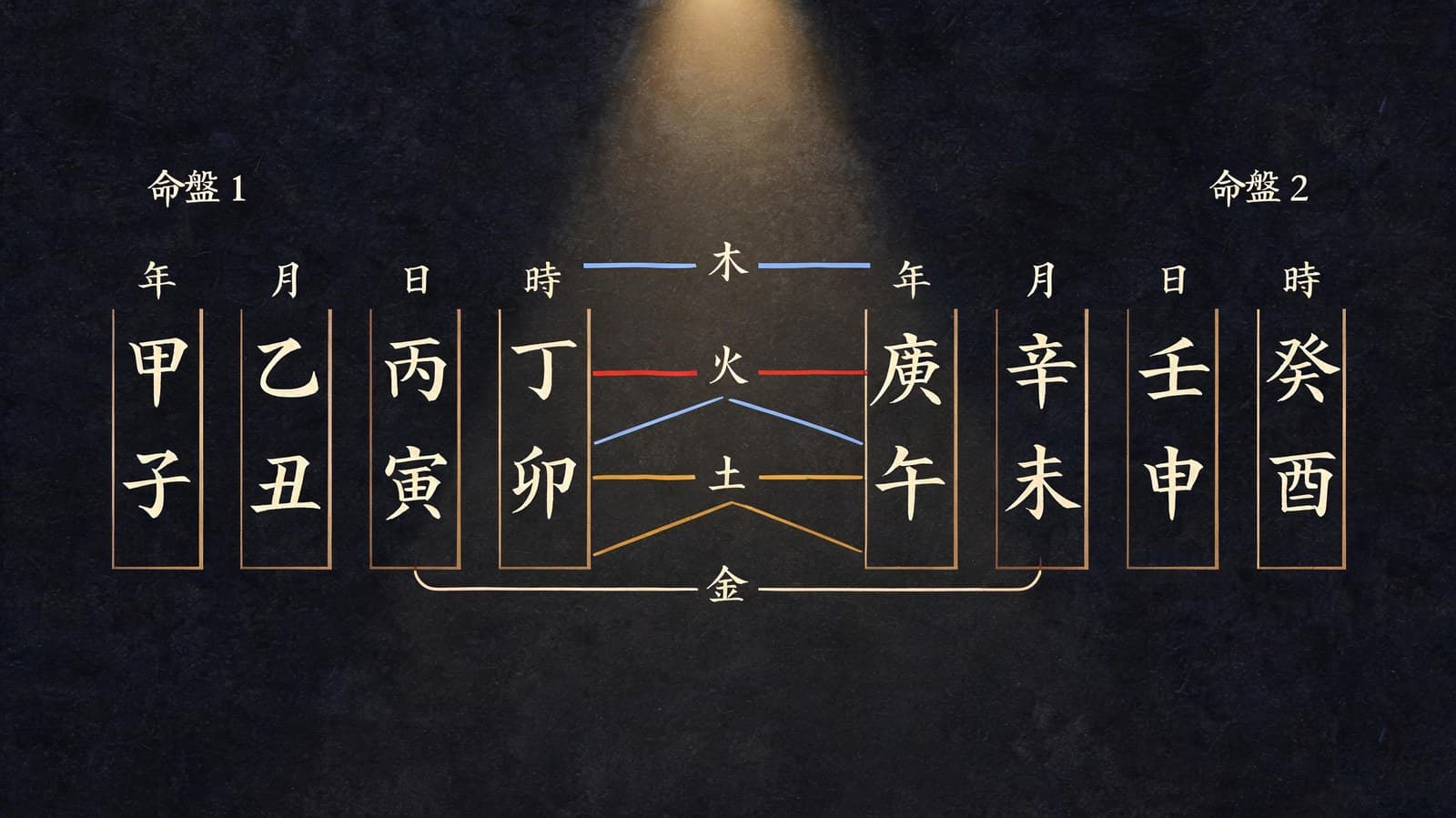
Before Koreans swipe right, they check the charts. Gunghap isn't just romantic astrology. It's a centuries-old system for reading the chemistry between two people's elemental DNA.