
How Saju Compatibility Actually Works: Three Structures, Six Positions
A gunghap reading gives two people one result. But the two of you are not standing in the same place, and the classical structure has always known which one of you is which.
Most people open a compatibility report, read the summary, and close it. The summary is the least useful part. Here is what the rest of it is actually telling you.
Most people open a gunghap report and read the last line first.
It's understandable. Somewhere in there is a sentence that sounds like a conclusion, and conclusions are what we came for. But that sentence is a compression of everything above it, and compression is lossy. The parts that got squeezed out are usually the parts that would have been useful on a Tuesday afternoon when the two of you are actually annoyed at each other.
So this is a guide to the rest of the report. Not what a good result looks like, but what each part of it is measuring, and what it means when they don't agree.

A gunghap analysis isn't one measurement. It's five, taken at five different depths of the chart, and they routinely contradict each other.
Two people can lock together beautifully at the surface and grind at the private layer. Another pair can look unremarkable everywhere except the one axis that matters most for what they're actually trying to build together.
A single blended verdict has to resolve that contradiction before it can say anything, which means it throws the contradiction away. But the contradiction was the information. "You two connect easily in public and struggle when it's just the two of you" is a real, actionable sentence about a relationship. No single blended verdict ever says that.
So the first habit to build is this: read the axes separately, and pay the most attention to the places where they don't line up.
Stem harmony (天干合). The heavenly stems are the outward-facing characters in each chart. This axis asks whether the visible parts of two people lock together. High activity here is the relationship where conversation caught immediately, where you seemed to already know how to talk. When there's no stem combination at all, that isn't a defect. It reads closer to two distinct currents running side by side, which some pairs prefer and some find lonely.
Day pillar compatibility (日柱 宮合). The day branch is traditionally the spouse seat, the most private position in the chart. This is the axis that explains the couple who are perfectly easy at dinner with friends and difficult alone in a car. Classical readings name specific interactions here: a six-harmony between day branches reads as a strong pull at the most intimate layer, while 怨嗔 (wonjin) describes two people who irritate each other for no reason either of them can name, and 害 (hae) describes a slow wearing-down. None of these are verdicts. They're descriptions of where the friction lives.
Five element balance (五行). Each chart carries a distribution of 木, 火, 土, 金, and 水. This axis asks what happens to those distributions when they're placed next to each other. It's the axis most likely to explain why one person feels tired in a relationship the other person is enjoying, which is the single most common thing people come to a reading trying to understand.
Useful-element support (用神 相生). Every chart has an element it's short of, and the classical name for the element that fixes that shortage is 用神 (yongsin, the useful god). This axis asks whether your partner actually supplies yours. Serious readers weight this above everything else on this list, and almost no free calculator computes it, because it requires determining each person's useful element first, which is a judgment call rather than a lookup.
Zodiac branches (年支). The year branch, the animal sign. This is the one Korean families ask about first at dinner, and it is one axis out of five. It's not wrong. It's just the shallowest of the five, and it got famous because it's the easiest to calculate in your head. There's a longer story about how gunghap became a family institution in the first place, and the zodiac's outsized reputation is most of it.

This is the habit most people never develop, mostly because most reports don't allow it.
Compatibility is directional. What A is to B is a separate fact from what B is to A, and in classical terms this is not a nuance, it's structural. The clearest example is 貴人 (gwiin), the noble-helper star. It's determined from your own day master, which means it can point one way and not the other. Your partner can be the person who quietly opens doors for you while you are, structurally, nothing of the kind for them.
If your report gives you two readings rather than one, read them both, and read the other person's first. It's uncomfortable in a productive way. Most of what people want from a compatibility reading is confirmation that they're being reasonable, and the fastest cure for that is seeing your own chart described from the opposite side.
If you haven't read about the underlying structures yet, that's the companion piece to this one, and it explains why the direction exists in the first place.

Want to see your own five axes broken out? Run a gunghap reading free.
Worth saying: a low reading on one axis is not a problem to be solved. It's a description of where this particular relationship will need attention, which is different information than whether it should exist.
A well-built reading asks you to say whether this is a partner, a spouse, a colleague, a co-founder, a friend, a sibling, or someone you're still figuring out. That question isn't a formality.
The same structure means genuinely different things across those contexts. A control dynamic that grinds inside a marriage can be the exact reason a working partnership functions, because someone setting the shape is what the arrangement is for. Heavy stem harmony that makes a friendship effortless can make a business partnership frictionless in the bad way, where nobody pushes back.
So if your report let you pick, pick honestly, including the awkward option. And if you're curious, run it twice under two different relationship types and compare. The axes don't change. What the reading emphasizes does.
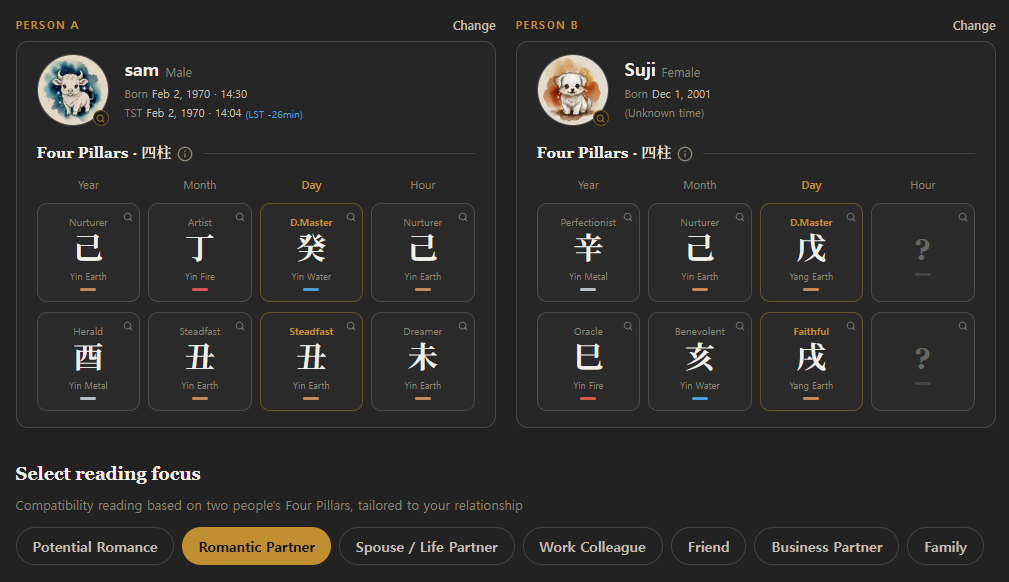
Reading a weak axis as a warning. Every axis measures activity, not quality. An axis that barely registers means that particular channel is quiet between you. Quiet channels are normal. A relationship where all five axes are loud is not a good relationship, it's an intense one.
Treating the private layer as the real answer. The day pillar axis feels the most true because it describes what happens behind closed doors, and there's a temptation to weight it above everything. Classical practice doesn't. Useful-element support outranks it, because a partner who fills what your chart is missing changes more than a partner who feels familiar.
Expecting the reading to settle something. A gunghap report can tell you where the friction sits, which direction the giving runs, and what each of you is structurally to the other. It cannot tell you whether to stay. Nobody's chart has ever contained that.
One axis is very low and the rest are fine. Should I worry? No, but read what it says rather than how it scores. A quiet axis names a channel that isn't doing much work in your relationship. If the other four are active, the relationship has plenty of channels. It's when a reading is uniformly flat that there's less to work with, and even then that describes a mild connection rather than a bad one.
We ran it twice and got different results. Check whether you changed the relationship type, which legitimately shifts emphasis. If you didn't, check the birth times. Compatibility runs off both charts, so an error in either one moves the whole reading, and an hour pillar sitting near a two-hour boundary is the usual culprit.
Can I read this for two people who aren't me? Technically yes, and it's common. Parents do it for children, friends do it for friends. Just be careful with what you do afterward, because a structural description delivered as a verdict about someone else's relationship stops being information and becomes pressure.
Does the report say who should change? It doesn't, and a reading that does is overstepping. What it can show is which of you is currently in the giving position on each axis. What to do about that is a conversation, not an output.
Read the axes before the summary. Read the other person's side before your own.
The report is trying to describe two people, and you only brought one of them to the reading.
Takes less than a minute · No signup required
Saju readings are meant for self-reflection and personal growth, not as a substitute for professional financial, medical, or legal advice. Your choices always shape your life more than any chart can.
A gunghap reading gives two people one result. But the two of you are not standing in the same place, and the classical structure has always known which one of you is which.
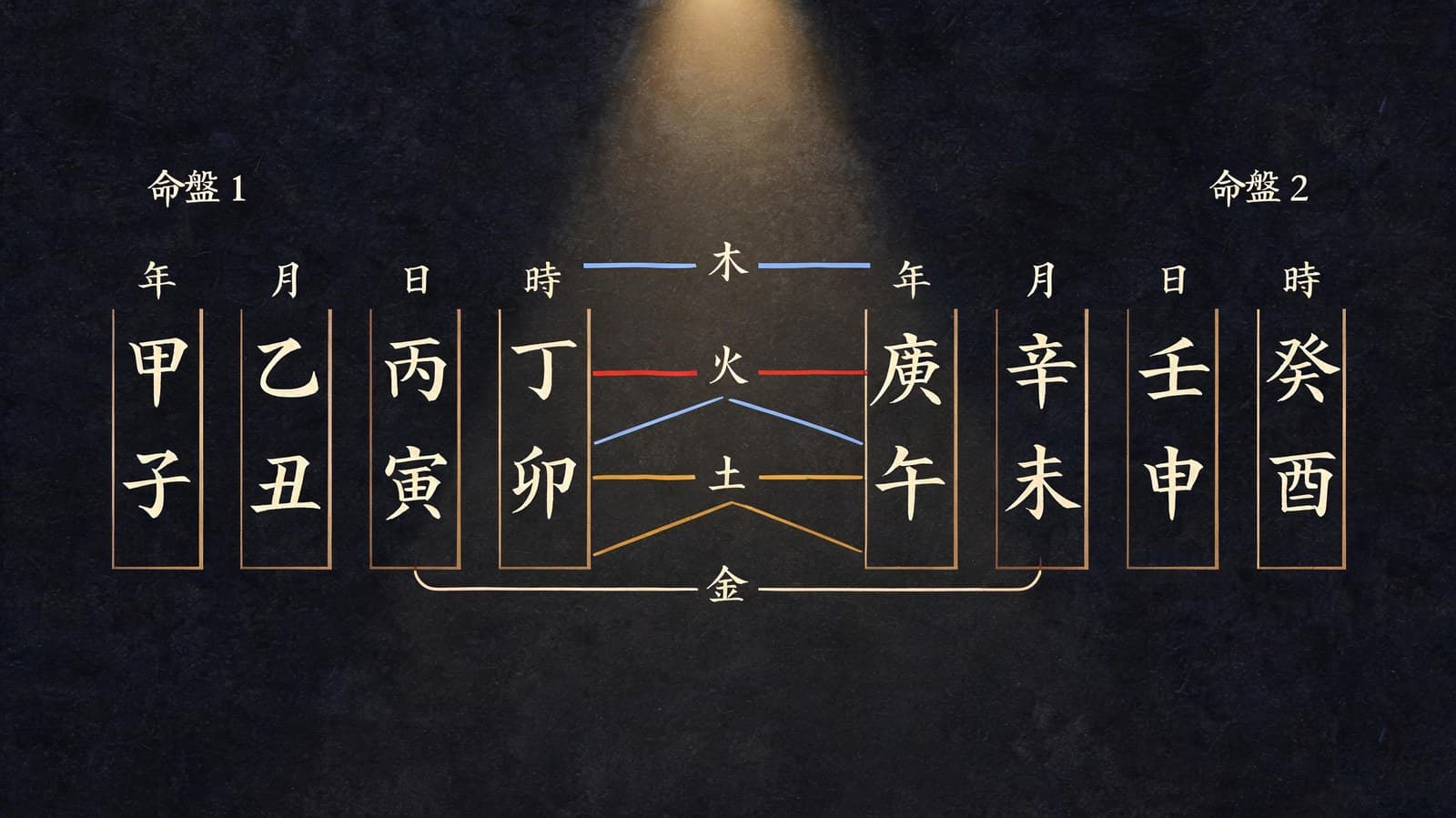
Before Koreans swipe right, they check the charts. Gunghap isn't just romantic astrology. It's a centuries-old system for reading the chemistry between two people's elemental DNA.
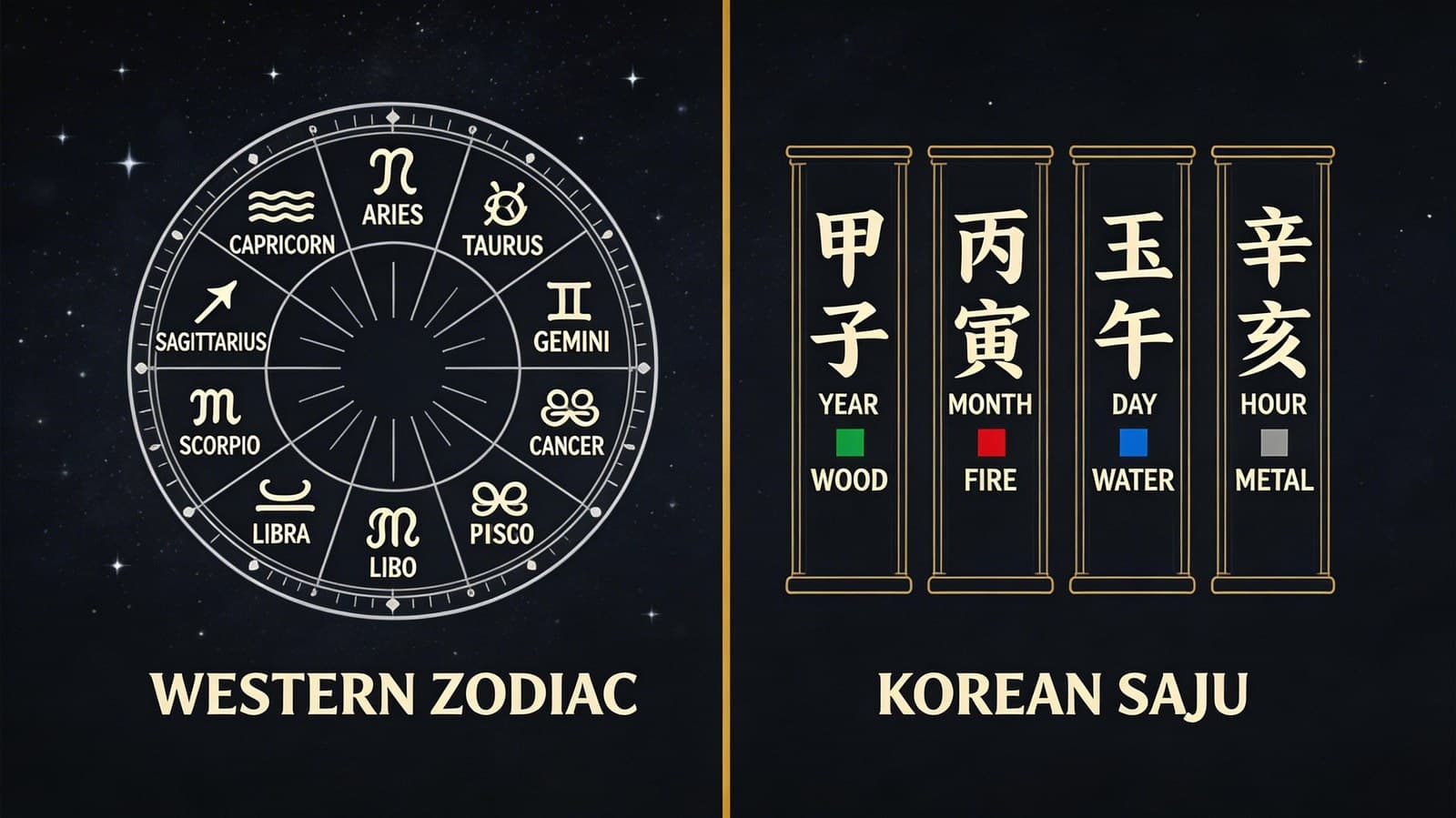
Western astrology and Korean saju both start at your birth moment — but they're asking completely different questions. One groups you with millions. The other finds just you.