
How to Read a Gunghap Report: Five Axes, Two Directions
Most people open a compatibility report, read the summary, and close it. The summary is the least useful part. Here is what the rest of it is actually telling you.
A gunghap reading gives two people one result. But the two of you are not standing in the same place, and the classical structure has always known which one of you is which.
A gunghap reading hands two people one result. One summary, one verdict, delivered to both of you at once.
But you are not both having the same relationship.
Think about blood. Type O can donate to almost anyone and can only receive from O. The compatibility is real, and it runs entirely in one direction. Saying "O and A go together" leaves out the only part that matters, which is who gives and who receives.
Gunghap has the same shape, and the classical reading has always known it. There's even a name for the side you're standing on.

Two people's charts meet at many points, but the entry point is the day master (日干, ilgan), the single character that stands for your core self. If you haven't met yours yet, start there, because everything below sits on top of it.
When two day masters meet, they meet as two of the five elements. Wood, fire, earth, metal, water. And the five elements only relate to each other in three ways.
They can be the same. One can generate the other. One can control the other.
That's the entire list. A thousand years of commentary since the Song dynasty, and the underlying grammar is three verbs.
Most tools take those three relationships, weigh them against each other, and hand back a single blended verdict. The blending is where the information dies. Generation has a direction. Control has a direction. Merge them into one statement about the pair and the direction is the first thing to go.
From the inside, the three are less abstract than the theory makes them sound.
🪞 The Mirror. Two people carrying the same element. Nothing flows between you because there's no gradient. You understand each other without explaining, which is the good news and also the entire problem. When you're both stuck, neither of you has a different kind of energy to offer. Two candles don't light each other. They just burn at the same time, and when the room gets dark you both notice it at once.
🌧️ The Rain. One element generates the other. Water grows wood. Wood feeds fire. This is the structure people usually mean when they say a couple is "good for each other," and it is genuinely warm. It's also the structure with the clearest asymmetry, because rain doesn't rain on itself.
🪵 The Trellis. One element controls the other. Metal cuts wood. Water puts out fire. This sounds like the bad one, and English translations usually make it worse by calling it a "clash." In classical terms, control is what produces 官星 (gwanseong), the pressure that becomes discipline and social standing, and 財星 (jaeseong), the resource you learn to manage. A vine without a trellis doesn't grow freer. It grows along the ground.

This is the part one shared answer can't reach.
The Mirror is symmetrical. You're both in the same position, and a single description covers both of you.
The Rain and the Trellis are not. In a Rain structure, someone is the rain and someone is the ground. In a Trellis structure, someone is the frame and someone climbs it. Two people in one relationship, standing in two different places, having two different years.
Three structures, two positions in two of them, and the Mirror's single shared position. Six places to stand.
This is what a single shared verdict deletes. When you and your partner are handed the same sentence about your relationship, neither of you learns the thing you actually came for, which is who is currently carrying whom.
Curious where you're standing? Run a free gunghap reading and see the structure, not just the summary.
Worth saying plainly: none of these six positions is the good one. Being the rain is generous until you're depleted. Being the ground is nourishing until you need to stand on your own. The classical texts are unsentimental about this in a way modern compatibility content usually isn't. They treat all six positions as weather rather than as luck, which is a colder framing and a more useful one.
Most simplified versions of this go wrong at the same place.
Whether a position feels good depends on how much energy your own chart is already carrying. A chart can be 身強 (singang, strong self) or 身弱 (sinyak, weak self), and the same structure inverts between them.
If your chart runs strong, being the rain is a relief. You have more than you need, and giving it away is how you find your balance. Generation drains you in exactly the way you wanted to be drained.
If your chart runs weak, that identical position is a slow leak. You're giving from a supply that was already short. Same structure, same partner, opposite year.
The Trellis inverts the same way. A strong chart under pressure finds shape and ambition. A weak chart under the same pressure just feels pressed.
This is why "we're a Rain couple" is a starting sentence and not a verdict. Two Rain couples can have nothing in common.

I want to be exact about how much the day master relationship covers, because a lot of free calculators quietly imply it covers everything.
It doesn't. A full gunghap reading looks at five things.
Day master relationship is the one this whole article has been about. The structure and your position in it. Stem harmony (天干合) looks at whether the outward, visible parts of your two charts lock together. Day pillar compatibility reads the day branch, traditionally the spouse seat, which is the most private layer of the chart. Useful-element support (用神 相生) asks whether your partner supplies the element your chart is actually short of, and it is the axis serious readers weight most heavily. Zodiac branches (地支 宮合) is the one Korean families ask about first at dinner, and it is one fifth of the picture.
The five can disagree with each other. That's normal, and a reading that reports the disagreement is more useful than one that averages it away. Our engine runs all five and shows them separately for that reason, and it reads them differently depending on whether you're asking about a partner, a business co-founder, or a sibling, because the same structure means different things in different relationships.
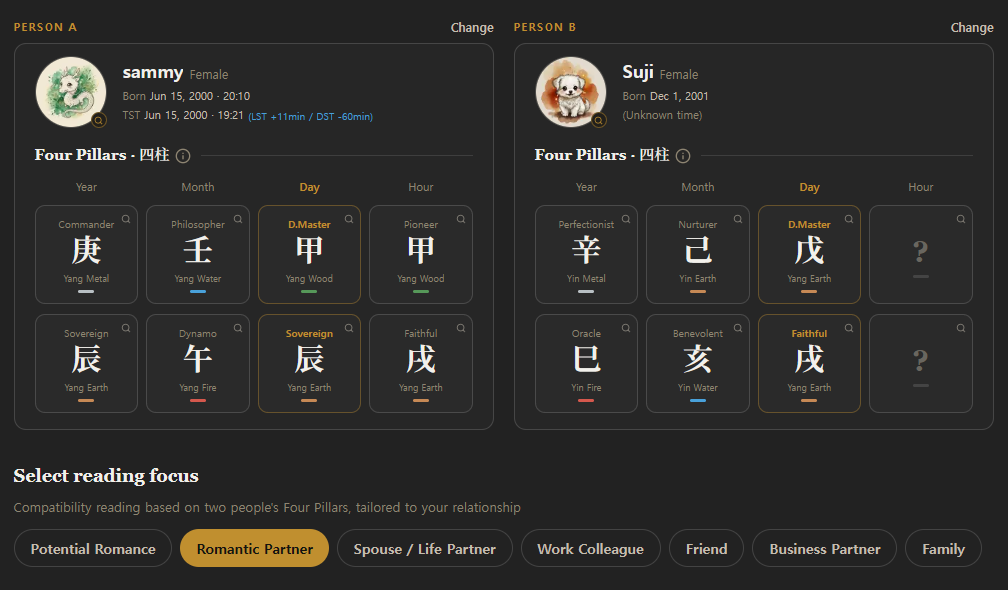
And because position is the whole point of this article, each axis runs in both directions. What A is to B is calculated separately from what B is to A, and you get both readings rather than one shared sentence.
The noble-helper star (貴人, gwiin) is the clearest case. It's determined from your own day master, so it can point one way and not the other. Your partner can be the person who quietly opens doors for you while you are, structurally, nothing of the sort for them. That asymmetry isn't a flaw in the relationship. It's just information that a single shared answer would have rounded off.

If you want the wider background on where gunghap came from and what families historically did with it, that's a separate story.
Is a Trellis structure a bad sign? It's a signal about friction, not a verdict about the relationship. Some of the most durable pairings in the classical case literature are control structures, because pressure produces shape. What matters more is whether both people can name their position and stay honest about what it costs.
Why do two sites give my partner and me different results? Usually because they're weighing different axes, or because one of them skipped birth time correction and moved an hour pillar. Ask what a calculator actually analyzes. If it won't tell you, the result is decoration.
Neither of us knows our exact birth time. Can we still do this? Yes, partially. Day masters come from the day pillar, which is fully determined without birth time, so the structure described here still holds. What you lose is the hour pillar, which affects the day pillar and useful-element axes.
Does this work for people we aren't dating? It works better than you'd expect, and it's underused. The same three structures describe co-founders, colleagues, and siblings. A Trellis dynamic that's exhausting in a marriage can be exactly right in a working partnership, where one person setting the shape is the whole point.
Six positions. Three of them are ones where you're carrying, three where you're being carried, depending on how you count the Mirror.
The useful question was never whether you're compatible. It's which one of you has been doing the giving lately, and whether either of you noticed.
Find out which side of the arrow you're on · No signup required
Saju readings are meant for self-reflection and personal growth, not as a substitute for professional financial, medical, or legal advice. Your choices always shape your life more than any chart can.
Most people open a compatibility report, read the summary, and close it. The summary is the least useful part. Here is what the rest of it is actually telling you.
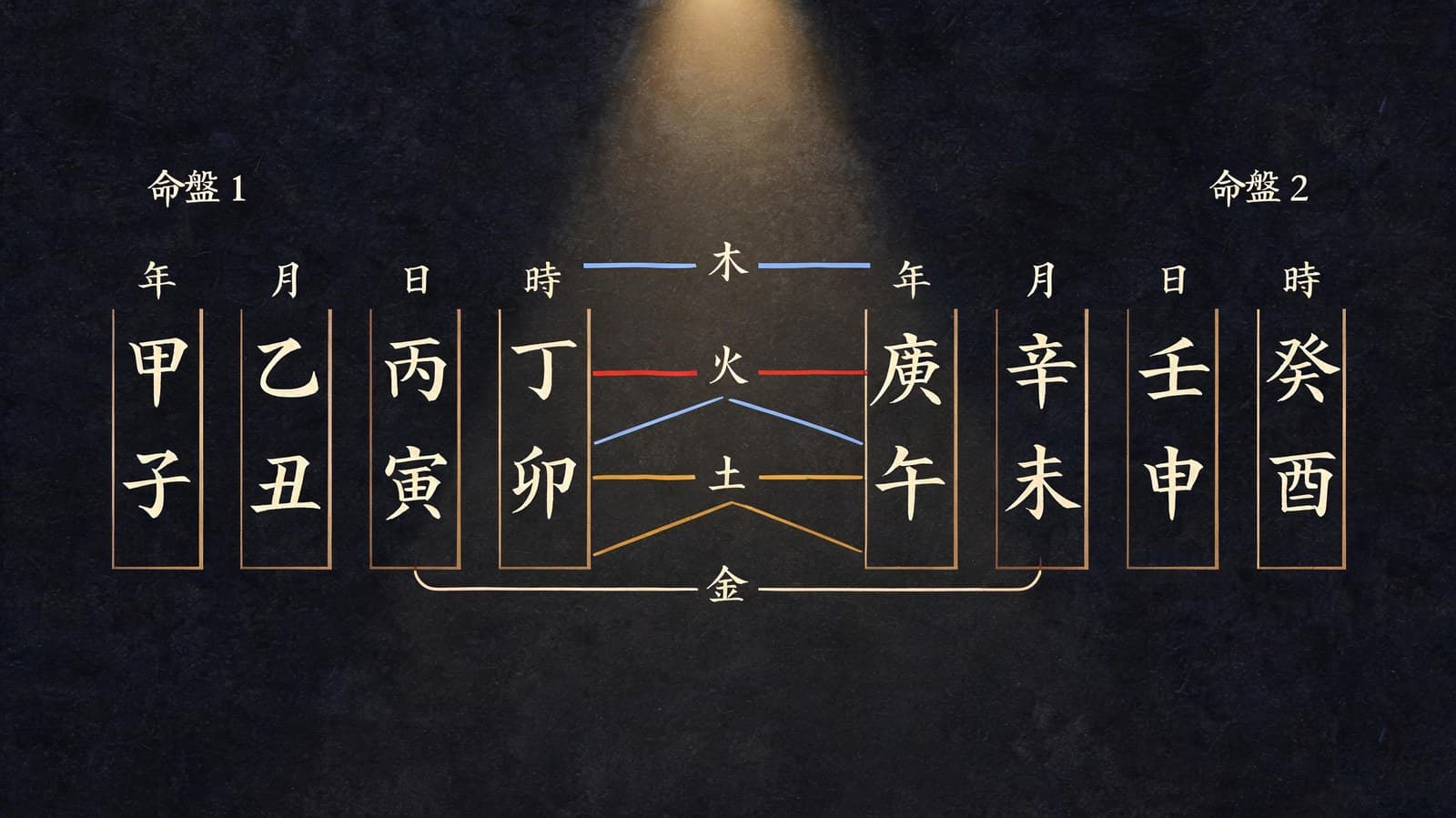
Before Koreans swipe right, they check the charts. Gunghap isn't just romantic astrology. It's a centuries-old system for reading the chemistry between two people's elemental DNA.
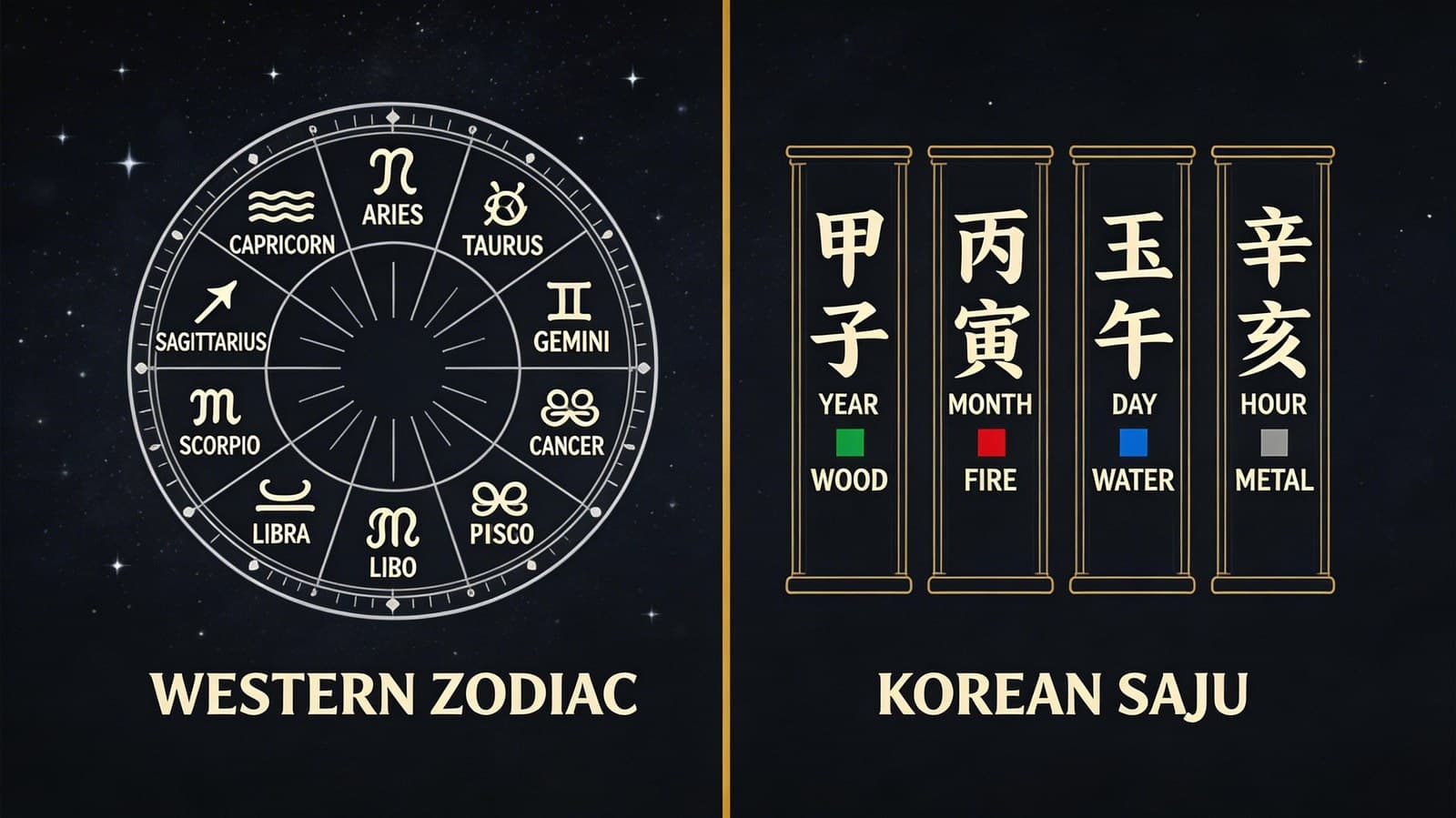
Western astrology and Korean saju both start at your birth moment — but they're asking completely different questions. One groups you with millions. The other finds just you.