
How to Read a Gunghap Report: Five Axes, Two Directions
Most people open a compatibility report, read the summary, and close it. The summary is the least useful part. Here is what the rest of it is actually telling you.
Korea turned MBTI into a national obsession. The same generation didn't drop it. They layered a thousand-year-old system on top, and the reason why says a lot about being young in Seoul right now.
In Korea, asking someone's MBTI on a first date is as normal as asking for their Instagram.
I'm not exaggerating. There are cafés organized by personality type. Job postings that name a preferred MBTI. Entire friendships that started with "Oh, you're INFJ too?" For a while, your four letters were your identity, a shorthand that told people how you think, what you need, and whether you'd get along.
Then something shifted.
The turning point wasn't dramatic. There was no backlash, no viral takedown. People just started hitting the edges of what four letters could do.
MBTI is excellent at describing how you process the world. Introvert or extrovert, thinking or feeling. But it's silent on timing. It can't tell you why this year feels heavier than last year. It doesn't account for the fact that the version of you at 22 and the version of you at 35 might need fundamentally different things.
It's a snapshot. A good one, maybe. But still a snapshot.
Saju (or BaZi, as it's known in Chinese) is built differently. Where MBTI categorizes your personality, saju maps your energy over time. Your birth chart doesn't just say "you're analytical and introverted." It says "your core element is water, you're in a fire-dominant decade, and the tension between those two forces is why everything feels like it's simultaneously too much and not enough right now."
That specificity is what's pulling the generation Koreans call MZ, meaning millennials and Gen Z, toward something their grandparents would recognize.

Your saju chart is built from the exact moment you were born: year, month, day, and hour. Each of those four time points gets two characters, a heavenly stem (천간, cheongan) and an earthly branch (지지, jiji). That's eight characters total, which is why saju is also called palja (팔자), literally "eight characters."
Those eight characters encode your elemental composition. They show a reader how the five elements sit in your chart (wood, fire, earth, metal, water) and where they push against each other. Your day master (일간, ilgan), the heavenly stem of your day pillar, is the single character that stands for your core self. If you only ever learn one thing about your chart, learn that one. On TikTok it's the part people actually care about: your day master gets translated into an image, and you find out you're a great tree, a candle flame, or a polished sword.
Here's where it diverges from MBTI completely. Your chart isn't only about who you are. It's about when certain energies show up in your life.
Every ten years a new elemental energy takes over. Koreans call it daewoon (대운), your ten-year luck pillar. If your twenties ran on wood energy, meaning growth and ambition and pushing forward, your thirties might shift to metal: refinement, cutting away what you've outgrown, precision instead of expansion.
MBTI has no mechanism for that. It says "you are this type." Saju says "you are this now, and here's what's coming."
There's a reason this lands with a generation that grew up being told they could be anything, then graduated into an economy that said "actually, no."
The turn toward saju isn't purely intellectual curiosity. It's also, maybe primarily, a response to uncertainty.
Housing prices in Seoul have drifted so far from what young people earn that the two numbers barely belong in the same sentence. Stable employment feels less like a career milestone and more like winning the lottery. And the competition is relentless across the board: university spots, jobs, apartments, dates.
When the future feels unpredictable, anything that claims to read it starts looking a lot more attractive. That's just human nature. And saju, with its decade-by-decade map of how your energy actually shifts, offers something specific: here's what you're working with for the next ten years, and here's how to spend it.
That's a different proposition from a newspaper sun-sign column announcing "Pisces, this month brings opportunities for growth!" It's built from your birth data, mapped against your timeline.

Somewhere in the last couple of years this stopped being a Korean thing.
If SJPJ hasn't hit your For You page yet, give it a month. The format barely varies. Someone runs a stranger's chart, hands back a day master, and the answer arrives as a picture instead of a paragraph. You're a great tree. You're a candle flame. Then the comments fill with people dropping their own birth times, asking to go next.
SJPJ is just saju palja squeezed into four letters, which tells you exactly what it's positioning itself against. Say it out loud next to INFP and the joke writes itself. The pitch, repeated often enough that it now works as a definition, is that saju is the new MBTI.
It's a useful hook, and a slightly misleading one.
The MBTI accounts never went anywhere, for one. The two systems aren't competing so much as measuring different things with different instruments. MBTI maps cognitive preference: how you decide, where your energy comes from, how you take in information. Saju maps elemental constitution: what you're made of, how outside forces act on that material, and how the mix shifts as you age.
You can be an INTJ with a water day master. You can be an ENFP running on metal. MBTI describes your processing style. Saju describes the raw material you're processing with.
Koreans worked this out without anyone explaining it. They didn't abandon MBTI, they stacked saju on top of it. Walk into a bookstore in Seoul and you'll find both systems on the same shelf, sometimes inside the same book.
Here's the shape of it in practice. Say your day master is yang metal and you're eight years into a fire decade. Metal is the material, fire is what shapes it. A reading won't tell you that's good or bad. It'll tell you this is a stretch that keeps handing you processes you didn't choose, and that people tend to come out of it more finished than they went in.
You already know your four letters. Finding your eight characters takes about a minute. See your four pillars free.

You can watch this stop being a niche thing in Hongdae, the university district where Seoul's twenty-somethings spend their weekends.
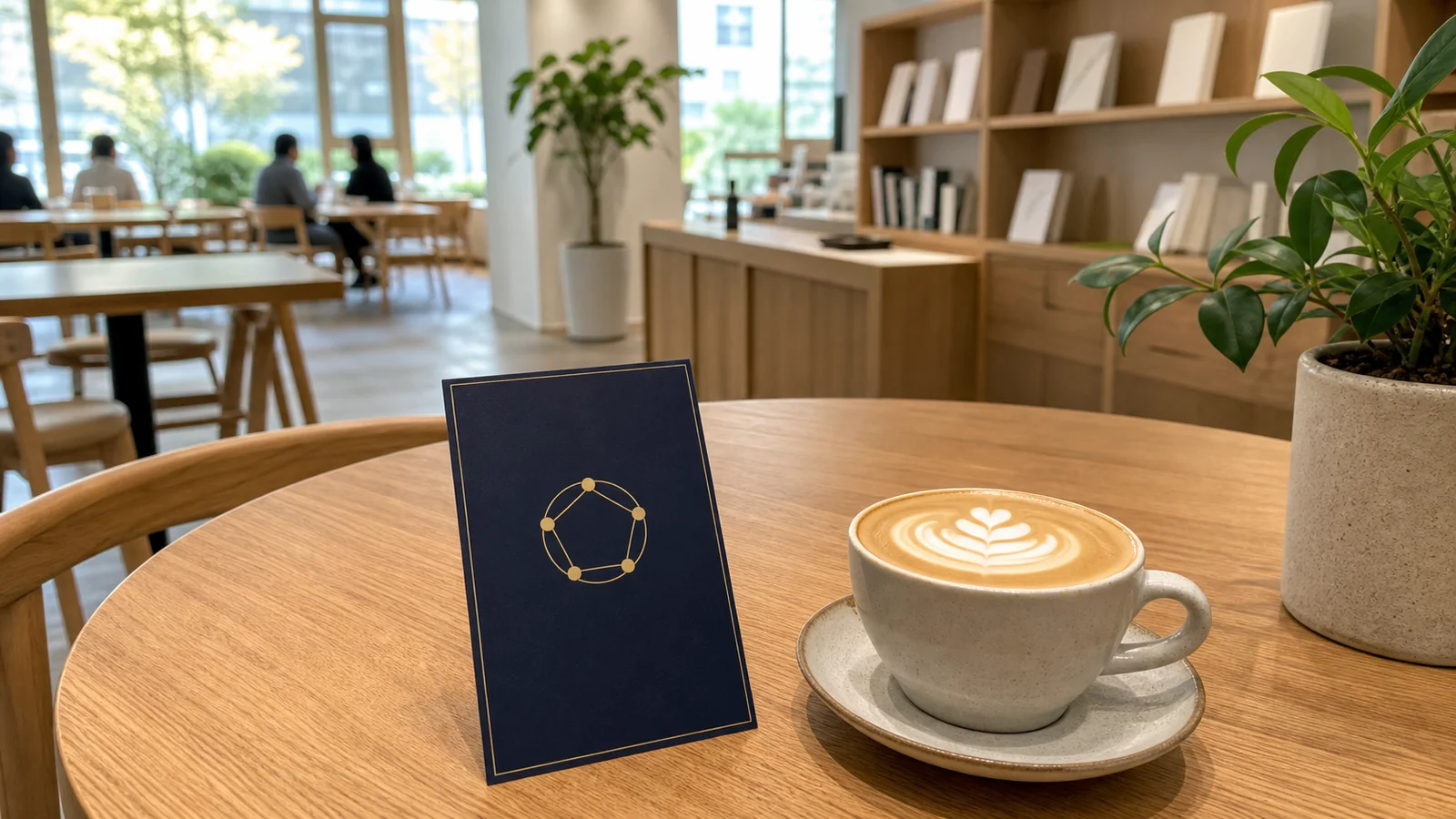
Between the vintage shops and the fried chicken places you'll find saju cafés. Not the dim, curtained consultation rooms your grandparents might have visited. These are bright rooms with good lighting and a plant wall, built to be filmed as much as to be sat in, where you order a latte and get a thirty-minute reading from someone who's probably under 35, probably studied both traditional myeongni (명리학, the classical study of how the elements move through a life) and modern psychology, and definitely has a different sense of design than the practitioners their parents would have visited.
The readings come on beautifully designed cards. The language is plain. The whole thing is built for people who want depth without the ritual.
Same tradition, different packaging. The packaging is working.
Worth noticing what you're actually buying, though. The card on that table holds the same eight characters you'd get anywhere. The thirty minutes are for someone reading them out loud. The characters were never the scarce part.
Is saju just MBTI with different labels? No. MBTI sorts you by how you process the world and stops there. Saju describes your elemental makeup and then tracks how it interacts with time, in ten-year cycles and year by year. Both hand you a vocabulary for yourself. Only one of them changes as you age.
Do I need my exact birth time? It helps, but you can start without it. Three of your four pillars come from the date alone, which covers your day master and your overall element balance. The hour pillar adds the fourth and speaks to your later chapters and inner life. If no time was recorded anywhere, the reading is still worth doing. One thing worth checking wherever you calculate: whether the tool corrects for true solar time. Clock time and sun time drift by up to half an hour in Korea, which is enough to move an hour pillar into the one next door.
Is saju accurate? Honest answer: it's an interpretation system, not a prediction machine. If it describes your patterns in a way that helps you decide something, it's doing its job. If it claims to know your future, be skeptical.
Is this the same as the Chinese zodiac? Related, but much smaller. Your zodiac animal comes from your birth year alone, one character out of eight. Saju reads all four pillars, which is why it goes deeper than your birth month.
A chart describes you. It doesn't sentence you.
2026 is a Fire Horse year, and if your own chart already runs hot you'll hear plenty about how that's supposed to burn you out. What the chart actually hands you is a weather report. Conditions are hot this year, so plan around the heat. Nobody cancels their life over a forecast. They just pack differently.
Same goes for the ten-year cycles. A "difficult" daewoon isn't a punishment scheduled for your thirties. It's a decade whose texture rewards different behavior than the one before it. What you do inside that decade stays entirely yours.
Which is the honest limit of the MBTI comparison too. Neither system knows what you'll do on Tuesday. One tells you how you tend to think, the other tells you what season you're standing in. Korea spent five centuries refining the second one, and the refinement was always pointed at better questions rather than better predictions. Which gives you a working test for any reading, whether it comes from a person or a machine: judge it by how specific it is, not by how certain it sounds.
Whether any of this is "real" in a scientific sense is a question I'll leave to people with more certainty than I have.
When someone in their twenties sits down for a reading, they're rarely asking what the chart says.
They're asking: is who I am enough for what's ahead?
MBTI answered the first half of that. It gave a generation language for their inner lives. It couldn't touch the second half, because it was never built to.
Saju doesn't predict the future either. But it does one thing MBTI can't: it admits that you exist in time. Your twenties have a different texture than your forties. Whatever is pressing on you right now might not be permanent.
It might just be seasonal.
If you want to start somewhere cheap, copy your eight characters into whatever AI you already talk to and ask it what they mean. That's the version I'd begin with.
Free: your eight characters, your day master, and your element balance, corrected to true solar time · No signup
Saju readings are meant for self-reflection and personal growth, not as a substitute for professional financial, medical, or legal advice. Your choices always shape your life more than any chart can.
Most people open a compatibility report, read the summary, and close it. The summary is the least useful part. Here is what the rest of it is actually telling you.

A gunghap reading gives two people one result. But the two of you are not standing in the same place, and the classical structure has always known which one of you is which.
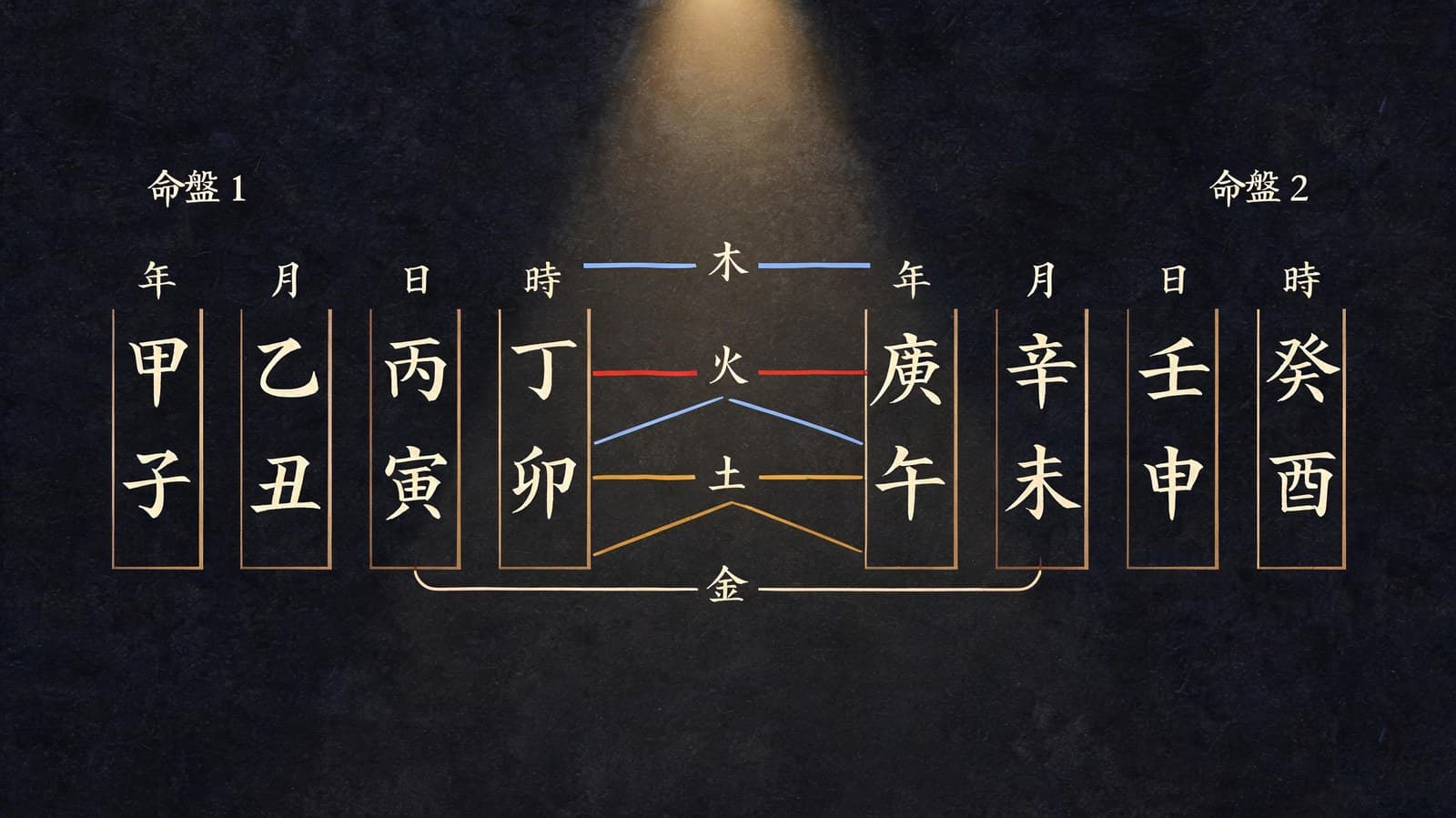
Before Koreans swipe right, they check the charts. Gunghap isn't just romantic astrology. It's a centuries-old system for reading the chemistry between two people's elemental DNA.