
Everything Works Around This Person? 3 Signs From Your Saju Chart
If life only seems to move when one person is beside you, it may not be your imagination. Saju calls this kind of relationship a generating connection.
When someone struggles to share their feelings, a Saju chart with little Water can explain why silence comes more easily than words.

Qiora Saju Love Q&A · Part 3
They may not be hiding their feelings because they do not care. People like this often have little Water in their Saju chart. Water is the element associated with feelings moving outward. When there is little of it, emotions can take longer to become words. The person may also have had few chances to practice expressing them, or may swallow worries to keep from burdening someone else.
You see it after a date. Their answers suddenly get shorter. You ask what happened and hear, "Nothing." Ask again and it feels like pressure. Let it go and it feels like avoidance. Soon one person is speaking louder while the other grows quieter.
The five elements, the Wood, Fire, Earth, Metal, and Water used to read a Saju chart, offer another way to understand this scene. Water flows and seeps through. It resembles the path an emotion takes from inside a person to the outside world.
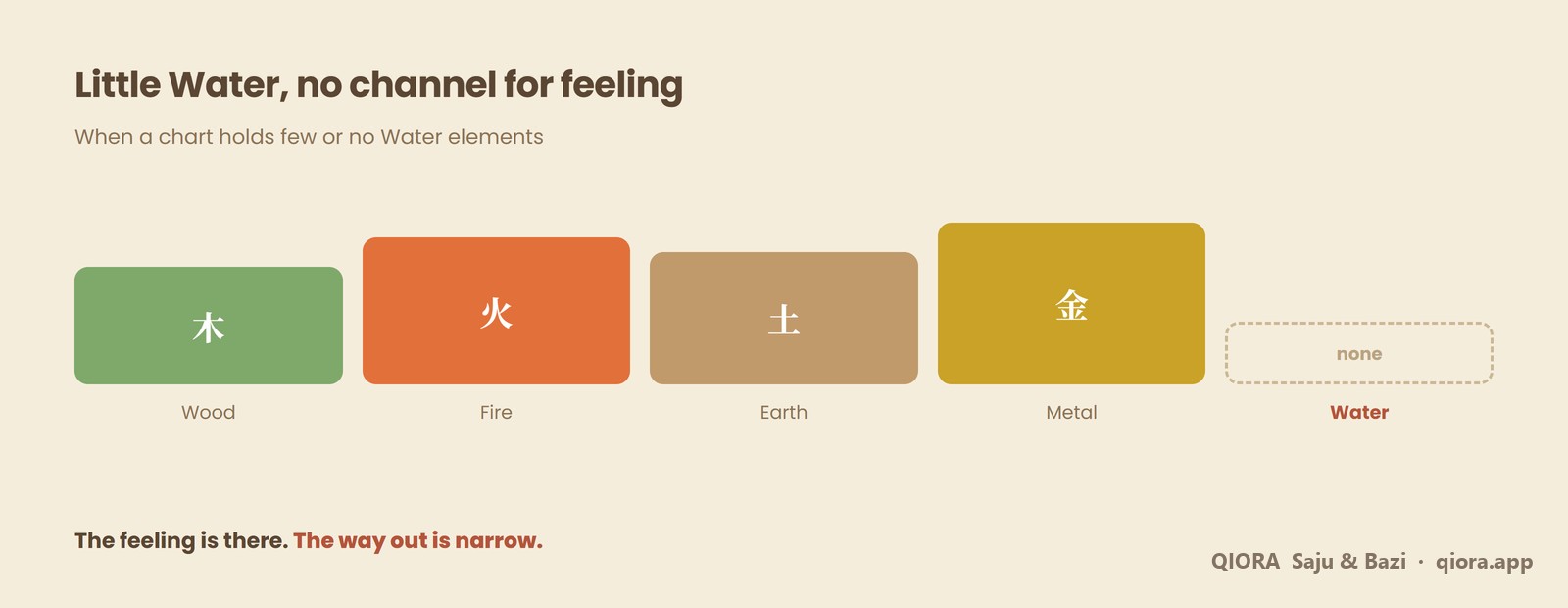
Having "no Water" means that none of the eight characters in the original chart carry Water, or that the Water present has little room to act because of its season and position. This is not unusual. A chart containing all five elements in even amounts is rarer than one with something missing or concentrated.

Some people can say, "That comment hurt me," the moment it happens. Someone with little Water may know only that something feels wrong. Their chest tightens and they stop talking, but they cannot yet tell whether they feel hurt, tired, embarrassed, or angry.
So when you ask, "Why won't you talk to me?" they may honestly think there is nothing to say. The feeling is there. The sentence is not. Two days later, it finally clicks: "I felt ignored when that happened." Their silence was not an answer. It was processing time.
To distinguish "I'm disappointed" from "I'm anxious" or "I feel left behind," you need experience saying those things out loud. Emotional expression is learned, just like any other language.
People with little Water often grew up seeing fewer examples of it. Problems were handled alone, or hurt feelings met with, "You can put up with that much." An apology might arrive as a repaired shelf or a favorite snack, never as a conversation. Asking what they feel does not reveal a hidden script. Sometimes they have to write the script on the spot.
Some people carry difficult things alone because sharing a worry feels like placing weight on someone else. They mention a work crisis only after fixing it. They admit they were sick once they have recovered. In their mind, the delay is considerate.
The person listening experiences it differently. Why was I the last to know? Do they not trust me? But the quiet person may have been acting from the opposite belief. They trusted you and did not want to add to your load. They learned to use silence as protection, even when it creates distance instead.
"What's wrong?" and "What are you thinking?" ask for too much at once. For someone who needs time to turn feelings into language, those questions feel like a test with no obvious starting point.
Make the question smaller: "Is this about work or us?" "Are you hurt, or do you want time alone?" "Do you want to talk tonight or tomorrow?" Let them choose the closest answer instead of producing a perfect explanation. If they say, "Neither," you still learned something. Then resist interpreting the answer for them. "I hear you. Tell me more when you're ready" is enough. They do not need a mind reader. They need someone who can receive words that arrive late.
So what does your own chart hold? See your five elements
If life only seems to move when one person is beside you, it may not be your imagination. Saju calls this kind of relationship a generating connection.

Most people open a compatibility report, read the summary, and close it. The summary is the least useful part. Here is what the rest of it is actually telling you.

A gunghap reading gives two people one result. But the two of you are not standing in the same place, and the classical structure has always known which one of you is which.