
How to Read a Gunghap Report: Five Axes, Two Directions
Most people open a compatibility report, read the summary, and close it. The summary is the least useful part. Here is what the rest of it is actually telling you.
Before Koreans swipe right, they check the charts. Gunghap isn't just romantic astrology. It's a centuries-old system for reading the chemistry between two people's elemental DNA.
Last year, a colleague told me she'd run a gunghap check on her boyfriend before agreeing to move in together.
She's a data analyst. She builds regression models for a living. And yet there she was, pulling up two saju charts on her laptop in a Pangyo coffee shop, tracing the lines between his metal and her wood with the same focus she'd give a quarterly forecast.
"It's not that I believe it," she said. "It's that I want better questions to ask."
That sentence stayed with me.
Most English-language articles translate gunghap (宮合) as "compatibility" and move on, as if it's the Korean version of a BuzzFeed quiz that tells you which Friends character your partner is.
It runs deeper than that.
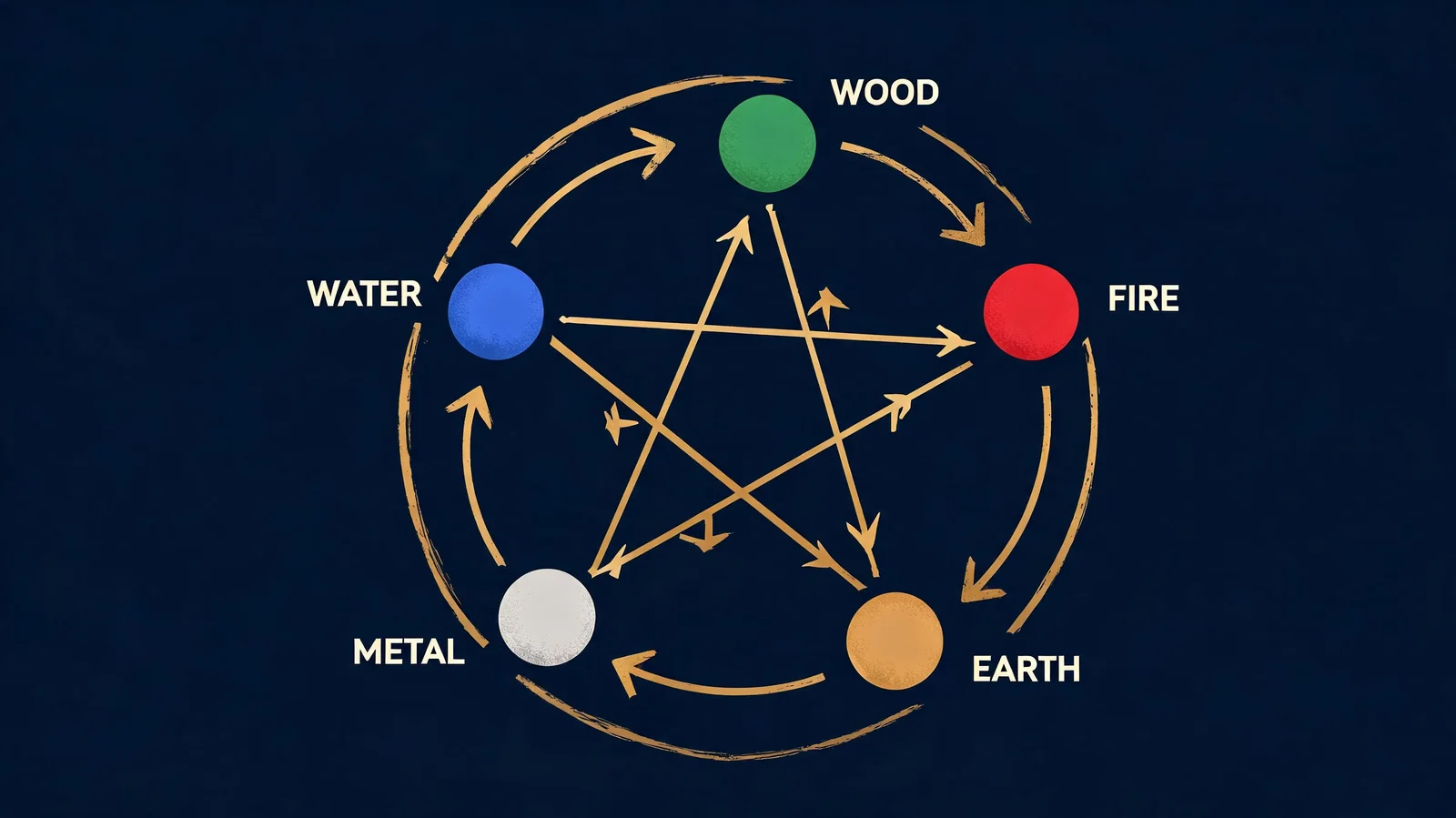
Gunghap compares two saju charts, meaning two complete elemental profiles, each built from the year, month, day, and hour of birth. Eight characters per person. Sixteen characters total. Within those sixteen characters, a trained reader is looking for how the five elements (木 wood, 火 fire, 土 earth, 金 metal, 水 water) interact between the two charts.
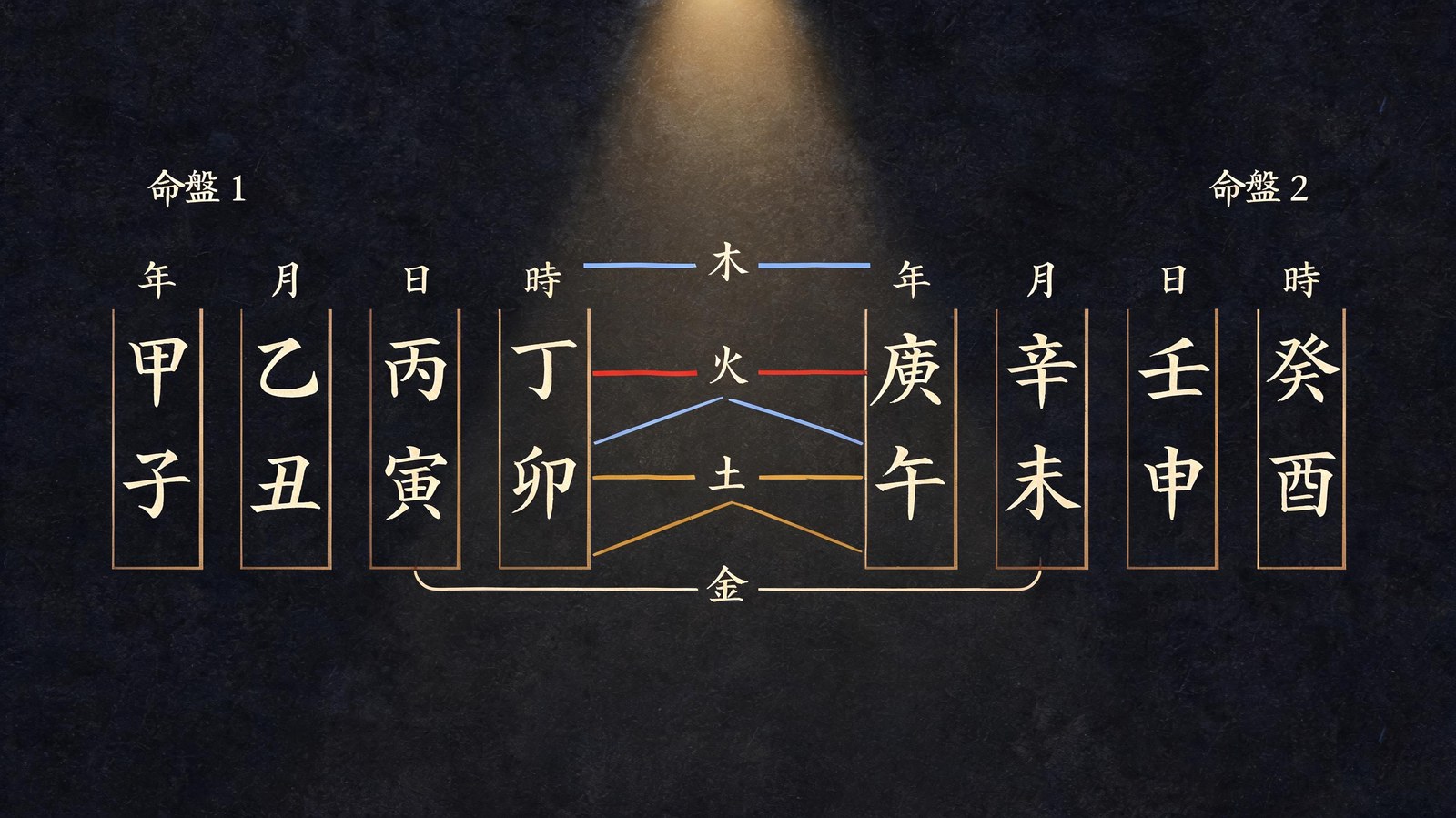
Do your day masters support each other? Does one person's excess fire balance the other's water deficiency? Or does one chart overwhelm the other, with too much metal clashing against fragile wood?
Think of it less like "are we compatible?" and more like "what happens when we put these two chemical compounds in the same beaker?"
Sometimes you get a pleasant reaction. Sometimes you get something that needs careful handling. Occasionally, though rarely, you get something explosive.
The traditional version was serious business. In Joseon-era Korea, a groom's family would send a sajudanja (四柱單子), a formal document containing his birth data, to the bride's family. The bride's side would then have a reader compare the two charts. If the gunghap was poor, the marriage could be called off entirely.
This wasn't superstition to them. It was risk assessment.
Without drowning you in technical detail, here's what a gunghap reader looks at:
Ohaeng (Five Elements) balance. If one person is heavily fire and the other is heavily water, that's not automatically bad. Water controls fire, which can mean one partner grounds the other. But if the fire is already weak and the water is overwhelming, you've got a dynamic where one person constantly feels extinguished.
Day master relationship. Your day master (日干) is the single character that represents your core self. When two day masters meet, the interaction tells you something about the fundamental dynamic. Some combinations naturally generate warmth. Others generate friction. Neither is a death sentence. It's information.
Clashing branches. The earthly branches (地支) in your chart can clash with the branches in your partner's chart. A chung (沖, clash) isn't necessarily destructive, but it does mean energy. Lots of it. Whether that energy becomes passion or conflict depends on everything else in the charts.
Harmonizing branches. Conversely, some branch combinations create hap (合, harmony), a natural ease, a sense of "we just get each other" that doesn't require effort.
Ten Gods cross-reading. This is where it gets sophisticated. The ten gods (十神) in your chart describe your relationship patterns, and when overlaid with someone else's chart, they reveal the roles you'll naturally fall into with each other.
Here's where things get interesting for anyone born after 1990.
Gunghap has gone from a formal pre-marriage ritual to something people do on a second date. Or a first date. Or, honestly, before they even agree to the date.
Korean dating apps now integrate birth-time data. Speed dating events in Gangnam run gunghap checks between rounds. YouTube channels with millions of subscribers break down celebrity couples' gunghap like sports commentators analyzing game tape.
And it's not just romantic anymore. People check gunghap with business partners. With potential roommates. With new team members at work. The underlying logic is the same: when two elemental profiles interact, certain dynamics become more likely.
Is this scientific? No. But neither is that gut feeling you get about someone in the first five minutes, and people trust that all the time.
Gunghap has real problems when it's done badly.
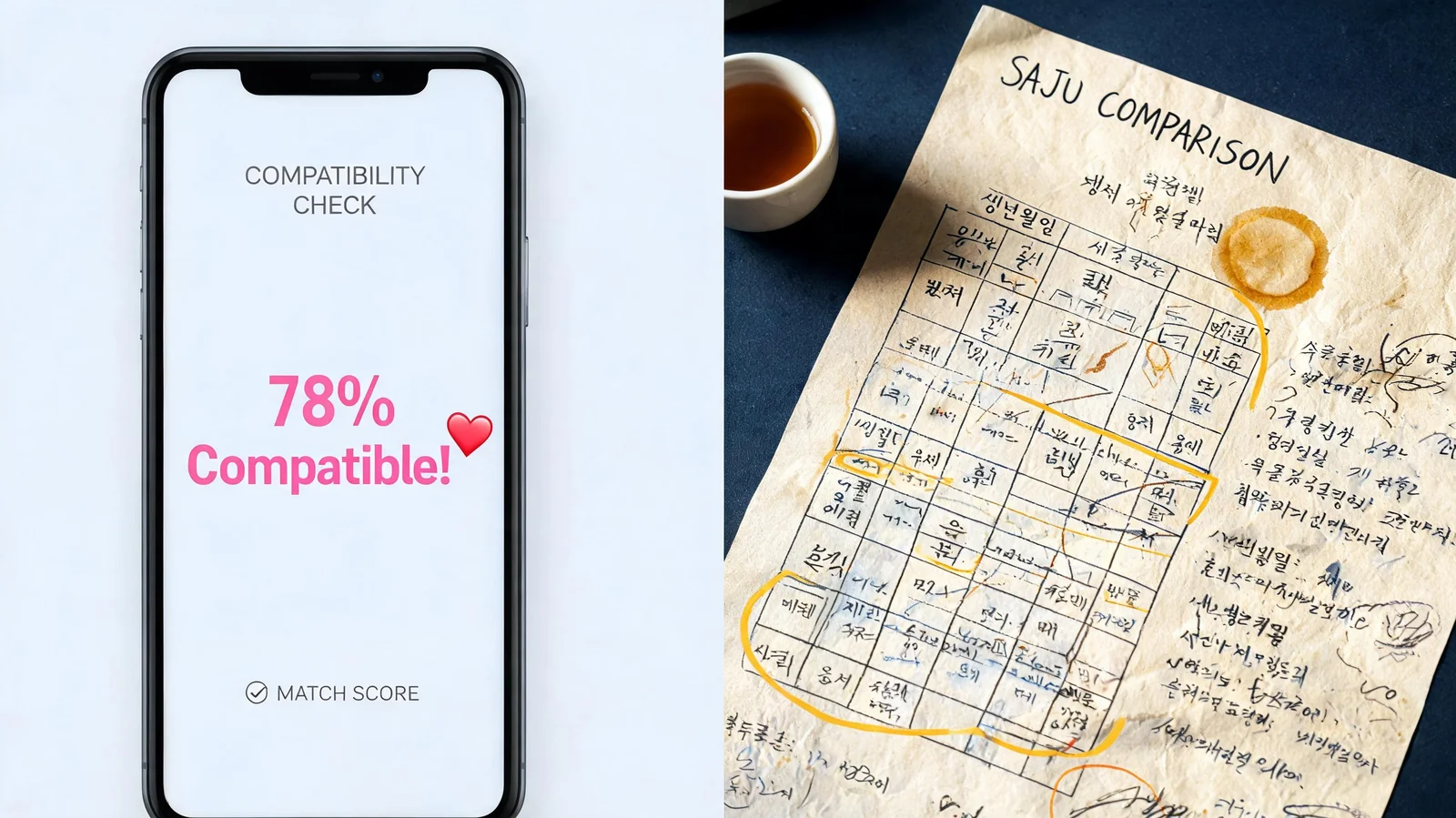
The worst version goes like this: someone inputs two birth dates into an app, gets a percentage score ("78% compatible!"), and makes a decision based on that number. This is like diagnosing a patient based on their blood type alone. It's not just incomplete; it's potentially harmful.
A percentage score from an automated gunghap check is reading maybe 5% of what a full comparison reveals. It typically looks at day master interaction and a couple of branch relationships. It ignores the ten gods, the element balance, and the current daewoon (大運, ten-year luck cycle) each person is in.
Two people with "poor" basic gunghap might be in complementary daewoon periods that make this exact decade the best time for them to be together. An automated check would never catch that.
I have a theory about why gunghap has survived the transition from Joseon-era marriage negotiations to Gen Z dating culture.
It's not because people believe it's magic. Most young Koreans I know are deeply pragmatic. They're not consulting their charts because they think the universe has a plan. They're doing it because relationships are complicated, and any framework that helps you think about compatibility more carefully is better than vibes alone.
Gunghap forces you to ask good questions. Not "are we compatible?", because that's too binary. Rather, "where will we naturally align, and where will we need to put in work?" That's a genuinely useful question, whether or not you believe in the five elements.
My colleague, the data analyst, eventually moved in with her boyfriend. She told me the gunghap flagged communication style as their friction point. Not a dealbreaker, just a spot that would need attention.
Six months later, she said that was the most useful relationship advice she'd ever received. Not from the charts themselves, but from the fact that they made her pay attention to something she would have ignored.
That's the thing about gunghap that the percentage-score apps will never capture. It was never designed to give you a yes or no. It gives you a map of the terrain, and you decide for yourself whether you want to walk it.
If you want the map instead of a percentage score, Qiora reads two charts the way a full gunghap analysis should — day masters, clashing and harmonizing branches, the ten gods, and the daewoon you're each moving through.
A full two-chart reading, not a percentage
Saju readings are meant for self-reflection and personal growth, not as a substitute for professional financial, medical, or legal advice. Your choices always shape your life more than any chart can.
Most people open a compatibility report, read the summary, and close it. The summary is the least useful part. Here is what the rest of it is actually telling you.

A gunghap reading gives two people one result. But the two of you are not standing in the same place, and the classical structure has always known which one of you is which.
They are not refusing to change out of stubbornness. They have gone rigid because they are trying not to collapse.