The Five Elements Are Always Moving
Learn Wood, Fire, Earth, Metal, and Water as changing relationships rather than a personality checklist.
The English word element sounds like a box of basic ingredients. The older East Asian idea is more active. Wood, Fire, Earth, Metal, and Water describe five phases of change: ways energy grows, expands, settles, condenses, and flows.
Having one of each element does not automatically improve a Saju chart.
The Korean term is Ohaeng (오행, 五行). The second character means movement, conduct, or going. "Five Elements" is the established English translation, so we will use it, but "five phases" often gives a beginner the better picture. These are not five substances sitting in separate jars. They are five recurring kinds of activity.
Yin and Yang tell us how a phase moves
Before the five phases split apart, Saju gives each character a polarity: Yin (음, 陰) or Yang (양, 陽).
Yang tends toward outward movement, visibility, expansion, and direct action. Yin tends toward inward gathering, containment, responsiveness, and consolidation. Morning is Yang relative to night. The shaded side of a hill is Yin relative to the sunny side. The comparison describes a relationship, not two enemy teams.
On a chart, each Stem and Branch has a fixed assigned polarity. Context changes how that character functions, but it does not rewrite the label. Gap Wood remains Yang Wood even in a quiet chart. Eul Wood remains Yin Wood even when it becomes the most forceful character in the room.
Older symbolic systems often associate Yang with masculine and Yin with feminine. Do not turn those historical correspondences into a diagnosis of anyone’s sex, gender, ability, or temperament. Yin is not smaller Yang. Yang is not Yin with better public relations.
Nor does a good chart require an exact 50:50 polarity score. Balance in Saju is functional. It asks whether the chart’s movements can circulate and regulate one another under the conditions in which they appear.
Five useful verbs
- Wood (목, 木) grows, reaches, plans, and branches.
- Fire (화, 火) warms, reveals, animates, and spreads.
- Earth (토, 土) holds, transforms, receives, and stabilizes.
- Metal (금, 金) defines, cuts, refines, and concentrates.
- Water (수, 水) stores, adapts, connects, and moves downward.
These are not fixed personality adjectives. Fire can illuminate or exhaust. Metal can clarify or become rigid. Water can connect distant things or lose its direction. Context decides which face becomes useful.
Wood is easiest to recognize as development. A seed breaks open, a root searches, a branch chooses sunlight. In human language, Wood can describe planning, direction, learning through growth, and the urge to extend beyond the current boundary. Unsupported Wood may struggle to establish itself. Excessive Wood can keep branching long after somebody needed a finished decision.
Fire turns what is present into something visible. It warms, illuminates, accelerates, and gathers attention. That can resemble expression, enthusiasm, recognition, social energy, or rapid response. Fire without enough fuel fades. Fire without enough regulation does not become "extra passionate." Sometimes it simply burns the kitchen.
Earth receives and transforms. It holds what arrives, creates continuity, and turns activity into something that can be used or stored. Earth can suggest reliability, mediation, practical organization, and the work of carrying responsibility. Too little containment creates instability. Too much can make movement heavy or turn helpful maintenance into permanent obligation.
Metal defines. It separates one thing from another, gives an edge, removes excess, and refines raw material. In people and systems, it may appear through standards, judgment, precision, discipline, or the ability to say no. Metal can create a beautiful instrument or a locked gate. The difference is not in the label alone.
Water moves toward depth and connection. It stores, adapts, finds openings, and links distant places. Water can resemble curiosity, strategy, memory, imagination, and the ability to work around an obstacle. Uncontained Water may scatter. Water under too much Earth may have nowhere to go.
These images are memory tools, not secret personality tests. They become useful when we watch the phases act on one another.
The two famous cycles
The Five Elements generate one another in a familiar sequence:
Wood → Fire → Earth → Metal → Water → Wood
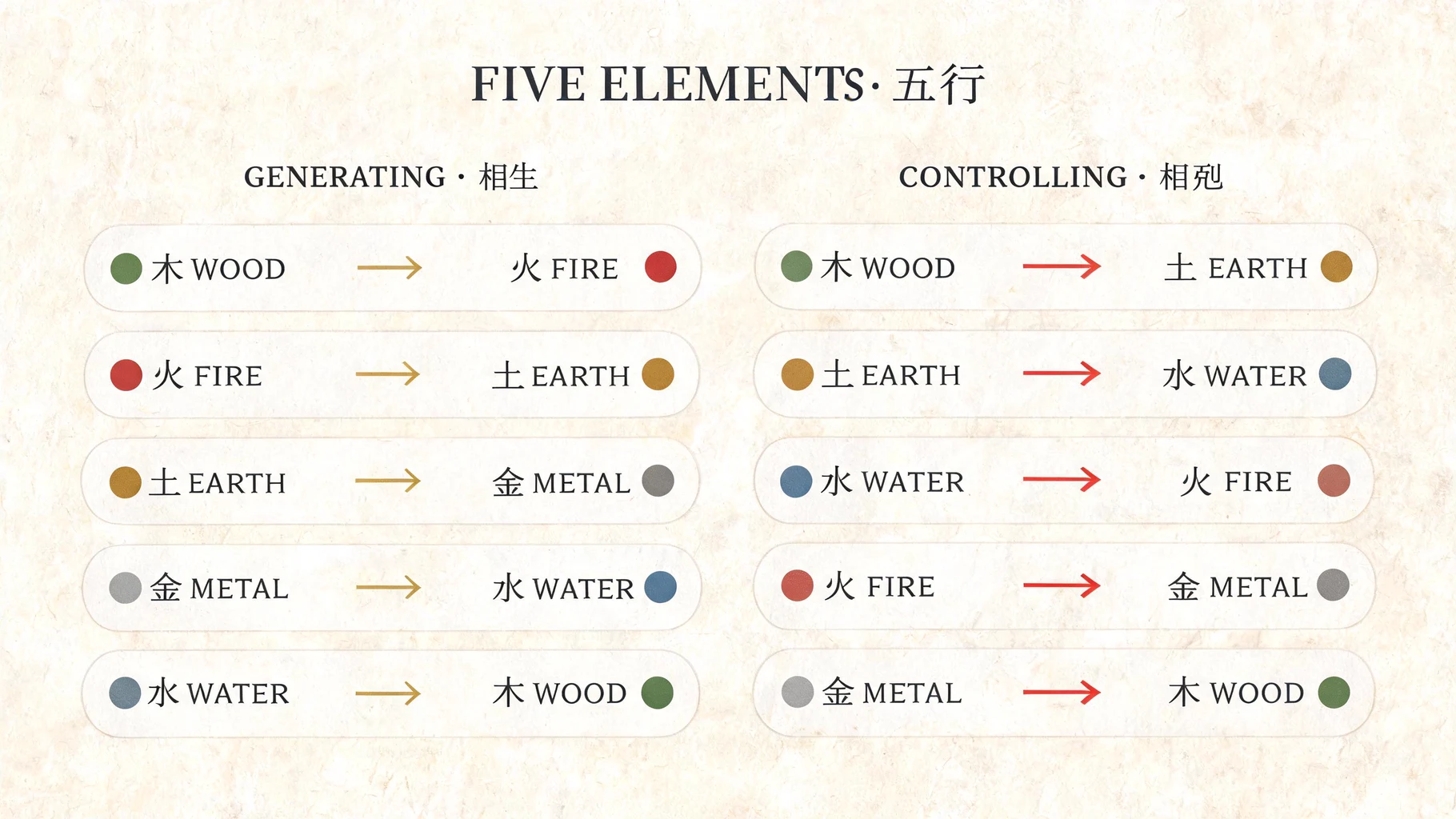
Wood feeds Fire. Fire leaves ash that returns to Earth. Earth bears Metal. Metal is associated with the gathering of Water. Water nourishes Wood.
The arrow has a cost as well as a gift. When Wood feeds Fire, Fire receives support and Wood gives energy outward. In later chapters, that outward movement becomes important. What supports one part of the chart may drain another. Generation is a transfer, not free confetti.
Traditional explanations for the cycle are mnemonic models, not modern material science. Metal "generating" Water, for example, has been explained through condensation, mineral springs, and older correlative thought. These images teach the conventional direction used in Saju interpretation. They are not chemistry lessons.
They also regulate one another:
Wood → Earth → Water → Fire → Metal → Wood
Wood penetrates Earth. Earth contains Water. Water cools Fire. Fire melts Metal. Metal cuts Wood.
Control is a limit placed on movement. Each image can sound violent if described badly, but limits make form possible. A river needs a bank. A blade needs heat and pressure before it becomes a tool. A tree sometimes needs pruning more than praise.
The controlling element also spends effort. Metal that cuts Wood is not floating outside the relationship untouched. Later, the strength of both sides and the season will tell us whether control is proportionate, ineffective, or overwhelming.
English books often call the second sequence the "destructive cycle." That is too dramatic. Control is not automatically harm. A riverbank controls water and gives it a usable course. Pruning controls a tree and may help it grow. A chart needs movement and restraint, not permanent cheerleading.
Generation can become unhelpful too. A parent can support a child and still overprotect them. Water can nourish Wood until the roots rot. In Saju, "produces" and "controls" describe directions. They do not stamp GOOD and BAD onto the arrows.
Some advanced texts add cycles of excessive control, reversal, or insult. Those are useful later, once the basic arrows are effortless. A beginner does not need six arrow styles competing for attention on the first diagram.
Yin and Yang change the expression
Each element appears in both Yang and Yin forms. Yang Wood can suggest a tree reaching upward; Yin Wood may suggest a vine adjusting to its support. Both are Wood, but they do not move in exactly the same way.
Five elements multiplied by two polarities create the ten Heavenly Stems. Yang and Yin do not change the elemental family. They shape its mode of expression.
Yang Fire is often compared with the Sun, broad and visible. Yin Fire is compared with a lamp or candle, concentrated and responsive to its surroundings. Yang Metal may evoke ore, an axe, or an unfinished blade. Yin Metal may evoke jewelry, a needle, or a refined edge. The images vary by teacher because they are teaching devices, not official portraits.
The images make the contrast memorable, but the chart must eventually correct the metaphor. A lamp in a sheltered room and a lamp in winter wind are not the same reading. The metaphor needs weather.
Yin does not mean weak, passive, feminine, or bad. Yang does not mean strong, active, masculine, or good. They describe contrasting modes such as outward and inward, direct and responsive, visible and contained. Every chart contains a shifting conversation between them.
Why counting elements misleads
Imagine two charts with three Wood characters each. One is born in spring, when Wood has seasonal support. The other is born in autumn, when Metal is strong and Wood may be under pressure. The count is identical. The situation is not.
A reader also checks whether an element has roots in the Branches, support from other elements, freedom to act, or a combination that changes its role. A single well-placed character can matter more than three characters that cannot do much.
Position changes the job. A visible Stem may express differently from an element stored inside a Branch. An element in the Month Branch carries seasonal weight. A Stem with a matching Hidden Stem below has a root, which is different from receiving support from a producing element nearby.
Relationships change the total again. An element may be generated, drained by what it produces, controlled, tied in a combination, or disturbed by a clash. Counting tells us who entered the room. It does not tell us who has the microphone, who knows the host, or who is already looking for the exit.
So "You have no Fire" is an observation about visible inventory, not a full reading. It does not automatically mean you lack passion, need a red wardrobe, or should move somewhere warmer.
"Missing" often means absent from the eight visible characters. The same element may still exist among the Hidden Stems. Even if it is truly absent from the natal structure under the chosen method, absence is not automatically a defect or a prescription. The chart may function without emphasizing that route. The missing element may become relevant under timing. It may be useful, neutral, or disruptive depending on the whole pattern.
Color remedies and one-line lifestyle prescriptions spread easily online because they turn a network into a shopping list. Wearing green because you enjoy it is harmless. Calling it a complete Wood treatment is doing a great deal of theoretical work with one sweater.
Element totals are an inventory and nothing more. A fuller reading identifies the Day Master’s element, places it in the season of the Month Branch, and traces what produces the Day Master, what it produces, what it controls, and what controls it. Chapter 7 will name those relationships the Ten Gods.
That shift from nouns to arrows is the moment the chart begins to speak in sentences.
The Five Elements Atlas will hold the detailed correspondences. In the main book, keep one rule: read relationships before quantities.
Chapter 4 introduces the actual characters that carry these elements. Ten appear above the chart as Heavenly Stems, and twelve wait below as Earthly Branches.
Previous: Four Pillars, Eight Characters
Next: Meet the Stems and Branches