Season Changes the Whole Chart
Learn why the Month Branch and birth season matter more than a simple count of elements.
A cup of water is useful on a hot afternoon and inconvenient in a flooded kitchen. The substance has not changed. The conditions have.
Saju reads the Five Elements in much the same way. Before calling an element abundant, weak, useful, or troublesome, a reader checks the season.
The Month Branch holds the seasonal key
The Month Branch is the lower character of the Month Pillar. It identifies the Saju month and provides the chart’s main seasonal context.
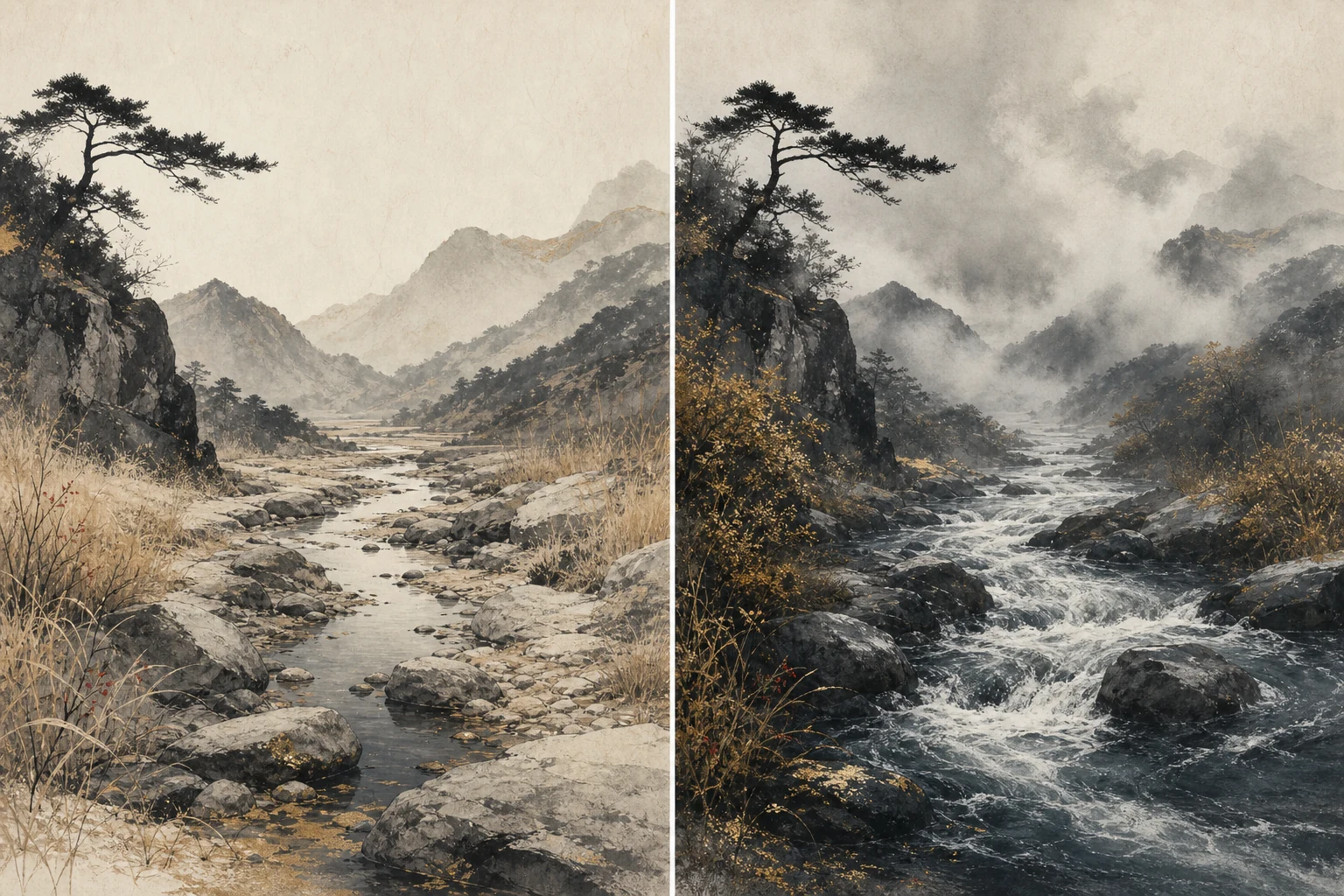
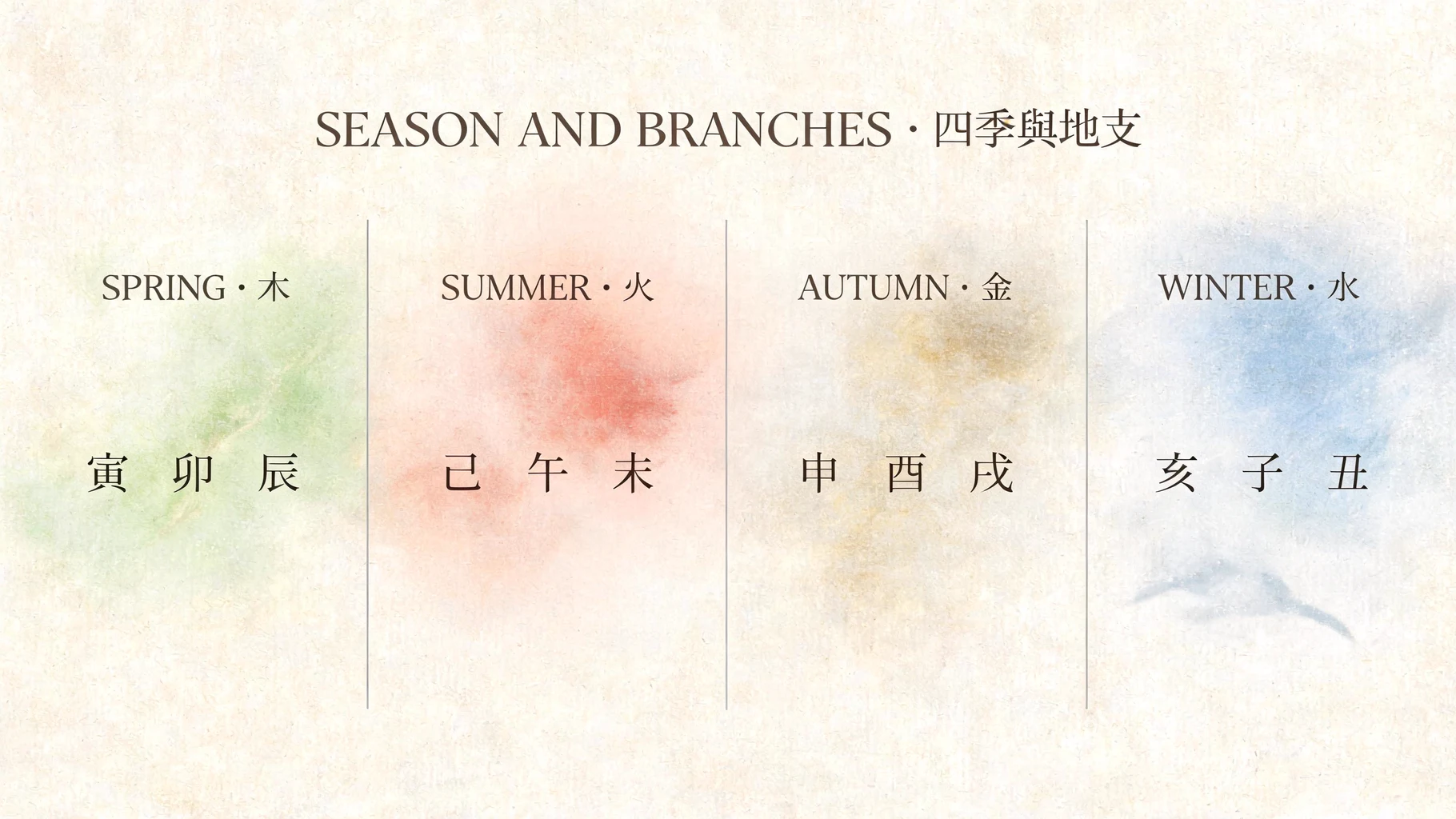
Spring supports the rise of Wood. Summer brings Fire forward. Autumn strengthens Metal. Winter gives Water its season. Earth appears throughout the cycle and becomes especially important around transitions.
This does not mean that only one element exists in each season. It means that every element begins from a different position. Fire in summer may already have heat, visibility, and momentum. Fire in winter may need fuel and shelter before it can warm anything. Winter Water can be abundant yet too cold to nourish Wood easily. Autumn Metal can be sharp, but it may still need Fire to become a useful instrument.
The Month Branch is therefore more than one character among eight. It describes the climate in which all eight must operate. It does not rule alone, but it sets the opening conditions.
Saju months do not begin on the first
A Saju month changes at a Solar Term boundary, not at midnight on the first day of a Gregorian month. It also does not begin on the first day of a lunar month.
The traditional calendar tracks the Sun’s seasonal position through twenty-four Solar Terms. Twelve of those terms open the twelve Saju months. The exact astronomical moment varies slightly by year and location, so the dates below are only familiar landmarks.
| Month Branch | Seasonal phase | Opening Solar Term | Approximate Gregorian date |
|---|---|---|---|
| In (Tiger) | early spring | Ipchun, Start of Spring | February 4 |
| Myo (Rabbit) | mid-spring | Gyeongchip, Awakening of Insects | March 6 |
| Jin (Dragon) | late spring | Cheongmyeong, Clear and Bright | April 5 |
| Sa (Snake) | early summer | Ipha, Start of Summer | May 6 |
| O (Horse) | mid-summer | Mangjong, Grain in Ear | June 6 |
| Mi (Goat) | late summer | Soseo, Minor Heat | July 7 |
| Sin (Monkey) | early autumn | Ipchu, Start of Autumn | August 8 |
| Yu (Rooster) | mid-autumn | Baengno, White Dew | September 8 |
| Sul (Dog) | late autumn | Hallo, Cold Dew | October 8 |
| Hae (Pig) | early winter | Ipdong, Start of Winter | November 7 |
| Ja (Rat) | mid-winter | Daeseol, Major Snow | December 7 |
| Chuk (Ox) | late winter | Sohan, Minor Cold | January 6 |
Someone born at 11 p.m. on March 5 does not automatically have one Month Branch simply because the calendar says March. The calculator must compare the birth moment with that year’s exact Solar Term in the correct time zone.
This is also why two apps may disagree near a boundary. One may use a rough date table, another an astronomical calculation. One may mishandle the birth location or daylight saving time. When the result changes a pillar, the difference deserves an explanation, not a coin toss.
Ipchun is the Saju year boundary
The same seasonal logic explains an important Korean Saju convention: the Year Pillar changes at Ipchun (입춘, 立春), the Start of Spring, rather than on January 1 or Lunar New Year.
For most birthdays, all three systems point to the same familiar zodiac year. Early-February births can fall between them. A person may be called one animal in everyday Lunar New Year convention while receiving the previous Year Branch in a Saju chart calculated before Ipchun.
Neither result is a software error merely because the labels differ. They answer different calendar questions, so the boundary behind a zodiac claim matters.
Ipchun does not always occur at the same clock time. Accurate calculators use the exact term. The calendar has no obligation to make its most important boundary land at a tidy midnight.
Saju season is not today’s weather
Someone born in Australia during July experiences local winter, while the traditional Branch sequence calls the Mi month late summer. Does Saju need a weather app?
No. The month system is a conventional East Asian calendrical model built from Solar Terms and inherited correlations. It is not a live meteorological report for every latitude. A reader should not replace the Month Branch because the person remembers rain, air conditioning, or an unusually warm week.
This distinction matters especially for readers outside East Asia. We can acknowledge the model’s historical geography without pretending that a branch label is a universal description of outdoor temperature. The Saju season is the calendar phase assigned by the system.
That may feel strange at first, but all calendars contain conventions. "Spring semester" does not guarantee flowers outside every classroom. The name tells us where we are in a shared structure.
Season changes elemental capacity
In the seasonal sequence, an element can be prosperous, supported, resting, constrained, or stored. Different schools use different technical vocabularies and weightings, but they share a practical insight: timing changes access to power.
Wood in spring has immediate seasonal momentum. It may still be damaged, blocked, or excessive, but it does not begin from the same place as Wood in autumn. Water in winter has volume and continuity, yet coldness may become part of the question. Fire in summer is visible and active, but more Fire may not be the remedy. Earth in transitional months can stabilize change or make movement heavy.
Season also changes relationships. Resource that supports the Day Master may be plentiful but frozen, dry, distant, or tied in a combination. An Authority Star may be strong enough to provide structure or so strong that it becomes pressure. An Output Star may create healthy circulation or drain a Day Master that has little support.
The arrow names stay the same. Their effect changes with capacity and climate.
Roots make the weather personal
Season is powerful, but the Month Branch does not contain the whole chart. A Day Master may have roots in other Branches. Supporting Stems may appear nearby. Combinations can strengthen a seasonal movement or redirect attention. Clashes can disturb a Branch without simply deleting it.
Imagine two Gye Water Day Masters born in summer. The first has strong Water roots and Metal support elsewhere. The second has neither and is surrounded by Fire and dry Earth. Both are summer Water. They do not have the same resources available.
Competent readers can agree on the season and every character yet assign different weight to roots, distance, transformation, or a special structure. The system has rules, but those rules still require judgment.
The responsible response to such disagreement is to show the reasoning. "I read the Day Master as weak because it lacks roots and receives little Resource support" is useful. "The app says weak, therefore you need blue" is mostly a color recommendation wearing a lab coat.
Balance is not equal slices
An ideal chart is not a pie divided into exactly twenty percent of each element. Seasons are naturally uneven. Living balance happens through circulation, timing, and function, not visual symmetry.
A winter chart may need warmth. That does not mean every Fire character is helpful in every position or at every time. A strong Wood chart may benefit from Metal’s pruning, but crude control can also damage it. A weak Day Master may appreciate Resource, unless the structure functions through a different dominant movement.
Advanced concepts such as the Useful God (용신, 用神) address this question. The Useful God is not simply the least frequent or missing element. Readers select it through a method that considers season, Chart Structure, strength, circulation, and the specific problem being resolved. Schools do not always select it in the same way.
We will keep that debate in the Reference Garden. A beginner first needs to see the weather before prescribing an umbrella.
Point of view, climate, and relationships
The Day Master supplies the point of view. The Month Branch sets the climate. The surrounding elements reveal where support, output, control, and pressure come from.
Even this is not a final verdict. The Branches have not yet been opened, and some of the support or pressure may be stored among the Hidden Stems. Once those contents appear, the Ten Gods can give every relationship a more precise name.
The next chapter opens those rooms.
Previous: Meet Your Day Master
Next: Hidden Stems and the Ten Gods