Reading the Basics in a Qiora Chart
Use a real Qiora result screen to find the Day Master, Four Pillars, two personal animals, and Five Elements without turning the chart into a verdict.
A first Saju chart can look crowded: eight characters, several labels, and a graph all arrive at once. You do not need to interpret every symbol. This short example uses a Qiora result screen to show where the ideas from the book appear in an actual chart.
This page is optional. You can follow the example without making your own chart. If you do use your own result, begin with the birth date and calendar type that were actually recorded. If the birth time is unknown, leave it unknown rather than choosing a convenient hour.
Qiora's English UI displays 丙 as Bing Fire. This book uses Korean readings, so the same Day Master is called Byeong Fire here.
1. Find the Day Master and Four Pillars
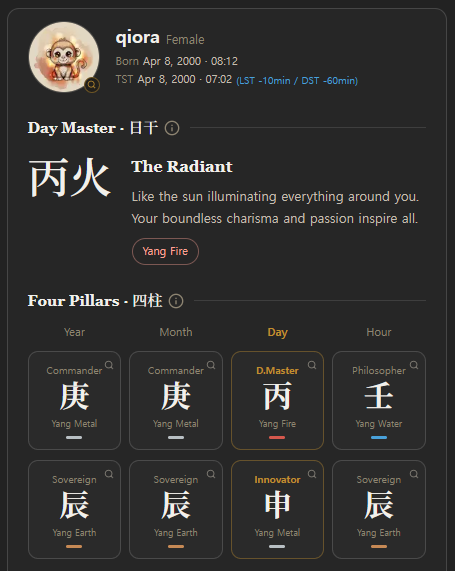
The first thing to find is the Day Master (日干). In this example it is Byeong Fire (丙火), the bright Yang form of Fire. The Day Master is the upper character of the Day Pillar and the reference point for the relationships elsewhere in the chart.
Byeong Fire alone does not describe a whole person. Its expression changes with the birth season, its roots, the surrounding elements, and the relationships among the characters. A name such as The Radiant makes the image easier to remember. The traditional reading still depends on what Byeong Fire is doing in this particular chart.
Below the Day Master, the screen arranges the Four Pillars:
| Pillar | Example | What to notice first |
|---|---|---|
| Year | Gyeong-Jin (庚辰) | The pillar of the birth year |
| Month | Gyeong-Jin (庚辰) | The pillar that locates the birth season |
| Day | Byeong-Sin (丙申) | The reference pillar containing the Day Master |
| Hour | Im-Jin (壬辰) | The pillar of the recorded birth time |
Labels such as Commander and Innovator are Qiora's memory aids for the characters. They are not extra pillars or classical technical categories. The chart positions come first; the nicknames are a second layer.
2. Meet the Two Animals
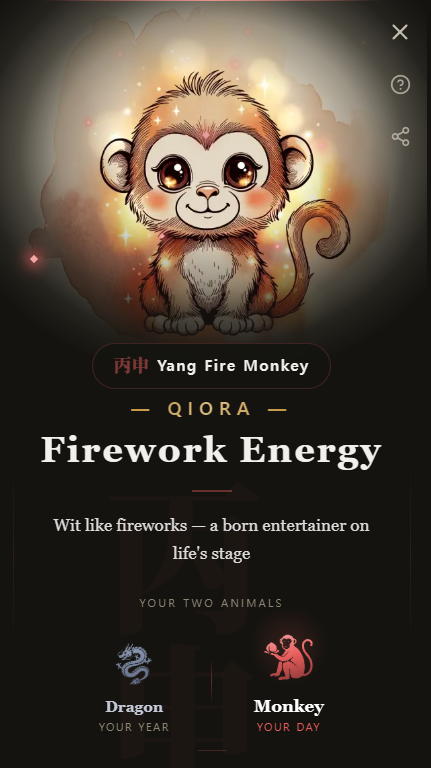
Most people know the animal of their birth year. This example has Jin (辰), the Dragon, in the Year Branch. It is the familiar animal people mean when they ask, "What is your zodiac animal?"
The Day Pillar has an animal too. Here it is Byeong-Sin (丙申), and its lower character, Sin (申), is the Monkey. We will call this the Day animal. Strictly speaking, the Byeong Fire Day Master is not itself a monkey. Byeong Fire is the Day Stem; the Monkey is the Day Branch. Together they make the complete Day Pillar.
The Heavenly Stems and Earthly Branches pair in a sixty-step cycle. Byeong-Sin is one of those sixty combinations, shown on the Qiora card as Yang Fire Monkey. A Monkey day can therefore carry a different element from another Monkey day, depending on the stem paired with it.
This gives the example two easy-to-recognize animals:
- Year animal: Dragon: the familiar animal found from the birth year
- Day animal: Monkey: the less familiar animal found in the Day Pillar
The title Firework Energy and the short description on the card are Qiora's contemporary portrait of the Byeong-Sin Day Pillar. They are not classical technical terms, and one animal does not settle a person's character or fate. The Dragon and Monkey are friendly entrances into the chart; the full reading still depends on season, structure, and relationships across all four pillars.
3. What the Five Elements Chart Can and Cannot Tell You
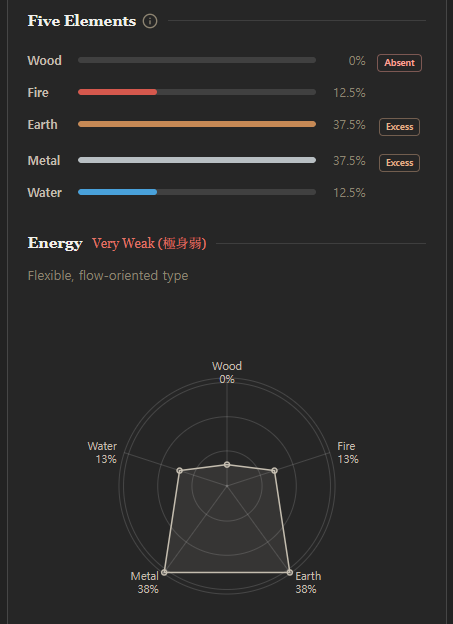
On the example screen, Earth and Metal each make up 37.5 percent of the visible eight characters. Fire and Water each make up 12.5 percent, while Wood is shown at 0 percent. This is a useful view of the chart's surface. It is not a final score for which elements are good or bad.
Wood, for example, does not appear among the eight visible characters, but the Jin branches contain hidden Eul Wood (乙木). The 0 percent bar therefore means that Wood is absent from the visible layer used by this graph, not that "there is no Wood anywhere in this life."
Nor does a large Earth or Metal bar make those elements automatically harmful. A small Wood bar does not automatically prescribe Wood-colored clothes, foods, careers, or partners. An element's role depends on season, position, roots, and the relationships of generation and control.
The screen also describes the Day Master as Very Weak (極身弱). This is not a judgment about the person's health, willpower, or worth. It is a technical assessment of how much support the Byeong Fire Day Master has relative to the forces it must produce, control, or withstand. Strong and weak describe different chart structures, not better and worse people.
4. Read the Three Screens as One Picture
The reference point in this example is a Byeong Fire Day Master. Its Year animal is the Dragon, and its Day animal is the Monkey. Earth and Metal dominate the visible layer, and Qiora assesses the Day Master as Very Weak after considering the surrounding structure. None of those facts alone determines a career, relationship, financial outcome, or future event. A fuller reading would next consider the Month Branch and season, the Hidden Stems, and the productive and controlling relationships among the characters.
That is enough for a first visit to a result screen. If you can answer four questions, the exercise is complete:
- Which character is the Day Master?
- Which two animals appear in the Year and Day Pillars?
- What does the Five Elements graph show on the visible surface?
- Which labels describe traditional chart structure, and which are modern aids that help explain it?
Opening Qiora beside this book simply shows where the language of Saju appears in a real chart. There is no need to learn every feature of the app.