Hidden Stems and the Ten Gods
Open the Earthly Branches and learn the five relationship families called the Ten Gods.
The four Earthly Branches are not empty labels. Each holds one or more Heavenly Stems inside. These are the Hidden Stems (지장간, 地藏干), and they explain why a chart contains more than its visible row suggests.
Then the Ten Gods (십신, 十神) give those Stems roles relative to the Day Master. One idea opens the rooms. The other introduces everyone inside.
A Branch is a container, not one ingredient
When we call In "Yang Wood" or O "Yang Fire," we name the Branch’s primary elemental face. The Branch may still hold several Stems.
Think of the primary element as the mood you notice at the door. Hidden Stems are the actual contents of the room. A late-summer Earth room may contain Fire left from the previous season and Wood preparing for another role. That layered structure helps the Branches carry seasonal transitions.
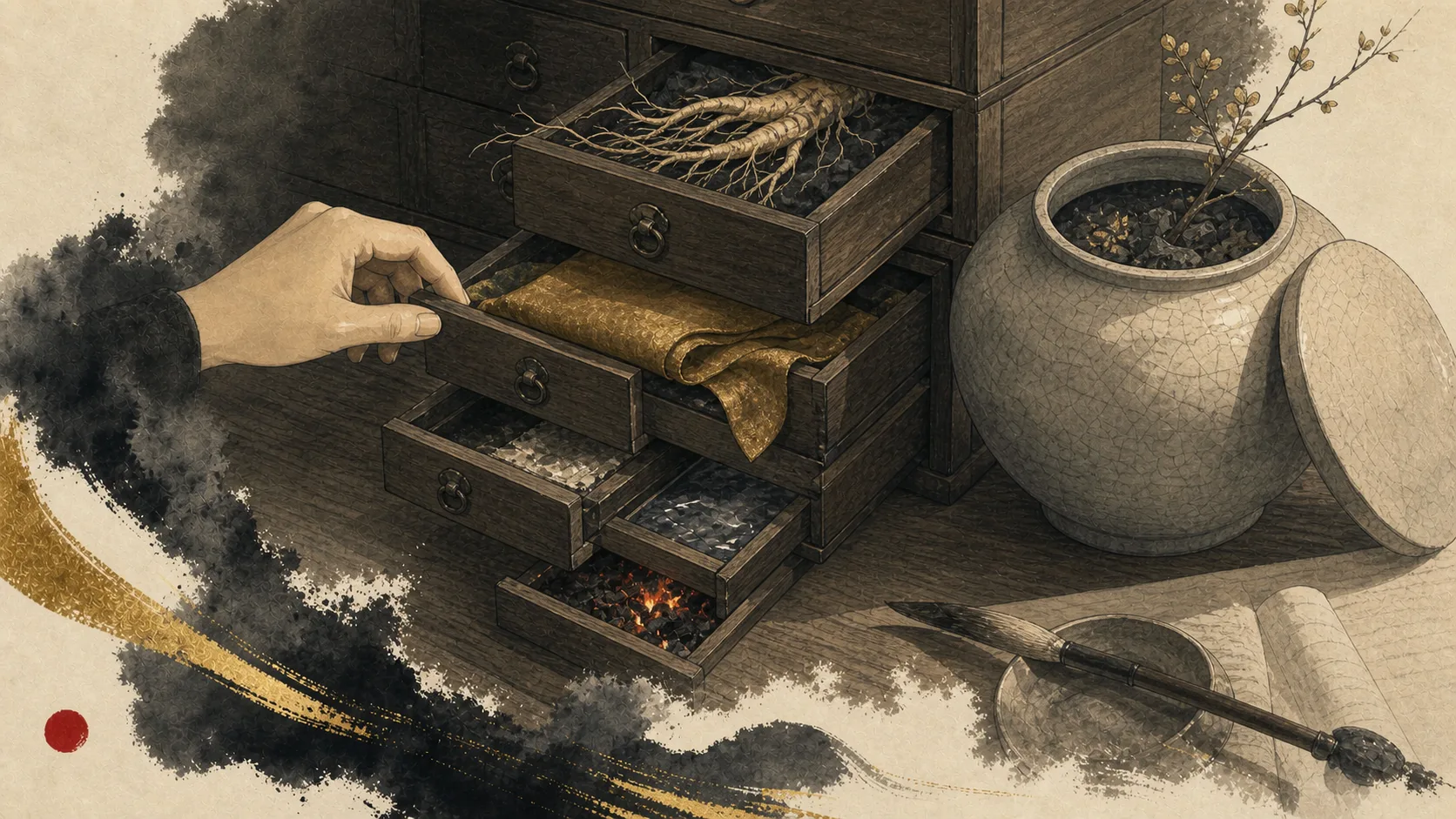
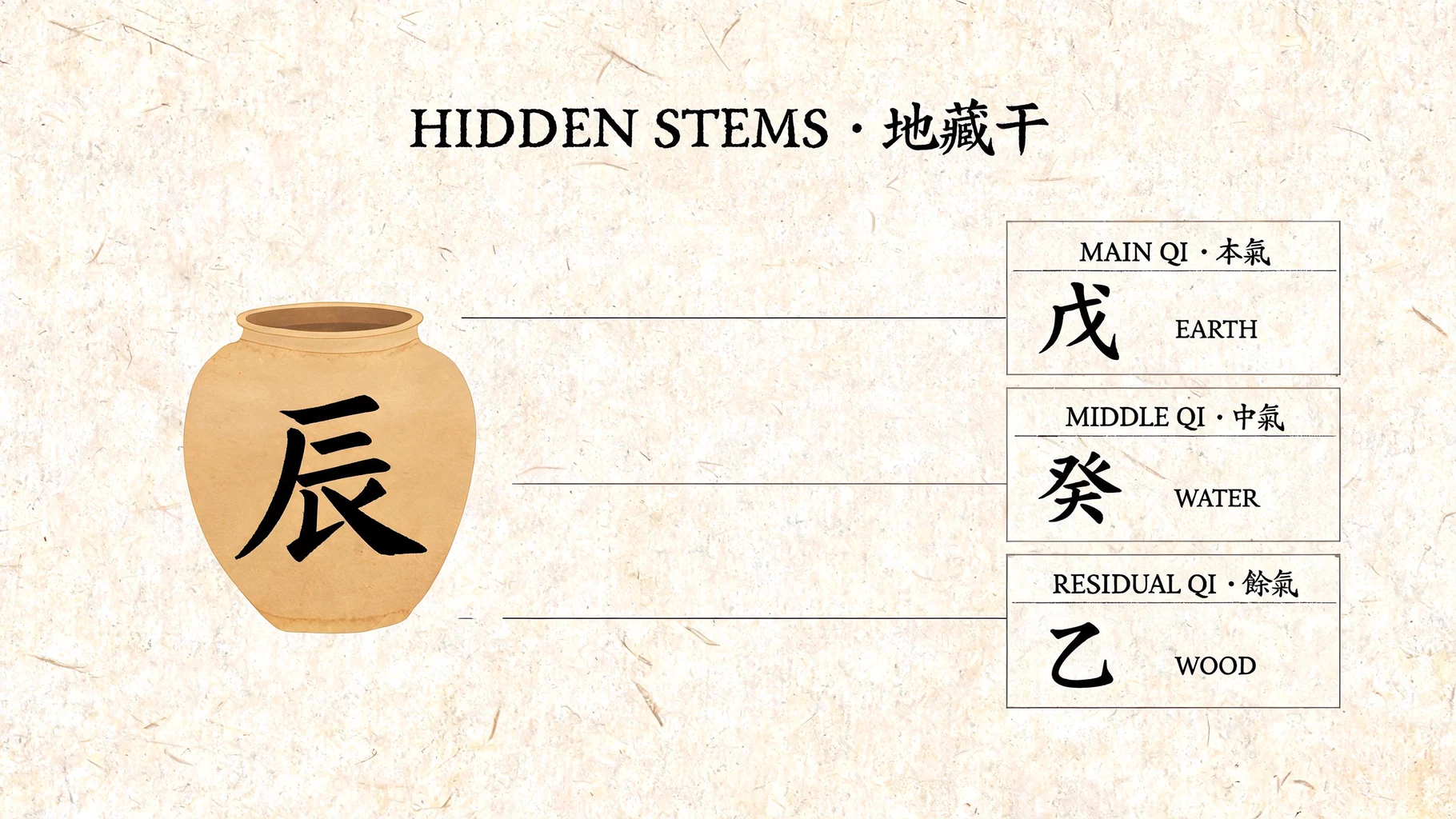
Traditional tables often distinguish Main Qi, Middle Qi, and Residual Qi. Main Qi is the dominant stored Stem. Middle and Residual Qi describe additional presences associated with the Branch’s seasonal history. Not every Branch has all three.
The labels do not mean that Main Qi always wins every interaction or that Residual Qi is decorative dust. A hidden Stem’s relevance depends on the season, the Branch’s position, roots and support, interaction with visible Stems, and timing.
The twelve rooms and what they store
The table below follows a common Korean arrangement, moving from the dominant Main Qi outward. Schools may present the columns in another order or differ in fine weighting, but the stored Stems themselves are widely shared.
| Branch | Main Qi | Middle Qi | Residual Qi |
|---|---|---|---|
| Ja (자, 子) | Gye (계, 癸) | ||
| Chuk (축, 丑) | Gi (기, 己) | Sin (신, 辛) | Gye (계, 癸) |
| In (인, 寅) | Gap (갑, 甲) | Byeong (병, 丙) | Mu (무, 戊) |
| Myo (묘, 卯) | Eul (을, 乙) | ||
| Jin (진, 辰) | Mu (무, 戊) | Gye (계, 癸) | Eul (을, 乙) |
| Sa (사, 巳) | Byeong (병, 丙) | Gyeong (경, 庚) | Mu (무, 戊) |
| O (오, 午) | Jeong (정, 丁) | Gi (기, 己) | |
| Mi (미, 未) | Gi (기, 己) | Eul (을, 乙) | Jeong (정, 丁) |
| Sin (신, 申) | Gyeong (경, 庚) | Im (임, 壬) | Mu (무, 戊) |
| Yu (유, 酉) | Sin (신, 辛) | ||
| Sul (술, 戌) | Mu (무, 戊) | Jeong (정, 丁) | Sin (신, 辛) |
| Hae (해, 亥) | Im (임, 壬) | Gap (갑, 甲) |
Ja, Myo, and Yu each store a single Stem in this table. O stores two. The rest carry two or three. Simplicity does not make a Branch weak, and a crowded room is not automatically stronger. The season still decides who has home advantage.
The four Earth Branches Chuk, Jin, Mi, and Sul are especially layered because they sit near seasonal transitions. Their stored contents link what is fading, what is dominant, and what is preparing to move. Traditional names such as "storage" make more sense once you see the inventory.
Hidden does not mean subconscious
English introductions often translate visibility into psychology: Stems are conscious, Branches are subconscious. That can be a useful metaphor in a particular reading, but it is not the definition.
Hidden means located inside an Earthly Branch. A Hidden Stem can become very obvious in a person’s daily life if it is seasonally strong, repeated, rooted, or activated by timing. A visible Stem can be hard to use if it is unsupported or tied up in an interaction.
Nor does a Hidden Stem reveal a secret that the person has been hiding from themselves. Sometimes it describes capacity that operates through context rather than direct display. Sometimes it gives a visible Stem a root. Sometimes it changes the balance quietly. Keep the calendar structure before adding psychological poetry.
A root is support with an address
When a visible Stem finds its own element among the Hidden Stems of a Branch, readers often say it has a root. A Gap Wood Stem above an In Branch finds Gap Wood below. An Eul Wood Stem may root in Myo or in another Branch that stores Eul.
Rooting gives the visible Stem an anchor in the Branch layer. The quality of that root varies. A Main Qi root in season is not identical to a small Residual Qi presence under pressure. Position and relationships matter. Still, the basic image is useful: the Stem is not floating without ground.
The claim "there is no Water" can be wrong before the sentence ends if it relies only on the upper row. Water may be stored in Ja, Chuk, Jin, Sin, or Hae. Its visibility, availability, and strength are separate questions.
From elemental arrows to human roles
Once the Day Master is known, every other Stem can be named by its relationship to it.
| Relationship to the Day Master | Relationship family | Broad themes |
|---|---|---|
| Same element | Companion Stars | peers, identity, competition, solidarity |
| Produces the Day Master | Resource Stars | support, learning, recovery, protection |
| Produced by the Day Master | Output Stars | expression, craft, ideas, production |
| Controlled by the Day Master | Wealth Stars | management, value, exchange, responsibility for resources |
| Controls the Day Master | Authority Stars | rules, pressure, discipline, role, accountability |
These are relationships, not objects. Wealth is not a bag of money hiding under Earth. Authority is not a police officer assigned to Metal. The names translate how the Day Master exchanges energy with another element.
Each family divides by polarity. Five relationships multiplied by two polarity patterns create the Ten Gods.
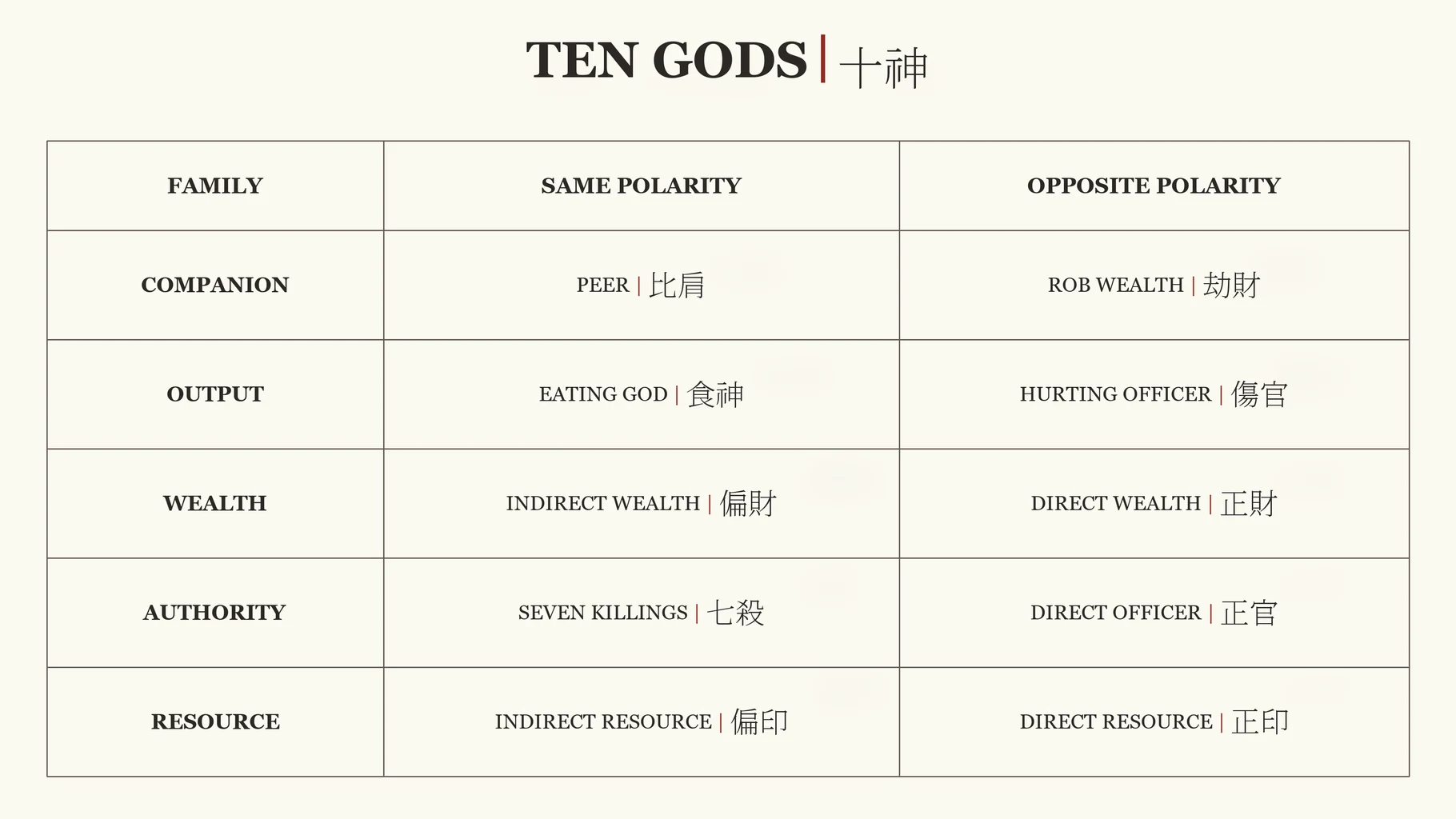
| Relationship | Same polarity | Opposite polarity |
|---|---|---|
| Same element | Peer (비견, 比肩) | Rob Wealth (겁재, 劫財) |
| Day Master produces it | Eating God (식신, 食神) | Hurting Officer (상관, 傷官) |
| Day Master controls it | Indirect Wealth (편재, 偏財) | Direct Wealth (정재, 正財) |
| It controls Day Master | Seven Killings (편관, 偏官) | Direct Officer (정관, 正官) |
| It produces Day Master | Indirect Resource (편인, 偏印) | Direct Resource (정인, 正印) |
The names are traditional technical labels. They are not instructions to eat a deity, hurt an employee, rob anyone’s wealth, or expect seven murders before breakfast. Translation inherited a flair for drama.
What the five families ask
Companion Stars share the Day Master’s element. They can describe peers, siblings, collaborators, competitors, and the part of us that meets an equal. Support and rivalry can exist together. A team mate and a rival may even be the same person by Friday.
Resource Stars produce the Day Master. They concern learning, care, protection, memory, credentials, and the capacity to receive or recover. Resource can nourish. Too much may shelter the Day Master from action or keep knowledge circulating without output.
Output Stars are produced by the Day Master. They concern speech, craft, creativity, children in some traditional contexts, performance, problem-solving, and what moves from inner capacity into the world. Output can become beautiful work or endless broadcasting. It also spends the Day Master’s energy.
Wealth Stars are controlled by the Day Master. They concern resources one manages, exchange, practical results, possessions, priorities, and the labor of taking responsibility for something outside oneself. Wealth can indicate financial themes, but the presence of a Wealth Star is not a bank statement.
Authority Stars control the Day Master. They concern standards, law, duty, status, deadlines, institutions, discipline, and pressure. Healthy Authority can give form and credibility. Excessive or hostile pressure can constrain. A chart with Authority is not automatically destined for government work, nor is one without visible Authority unemployable.
Direct and Indirect are not good and bad
The opposite-polarity member of a pair is commonly called Direct, while the same-polarity member often receives an Indirect or distinctive traditional name. The exact naming pattern is worth learning from the table rather than guessing.
Direct does not mean honest, legitimate, or superior. Indirect does not mean shady, fake, or second best. The words distinguish polarity relationships and often suggest different modes of engagement. Direct Resource and Indirect Resource both support the Day Master; neither is a higher grade of education.
Likewise, Seven Killings is not automatically dangerous and Direct Officer is not automatically virtuous. Both belong to the Authority Stars. Their expression depends on strength, balance, placement, and the rest of the chart.
One example: Gye Water as the reference point
Suppose the Day Master is Gye, Yin Water.
- Im, Yang Water, shares the element with opposite polarity, so it becomes Rob Wealth.
- Gye, Yin Water, shares both element and polarity, so it becomes Peer.
- Water produces Wood. Gap, Yang Wood, has opposite polarity and becomes Hurting Officer. Eul, Yin Wood, has the same polarity and becomes Eating God.
- Water controls Fire. Byeong, Yang Fire, becomes Direct Wealth. Jeong, Yin Fire, becomes Indirect Wealth.
- Earth controls Water. Mu, Yang Earth, becomes Direct Officer. Gi, Yin Earth, becomes Seven Killings.
- Metal produces Water. Gyeong, Yang Metal, becomes Direct Resource. Sin, Yin Metal, becomes Indirect Resource.
Nothing about Gap Wood changed when we chose Gye Water as the Day Master. Only its relationship label did. With a different Day Master, Gap receives a different role.
This is the camera principle from Chapter 5, now with a cast list.
People are not Ten God name tags
Traditional manuals connect Ten Gods with family roles. Wealth may be linked with a father or spouse in some gendered conventions. Authority may be linked with a husband, workplace hierarchy, or social role. Resource may be linked with a mother, teachers, or support systems.
These correspondences come from historical household and gender assumptions. They remain one layer of inherited symbolism, not a compulsory map of a modern family. A same-sex partnership, chosen family, single life, nontraditional work, or complex caregiving history does not fall outside Saju because an old table had narrow columns.
Function comes before a fixed cast list: support, regulation, competition, management, and expression may appear through different people and institutions in different lives. The chart offers relationship patterns. Reality decides where they appear.
Visible and hidden roles belong to the same cast
Ten God labels apply to visible Stems and Hidden Stems alike because both are measured from the Day Master. A chart may show one family clearly across the upper row while storing several others below.
Visibility still matters. A Ten God on a Stem may be easier to recognize or articulate. A role held mainly in Branches may depend more on context, position, or timing. But hidden is not absent, and visible is not automatically dominant.
At this point the chart has become much richer. Eight visible characters contain further Stems. Every Stem has a relationship name. The temptation is to read each label as a separate fortune cookie.
Repeated families, seasonal support, roots, and the way roles connect across pillars matter more than isolated labels. A cast becomes a story only when the characters interact.
The Hidden Stems and Ten Gods Atlas keeps the complete lookup tables. The next chapter watches the characters combine, clash, and change one another’s working conditions.
Previous: Season Changes the Whole Chart
Next: When the Characters Meet