Birth Time and Calendar FAQ for Your Saju Chart
Answers to the questions that stall a Saju chart: unknown birth time, solar or lunar dates, Ipchun, birthplace, time zones, and the gender field.
Short answer: Enter the birth date exactly as it was recorded, choose the calendar type that matches it, and add the birth time and birthplace only when you actually have them. If the time is unknown, mark it unknown. Qiora is designed to keep the public Hour Pillar as ?, and any noon value it uses internally is a placeholder rather than a recovered birth time.
This page handles the input problems that stop a chart before it starts. For short answers to broader first-reading questions, use Saju Beginner Q&A. For the step-by-step setup, use Get Your Saju Chart.
These rules work the same way whether you call the system Saju or BaZi, because the input problems are identical. Hanja, the Chinese characters in parentheses, appear throughout as precise ID tags for each term, and you never need to read them. The Korean Saju Glossary has the full list.
Four things to check before you enter anything
| Input | What it decides | If you are not sure |
|---|---|---|
| Birth date | The Year, Month, and Day Pillars | Use the date you were actually born, not the date on a document that was filed late |
| Calendar type | How the date is read before the Pillars are placed | Match the calendar the date was written in, and do not convert it yourself |
| Birth time | The Hour Pillar, and the Day Pillar near late-night boundaries | Choose unknown instead of guessing |
| Birthplace | The historical time zone, daylight saving rules, and longitude | Use the actual city of birth, not the current address |
Most birth times land nowhere near a boundary. For most readers, this page is a manual for the exceptions, not a warning about their own chart.
Your name labels the saved profile and changes nothing in the calculation. The gender field does affect one part of the result, and it gets its own section below.
When you know your birth time, and when you do not
A traditional hour block (시진, 時辰) covers about two clock hours, so a few minutes usually change nothing. Near the edge of a block, those same minutes change the entire Hour Pillar.
If the time was written down somewhere, use it. Birth certificates, hospital records, baby books, and family registers are all better sources than a confident memory. When a relative says you arrived "around dinner," it is worth asking whether dinner meant six o'clock or nine.
If nobody wrote it down, choose unknown. The chart still opens. The Hour column simply shows up wearing a ? badge.
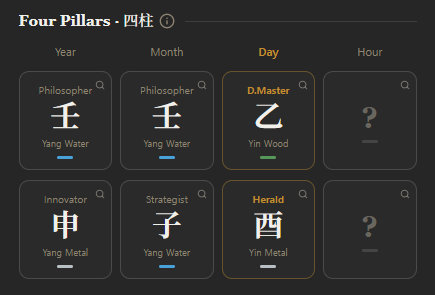
Here is what Qiora does with an unknown time:
- The public Hour Pillar is designed to stay
?. In the current build, placeholder characters can appear in that column instead. That is a display bug, not a mistake you made, and it does not mean the system recovered your birth time. - True Solar Time correction is turned off.
- A reading needs a value in that slot, so the system may use 12:00 noon in local civil time internally. A copied prompt can therefore contain a noon-derived Hour marked as estimated.
- Noon is a technical placeholder. It is not your birth time, and it is not a recovered one.
What still works, and what stays provisional
| Usable without a birth time | Provisional until the time is confirmed |
|---|---|
| Year, Month, and Day Pillars, with the caution below | Hidden Stems (地藏干) and Ten Gods (十神) of the Hour Branch |
| The Day Master, and the Ten God relationships among the Year, Month, and Day characters | Element counts that include the Hour, and Day Master strength (身强·身弱) |
| Combinations and clashes (合沖) among the first three Pillars | Any combination, clash, or Special Star (神煞) that involves the Hour |
| Luck Pillar (大運) direction and the sequence of its characters | Chart Structure (格局) and Useful God (用神) where the Hour affected the judgment |
| Season, Month Branch, and everything the Month Pillar governs | Anything the Hour position traditionally represents, including children and later life |
One caution applies to that whole first column. If you genuinely have no idea when you were born, the Day Pillar is not fully settled either, because a birth after 11:00 p.m. shifts it to the next day's characters. The good news is that this uncertainty collapses quickly. You do not need the exact minute to rule it out. Knowing only that you were born during the day, or clearly not near midnight, is enough to settle the Day Pillar. Families often remember that much even when the clock time is gone, so write down whatever window you can confirm.
Luck Pillar direction and sequence stay usable once the Year and Month Pillars and the gender selection are confirmed. The starting age is estimated from the gap between the moment of birth and a Solar Term boundary, using the traditional rate of three days to one year, then rounded to whole years. A noon placeholder can be off by at most half a day, and that half day usually disappears in the rounding. Expect the same starting age in most charts and a one-year shift only when the value sits near a rounding edge, which matters mainly if you are already close to a transition.
One more caution. Qiora's current unknown-time form does not ask for a birthplace, so if you did not enter one, the time zone that noon value was measured in is provisional too. Keep the unknown-time setting saved with your screenshot.
Some practitioners try to recover a missing time by testing candidate hours against documented life events. That is birth-time rectification, an advanced interpretive method. Qiora's noon placeholder is not rectification. If any service describes it that way, treat that as a reason to ask more questions.
Which calendar do I enter, and when does the Saju year start?
Enter the date in the calendar it was recorded in. A Gregorian date goes in as solar. A Korean lunar date goes in as lunar, with the leap-month option when it applies. Converting the date yourself and then labeling the result as lunar sends one birthday through the converter twice, and the second trip is the one that breaks it.
Qiora's English chart form currently accepts Gregorian solar dates. The Korean form offers solar, lunar, and leap-lunar input. A date from a different lunar tradition, such as the Chinese or Vietnamese calendar, needs a converter built for that tradition, and the converted result goes into the solar field. Submitting it as lunar runs the conversion a second time.
If your family's records and your official documents disagree about the date, use the day you were actually born. Late birth registration and dates filed on the wrong calendar are common enough that the document is not automatically the better source.
Now the part that surprises almost everyone: Seollal (설날), the Korean Lunar New Year, is not the Saju year boundary. It is a calendar holiday. The Saju Year Pillar changes at Ipchun (입춘, 立春), the Solar Term that opens spring, and Ipchun usually falls on February 3, 4, or 5. Seollal keeps its rice cake soup; it just never got the keys to the Year Pillar.
The gap is not theoretical. Someone born in Seoul on February 4, 1994 at 5:00 a.m. has a Yin Water Rooster (癸酉) Year Pillar and a Yin Wood Ox (乙丑) Month Pillar. Someone born on the same date at 8:00 p.m. has a Yang Wood Dog (甲戌) Year Pillar and a Yang Fire Tiger (丙寅) Month Pillar. One date, two Year Pillars, because Ipchun passed between those two clock times.
Two boundary rules are worth memorizing:
- The Year Pillar changes at Ipchun, and the Month Pillar always changes with it, because Ipchun is itself the term that opens the Tiger month.
- The Month Pillar changes at the twelve month-opening Solar Terms, called jie in Chinese and jeolip (절입, 節入) in Korean, not at every one of the twenty-four Solar Terms.
If your birthday lands within a day or two of either boundary, treat the Year and Month Pillars as something to verify, not something to assume. Read Why the Saju New Year Begins at Ipchun for the reasoning behind the rule.
Birthplace, time zone, and daylight saving
Qiora uses the birthplace coordinates for two separate jobs. The first is finding the historical time zone and daylight saving rules that applied on your birth date. The second is supplying the longitude used for True Solar Time.
Historical is the important word. Time zones are legislation, and legislation changes. Korea observed daylight saving time during several past periods, including the summers of 1987 and 1988, when clocks ran an hour ahead of standard Korean time. A birth recorded as 10:00 a.m. on an August day in 1988 was not 10:00 a.m. standard time. In the mid-1950s, Korea also ran on a different standard time entirely.
You do not need to know any of that history. You need to enter the city where the birth happened and the clock time as it was recorded. The engine applies the rules that were in force that day. Just do not adjust the clock yourself before entering it. The engine will apply that correction again, and you will end up an hour off.
The same caution applies to a birth abroad. Enter the actual city, not the place the family moved to later.
True Solar Time and the 11 p.m. day boundary
Two clocks are running in a Saju chart, and they have different jobs.
True Solar Time corrects for the difference between your birthplace longitude and the standard meridian of its time zone. For Seoul, that gap is about 32 minutes. Qiora applies the correction to the Hour Pillar only, and it does not move the Year, Month, or Day boundaries. By default Qiora corrects for longitude alone. The equation of time, which shifts the sun's apparent position by up to about 16 minutes across the year, is available but off by default, so a calculator that includes it can land on a different Hour Pillar near a block edge.
The Day Pillar boundary runs on local standard time. If daylight saving time was in force, Qiora removes that offset before applying the 11 p.m. boundary. Its default treats the block from 11:00 p.m. through 12:59 a.m. in standard time as belonging to the next Day Pillar. The wall calendar may not have turned over yet, but the Day Pillar has already checked into tomorrow.
Classical texts split that block in two. The 11 p.m. hour is Night Rat (야자시, 夜子時) and the midnight hour is Early Rat (조자시, 早子時). Schools that keep the split leave the 11 p.m. hour on the same day, so a birth at 11:30 p.m. can produce two different Day Pillars depending on which rule a calculator follows. Qiora's default does not keep the split. It treats the whole block as Early Rat, and that is what the mode label refers to.
That rule matters more than its size suggests, because the Day Stem is your Day Master, and every Ten God label is calculated from it.
Take two births in Seoul on May 20, 1994, fifty minutes apart:
| Recorded time | Day Pillar | Hour Pillar |
|---|---|---|
| 10:50 p.m. | Yang Fire Horse (丙午) | Yin Earth Pig (己亥) |
| 11:40 p.m. | Yin Fire Goat (丁未) | Yang Metal Rat (庚子) |
The Day Master moved from Yang Fire (丙) to Yin Fire (丁), so every Ten God relationship in the chart was recalculated, and the Hour moved from the Pig hour into the Rat hour. Fifty minutes, two different charts.
If your recorded time sits anywhere near 11:00 p.m., write down the exact minute and note whether the record used standard time or a daylight saving clock. That single detail decides which day your chart belongs to. Between 11:00 p.m. and roughly 11:32 p.m. in Seoul, the day boundary and the corrected Hour are measured on different clocks. If your time falls in that window, run the chart in a second calculator and compare the Day Pillar before you trust the Hour Pillar.
The gender field and Luck Pillar direction
The gender selection does not change your Eight Characters, your Day Master, or your natal Ten Gods. It drives one thing: the direction your Luck Pillars run, plus the handful of calculations that follow from that direction.
So the practical answer at the input screen is simple. Pick either option and generate the chart, because the Eight Characters come out identical either way. When you reach the Luck Pillar section, generate the other version too and read them side by side.
Qiora follows the traditional rule:
| Your selection | Year Stem | Luck Pillars run |
|---|---|---|
| Male | Yang | Forward |
| Male | Yin | Backward |
| Female | Yang | Backward |
| Female | Yin | Forward |
The direction also decides which Solar Term boundary is measured to estimate the starting age: forward counts toward the next jeolip, backward counts toward the previous one. Traditional spouse and kinship mappings may use the selection as well.
Qiora's interface currently offers a binary field. If neither label describes you, the honest way to read it is as a parameter in an old formula rather than a statement about who you are. What no one should do is present one version as the secretly authentic one.
For the longer discussion, read Which Gender Should I Pick for My Saju Reading?.
Do twins have the same chart?
Generate each twin's chart separately, from that twin's own recorded time. Whether the two charts match is something you find out afterward, not something to assume at the input screen.
Twins born inside the same traditional hour block, under the same settings, share all four Pillars. Twins born on opposite sides of an hour boundary or a day boundary do not. With the same Year Pillar, Month Pillar, and gender selection, Luck Pillar direction and sequence match, while the exact starting ages can differ slightly because each is measured from that twin's own recorded time.
Identical charts do not produce identical lives. Two people can share all eight characters and still end up with different health, different families, different opportunities, and a few thousand different decisions.
Quick troubleshooting
| What you are seeing | What to check | Where to go |
|---|---|---|
| Two calculators show different Year Pillars | Whether your birthday is near Ipchun, and whether both tools use Ipchun as the year boundary | Ipchun |
| Two calculators show different Day Pillars | A birth time near 11:00 p.m., and whether each tool keeps the Night Rat split | The day boundary section above |
| Two calculators show different Hour Pillars | The birthplace, the time zone applied, whether solar time correction was used, and whether it included the equation of time | The True Solar Time section above |
| You were born after 11:00 p.m. but the Hour Branch is not the Rat | Normal. Solar time correction can pull the reading back into the previous block | The True Solar Time section above |
| Your Hour column shows characters after you chose unknown | Known display issue. That is the internal placeholder, not a recovered time. Confirm the unknown setting was saved, and label the column unverified | The unknown-time section above |
| You only know a lunar birthday | Use the chart calculation guide to convert and preserve the original calendar type | Get Your Chart |
| Your record shows a daylight saving clock time | Enter it as recorded with the correct birthplace, and do not subtract the hour yourself | The birthplace section above |
| Your documents and your family disagree about the date | Build the chart from the actual birth date, then build a second one from the document date and compare | The calendar section above |
Entering your details in Qiora
- Open the free Qiora Saju calculator.
- Enter the birth date as recorded. If it is lunar, use the chart calculation guide and preserve whether it was a leap month.
- Enter the birth time if you have it, or choose unknown.
- Enter the birthplace when the form asks for it.
- Choose a gender option. It sets your Luck Pillar direction.
- Generate the chart and save a screenshot of the raw Pillars.
- Write the settings down with that screenshot: the calendar type, the unknown-time choice, and the birthplace.
A screenshot without its input settings is evidence with the label peeled off. If a second tool later disagrees, those saved settings are what let you find the reason.
Once the chart is confirmed, Four Pillars, Eight Characters explains the columns, and Reading the Basics in a Qiora Chart shows them on a real result screen.
More questions
Is the noon value my real birth time?
No. It is a technical placeholder that lets a reading run when the Hour slot is empty, and it appears with True Solar Time turned off. If you see it in a copied prompt, label it estimated. Nothing about noon has been verified against your birth record.
What if I find my birth time later?
Rebuild the chart from scratch rather than adding the Hour to the old one. A confirmed time can change the Day Pillar if the birth was after 11:00 p.m., and that changes the Day Master and every Ten God with it. Keep the old screenshot so you can see what changed.
My birthday is on the Chinese or Vietnamese lunar calendar. What do I enter?
Convert it first. Qiora's lunar option is built for the Korean lunar calendar, so use a converter made for your own tradition and enter the result in the solar field. Do not enter a converted date as lunar, because that runs the conversion twice.
Does the gender field change my Eight Characters?
No. It changes the direction of the Luck Pillar sequence and the boundary used to estimate its starting age. Your Day Master, natal Ten Gods, and the Eight Characters themselves are identical under either selection.
My family says I was born "around midnight." What do I enter?
It depends on whether anyone can narrow it down. If the record is genuinely uncertain across the 11:00 p.m. boundary, choose unknown rather than picking a side, because that boundary can change the Day Master and every Ten God with it. Even a rough window such as "before the late news" is worth writing down.
Two calculators disagree. Which one is right?
Usually neither is broken. Compare the conventions first: calendar type, birthplace and historical time zone, the year boundary, the month boundary, the late-night day rule, and whether solar time correction was applied. Away from a boundary, reputable tools generally agree. Near one, the conventions are the whole story.
Sources and editorial notes
- Calculation behavior described here was read from Qiora's current engine on 2026-07-31, including the Day Pillar boundary rule, the Hour Pillar solar time correction, the equation-of-time default, and the Luck Pillar direction and starting-age rules.
- The February 4, 1994 and May 20, 1994 examples were generated with that engine rather than worked out by hand.
- Korea's past daylight saving periods and standard time changes come from the historical time zone database the engine uses.
- The unknown-time behavior follows Qiora's current product contract: public Hour
?, noon used only as an internal placeholder, and provisional status for anything derived from it. A live Korean unknown-time check on 2026-07-31 showed the placeholder rendering as a regular Hour Pillar, which is why this page tells readers to preserve the unknown-time setting. - Night Rat and Early Rat naming follows classical usage, in which the 11 p.m. hour is Night Rat and the midnight hour is Early Rat. Qiora's default mode does not separate the two and is labeled Early Rat in the product.
- The gender answer describes Qiora's current calculation parameter and binary interface. It does not define anyone's identity.
- S31 owns the short beginner questions. This page owns the detailed input and calculation questions.
Get the input right, and the rest of the chart is worth arguing about. Get it wrong, and you will be reading a very well-explained stranger.