Four Pillars, Eight Characters
Learn how a Saju chart turns a birth year, month, day, and hour into four paired columns.
A Saju chart is small. That is part of its charm and most of its mischief.
Four columns hold eight main characters, yet readers may spend years discussing how those characters change one another. Before we invite in the Five Elements, seasons, Hidden Stems, Ten Gods, and timing cycles, let us simply learn where everything sits.

A birth moment becomes four pillars
The four pillars correspond to four parts of a birth moment:
| Pillar | Built from | What to call it |
|---|---|---|
| Year | birth year | Year Pillar (년주, 年柱) |
| Month | birth month in the Saju calendar | Month Pillar (월주, 月柱) |
| Day | birth day | Day Pillar (일주, 日柱) |
| Hour | birth time | Hour Pillar (시주, 時柱) |
Each pillar contains one Heavenly Stem above one Earthly Branch.
| Hour | Day | Month | Year | |
|---|---|---|---|---|
| Heavenly Stem | ? | ? | ? | ? |
| Earthly Branch | ? | ? | ? | ? |
Four Stems plus four Branches make the Eight Characters.
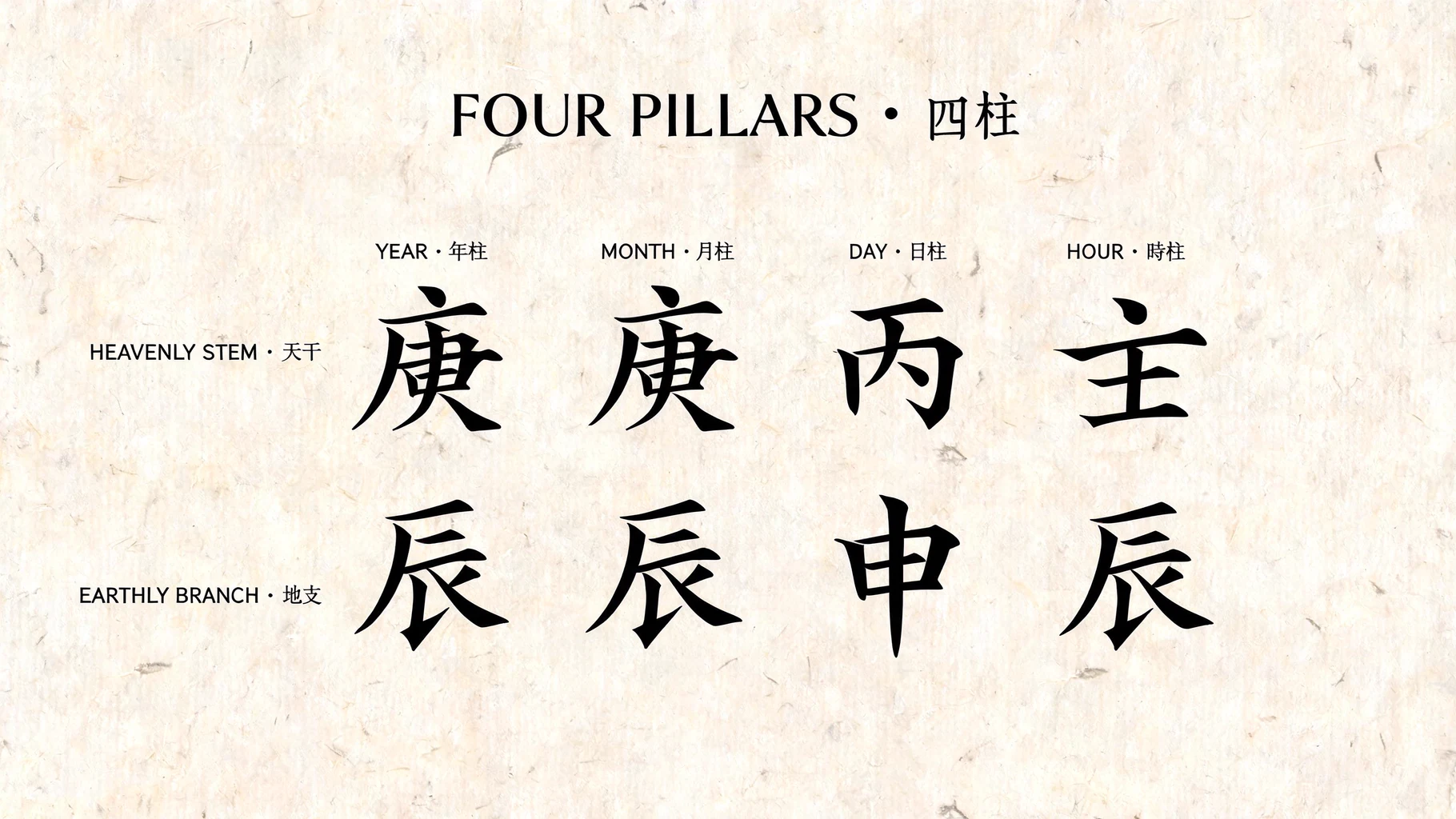
The words year, month, day, and hour make the chart sound as though a modern calendar has simply been copied into four boxes. It has not. Each pillar is a Stem-Branch pair assigned through a traditional calendar system. The familiar labels tell us which layer of time is being calculated, not that the Year Pillar contains the number 1994 or the Month Pillar contains "April."
A finished chart might show Gap-Sul for the Year and Mu-Jin for the Month. Those are not translations of calendar numbers. They are positions inside repeating Stem-Branch cycles. Chapter 4 will introduce the two alphabets. For now, the important visual fact is that every column has the same two-story architecture.
Different books and apps may display the pillars in the opposite horizontal order. The column labels, rather than the side on which the sequence begins, identify each pillar. A chart is not wrong merely because it learned to stand on the other side of the room.
Why do the columns have different names?
The Year, Month, Day, and Hour Pillars record different parts of the birth calculation. Traditional readers also associate their positions with different scales of experience.
The Year can suggest the wider social or ancestral background. The Month often receives special attention for season and environment. The Day contains the Day Master, the main reference point of the chart. The Hour can add later-life, private, creative, or legacy themes.
Treat those associations as reading lenses, not four locked drawers labeled "grandparents," "parents," "spouse," and "children." Real families are more inventive than old diagrams.
Position still matters. The same character in the Month Pillar does not automatically carry the same emphasis when it appears in the Hour Pillar. The Month is closely tied to season and the environment in which the chart’s elements begin. The Day gives the central reference point and a particularly private pair. The Hour can bring information that is absent when birth time is unknown.
Traditional assignments describe fields of experience rather than fixed occupants. The Year Pillar may frame lineage, institutions, or an early social world; the Hour may frame later projects and legacy. These associations invite context, not a literal relative in every box. Charts have enough pressure without being made to seat the whole family at assigned places.
One positional fact will matter throughout the book: the Heavenly Stem of the Day Pillar is the Day Master. Chapter 5 will introduce it properly.
The Month Pillar is not simply your calendar month
Here is the first surprise. A Saju Month Pillar does not normally change on the first day of a Gregorian month. Its boundaries follow Solar Terms, points in the traditional solar calendar that track the Sun’s seasonal movement.
That means someone born near a monthly boundary can receive a different Month Pillar depending on the exact date, time, and calculation rules. The Year Pillar also changes at the Saju year boundary associated with Ipchun, the Beginning of Spring, rather than automatically at midnight on January 1.
These boundaries are normally handled by a chart calculator. Its stated calendar rules and the quality of the birth information determine whether the resulting pillars can be trusted.
The Day Pillar has its own boundary question. Some traditions change the Saju day at midnight, while others use an earlier boundary associated with the beginning of the Ja hour around 11 p.m. Near that boundary, two calculators may differ because they follow different conventions. The detailed input and boundary questions belong in the birth-time and calendar guide, where the assumptions can be compared without interrupting the chapter.
The detail sounds fussy until someone is born near a boundary. Then it becomes the entire reason two calculators disagree.
Why the input details matter
A reliable chart begins with ordinary records:
- date of birth
- recorded birth time, if known
- birthplace or the time zone that applied there
- whether the recorded date is Gregorian/solar or lunar
- any additional field the calculator uses for timing-cycle direction or presentation
A date must be identified in the calendar system in which it was actually recorded. Converting a lunar date and then entering the converted result as though it were still lunar gives the date two costume changes and no way home.
"Solar" in a date selector usually means the Gregorian civil date written on a modern birth record. "Lunar" means a date recorded in the traditional lunar calendar and supplied to the calculator for conversion. It does not mean the Four Pillars system ignores the Sun. The Month and Year boundaries still use solar seasonal markers, which is why the terminology can be confusing at first.
A family record such as "the fifteenth day of the eighth lunar month" remains a lunar date. An official Gregorian record remains Gregorian. Preserving the original form makes a later calculation reproducible.
Birthplace matters because "10:30 a.m." is a local time. Historical time zones and daylight-saving rules can also matter. Some Korean Saju calculators offer a longitude-based True Solar Time correction for the Hour Pillar. Two calculators may disagree because their boundary or correction rules differ, not because one of them sensed a more poetic destiny.
A city name is not decorative profile information. It helps resolve the time zone and geographic context for the recorded clock time. Historical rules matter because governments have changed time-zone offsets and daylight-saving policy. A person born during an old daylight-saving period should not be calculated as though today’s clock rules had always existed.
A screenshot without its inputs is an incomplete record. The full birth-time and calendar guide explains the possible settings; here, the important distinction is between the recorded birth information and the chart calculated from it.
What if the birth time is unknown?
An unknown birth time leaves the Hour Pillar unknown. A convincing-looking hour does not become evidence simply because it completes the grid.
You still have the Year, Month, and Day Pillars. That is six visible characters and plenty to learn from. The missing Hour means some conclusions remain incomplete or provisional, especially when they depend directly on the Hour Stem, Hour Branch, or timing calculations that use the birth hour.
An unknown Hour does not erase the entire chart. The first three pillars remain, which preserves the Day Master, the Month Branch and season, and many relationships among the six known characters.
What changes is confidence. A claim that depends on the Hour cannot be presented as confirmed. Some overall interpretations may also shift because the missing pair could add support, pressure, a root, or an interaction. Honest software and honest readers make that uncertainty visible instead of quietly promoting the placeholder to fact.
The distinction is simple:
- Known: the recorded birth information
- Calculated: the pillars produced under stated rules
- Provisional: anything that could change with the missing hour
Keeping these three categories separate prevents a great deal of accidental certainty.

The eight characters are only the front door
Having all eight characters makes the chart recognizable. Reading it requires the relationships that come next.
The characters carry Yin or Yang and one of the Five Elements. The Branches also contain Hidden Stems. The Day Master changes how the other Stems and Branches relate to the chart owner. Season changes the strength and usefulness of what appears. Combinations, clashes, and timing layers add movement.
A personality paragraph without its underlying chart is like a restaurant review without the address. Calculation and interpretation are different layers. If two results show different pillars, the disagreement concerns birth data, calendar boundaries, or calculation conventions. If the pillars match but the readings differ, the disagreement concerns interpretation. Mixing the two is how a settings menu turns into a philosophical dispute.
None of that means the chart is secretly a pile of forty unrelated features. Each later layer answers a version of the same question: what is the relationship among these characters in this season and position?
Chapter 3 begins with the Five Elements, but not as five personality types or a shopping list of what your chart is missing. We will meet them as verbs: growing, warming, stabilizing, refining, and flowing.
Previous: Welcome to Korean Saju
Next: The Five Elements Are Always Moving