Welcome to Korean Saju
Meet Saju as a living Korean tradition before learning how its Four Pillars chart works.
In Korea, asking about your Saju can be surprisingly ordinary.
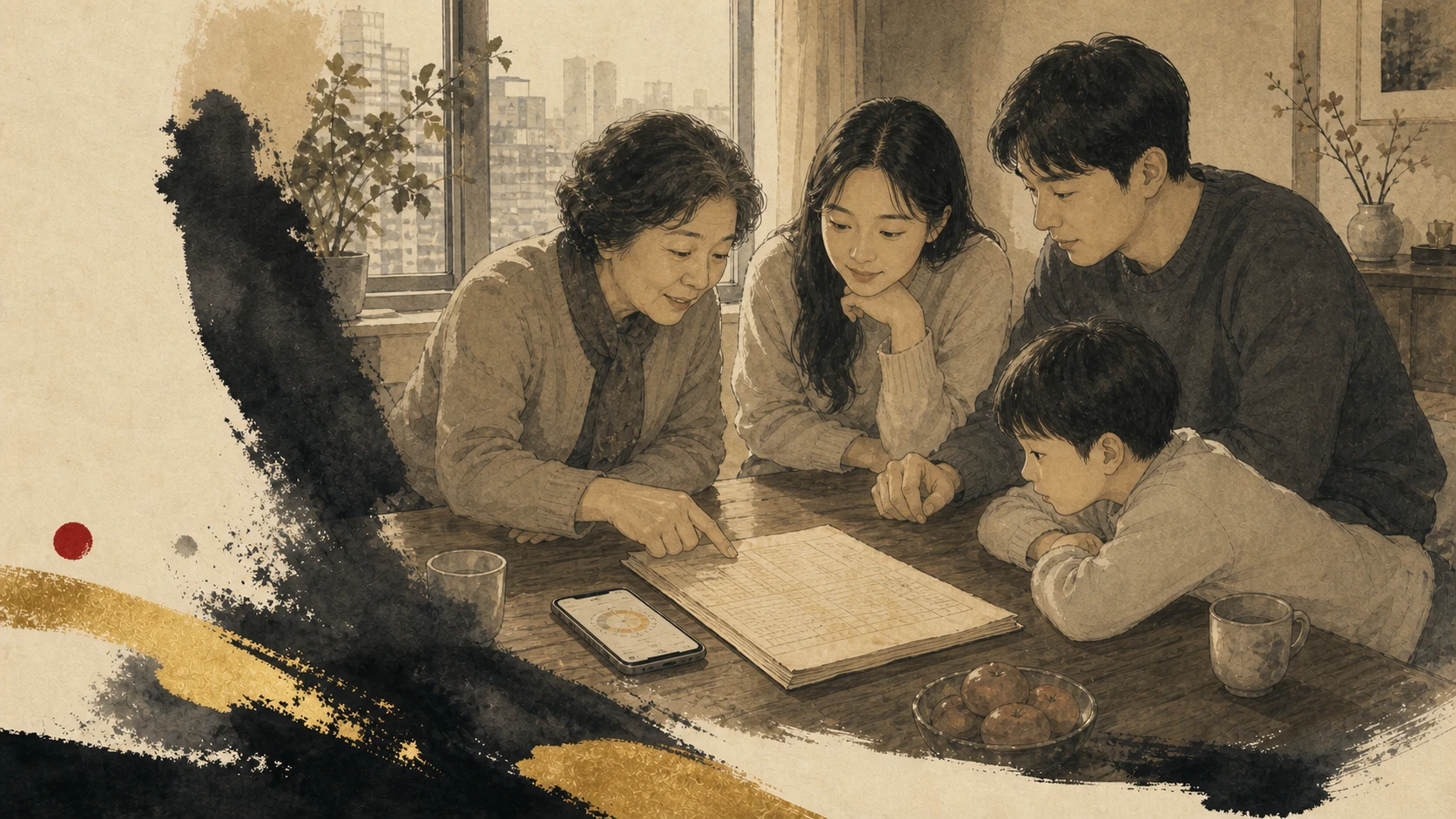
It may happen at a family gathering, after someone announces an engagement. It may happen over iced coffee when a friend pulls up a birth chart on a phone. A parent may remember the exact minute a child was born because an elder insisted it would matter one day. Someone may laugh at the whole idea, then lean across the table and ask, "Fine, but what does mine say?"
That mixture of seriousness, curiosity, inheritance, and play is a good place to begin.
Saju (사주, 四柱) literally means "Four Pillars." It is the Korean practice of reading a birth chart made from the year, month, day, and hour of birth. Each pillar contains two characters, giving the chart eight characters in total. That is why you may also hear Saju Palja (사주팔자, 四柱八字): Four Pillars, Eight Characters.
The basic structure is simple enough to fit on a napkin. Learning to read the relationships inside it takes longer. Fortunately, nobody is asking the napkin to reveal your entire destiny before dessert.

The scene matters because it corrects a common first impression. English-language introductions often present Saju as a sealed piece of ancient wisdom, untouched until a modern reader discovers it. In Korea, it never sat that still. It moved through family habits, marriage customs, naming practices, consultation rooms, television, cafes, and eventually phone screens. The practice is old, but it is also ordinary.
One chart, a long journey
The Four Pillars system did not begin in Korea. Its classical framework developed in China, where it is widely known as BaZi (八字), or Eight Characters. It traveled across East Asia with calendars, philosophy, statecraft, medicine, and other systems for thinking about time and change.
In Korea, that shared framework acquired Korean pronunciations, local teaching lineages, consultation customs, and a place in everyday life. The chart underneath Saju and BaZi is closely related. The cultural experience around the chart is not identical.
Think of a musical instrument that crosses a border. The tuning may remain familiar, but the songs, settings, and habits of performance change. Calling the Korean practice Saju does not erase its Chinese roots. Calling it BaZi alone does not tell the whole Korean story either.
For this book, Saju names the Korean practice and BaZi appears when a comparison or search term helps. The Korean terms stay visible because they are part of the tradition you came to meet.
The history is more gradual than the tidy version found in many introductions. Stems and Branches were used to record time long before the birth-chart method we now recognize. Different forms of birth analysis developed over centuries in China. Later tradition connects early methods with Li Xuzhong and the Day Master-centered approach with Xu Ziping, but surviving texts and later attributions do not fit into a clean inventor-and-invention story.
What matters for a beginner is the broad line. The Zi Ping Four Pillars tradition took shape in China and reached Korea through long periods of scholarly and cultural exchange. Korean scholars were studying related methods by the late Goryeo and early Joseon periods. From there, the practice continued in Korean language and society for centuries.
That gives us two facts worth holding at the same time. The framework has Chinese roots. Korean Saju also has a long Korean history. Neither fact needs to evict the other from the room.
The whisky analogy is useful up to a point. Japanese whisky learned heavily from Scotch, then grew its own makers, methods, and tastes. Nobody needs to deny Scotland to take Japanese whisky seriously. Four Pillars techniques traveled too. The comparison becomes less useful when it suggests a sharp national border. Saju and BaZi schools still overlap, borrow, disagree internally, and cross borders. Two teachers in Seoul may differ more than one teacher in Seoul and another in Taipei.
Shared roots do not produce one frozen practice. They produce a family tree with argumentative relatives, which may be the most believable kind of family tree.
What does a Saju reader actually read?
A Saju chart uses a traditional calendar system to translate a birth moment into four pairs of signs. Those signs belong to two families:
- ten Heavenly Stems (천간, 天干)
- twelve Earthly Branches (지지, 地支)
Each sign also carries Yin or Yang and an association with one of the Five Elements: Wood, Fire, Earth, Metal, or Water.
At first glance, the chart looks like a small grid of unfamiliar characters. A reader does not treat each box as a separate fortune-cookie message. The important questions are relational.
What season was this chart born into? Which element supports another? Which one controls or redirects it? What changes when two characters meet? What happens when a ten-year or annual timing layer enters the picture?
Saju is therefore closer to reading a sentence than counting colored tokens. Vocabulary matters, but grammar makes the meaning.
Is Saju astrology?
"Korean astrology" is the easiest English label, and it helps people find the subject. It is not a perfect fit.
Saju does not use a circle of planets and zodiac houses in the way Western natal astrology does. Its chart is built from a calendrical cycle of Stems and Branches, then read through season, Yin and Yang, the Five Elements, and relationships among the characters.
Saju is also not a religion. It is distinct from Korean shamanism, although real Korean lives are untidy and the two can sometimes appear in the same spiritual or consultation setting. Some readers approach Saju as divination. Others treat it as a traditional language for reflection. Many people move between belief, skepticism, and curiosity depending on the day.
It is equally unhelpful to rescue Saju from the word "fortune-telling" by calling it science. The chart is calculated through rules, but a rule-based calculation does not automatically validate every interpretation built on top of it. Saju belongs to a traditional metaphysical and divinatory history. Modern readers can value its cultural depth and reflective usefulness without inventing a laboratory certificate it does not have.
That leaves room for several honest ways to read. You may take the cosmology seriously. You may treat the chart as a structured prompt. You may be interested mainly in Korean culture. You may remain unconvinced and still find the grammar interesting. This book does not require a loyalty oath.
You do not need to settle that philosophical question before reading Chapter 2.
The Chinese zodiac is another nearby subject that often causes confusion. Your zodiac animal comes mainly from the Year Branch. A full Saju chart contains four Branches and four Stems, so two people born in the same animal year can still have very different charts. The animal at the gate is not the entire house.
What can people ask it?
Traditional consultations have covered large questions: marriage, family, work, money, health, travel, and the timing of important decisions. Modern conversations often ask similar questions in newer clothes.
- Why do I keep falling into the same kind of work conflict?
- Why does this relationship feel easy in one area and exhausting in another?
- Is this a season for expansion, repair, study, or patience?
- What does my chart seem to emphasize, and what does it leave me to develop deliberately?
A chart cannot interview your boss, check your bank account, diagnose an illness, or know what your partner said last Tuesday. Real evidence keeps its job. Saju adds a patterned way to ask questions; it does not replace the world those questions are about.
This distinction will matter throughout the book. We will learn the tradition seriously without handing it the keys to the car.
The chart has a social life in Korea
One of the easiest ways to understand Korean Saju is to look at the objects and rituals that formed around birth information.
In traditional marriage arrangements, a sajudanja (사주단자, 四柱單子) could carry the groom’s birth year, month, day, and hour from his family to the bride’s family. The document itself was not a compatibility verdict. It was a formal way of transmitting the birth data used within a larger marriage process.
Then there is Gunghap (궁합, 宮合), the practice of comparing two people’s charts. Parents may still suggest checking it. Couples may check it themselves, sometimes with sincere concern and sometimes because it sounds more entertaining than another online compatibility quiz. The custom is real, but it has never operated with identical force in every family, region, or generation. A poor result did not automatically cancel every marriage, whatever a television drama may find convenient.
Naming is another meeting point. Some families consult a naming specialist after a child is born. The specialist may consider the chart alongside the sound, meaning, Hanja, and stroke structure of a proposed name. This is more involved than spotting a missing element and inserting a matching character as if debugging software. Different naming schools have their own rules, and plenty of Korean children receive names without a Saju consultation at all.
Around Lunar New Year, many Koreans also check Tojeong Bigyeol (토정비결, 土亭秘訣), a Korean annual divination tradition. It often appears beside Saju in popular culture, but it is not simply a Korean nickname for BaZi, nor is it the same thing as reading Annual Luck Pillars. Neighboring traditions can share a waiting room without becoming the same patient.
These practices help explain why asking for an exact birth time can feel less unusual in Korea than it does in many English-speaking families. The information has had somewhere to go.
The modern setting is no less Korean for containing Wi-Fi. A consultation can happen in a quiet office, at a Saju cafe, through a video call, or inside an app. Friends compare chart cards. Television programs borrow the language of Saju when talking through a guest’s worries. Skeptics join because someone else booked the appointment, then ask the most follow-up questions.
None of this proves the chart’s claims. It shows what kind of cultural object the chart has become: part technical system, part conversation ritual, part inherited habit, and occasionally part of a very elaborate family group chat.
There is no single national consultation personality either. It is tempting to describe BaZi as clinical and Korean Saju as warm, then let two countries behave like characters in a sitcom. Real practitioners refuse to cooperate. Korea has blunt prediction-focused readers and patient listeners. Chinese-speaking communities have both too. School, temperament, business model, and the question brought into the room can shape a consultation as much as nationality.
The Korean distinction is easier to locate in language and social use than in a promise that every Korean reader behaves a certain way. Saju, palja, gunghap, and daeun appear in ordinary conversation. Birth data traveled through marriage documents. Charts entered naming and New Year customs. Modern delivery developed around those habits. This is a more specific claim, and therefore a more useful one.
The consultation itself can still feel intimate because the chart gives people permission to discuss subjects that are otherwise awkward. Work resentment, family duty, money anxiety, marriage pressure, and the fear that one has chosen the wrong life all fit inside the appointment. Sometimes the most useful part is not a prediction. It is hearing the problem arranged into a pattern that can finally be discussed.
That does not make every reading therapy, and a practitioner is not automatically trained as a therapist. It explains why the experience can feel larger than someone decoding eight symbols across a desk.
Korean words are part of the fun
English books translate the same Saju term in several different ways. A dramatic translation may even make an ordinary technical label sound like the title of a fantasy villain.
This guide uses Qiora’s standard English terms consistently. On first appearance, important terms also include Hangul and Hanja:
- 사주: the Korean spelling
- 四柱: the shared classical characters
- Saju: the romanized Korean name
- Four Pillars: the plain English meaning
You do not have to memorize all four. The Hanja is especially useful when two English translations look unrelated, while the Hangul keeps the Korean voice of the practice present.
When you need to look something up, the Reference Garden will hold the full tables and terminology. The main book will keep moving.
There is no prize for speaking only in translated terms. There is also no virtue in making every sentence carry three scripts until it collapses. We will introduce the Korean word where it adds recognition or cultural texture, then use the clearest English term for the rest of the discussion.
This becomes especially helpful with dramatic names. Seven Killings is a technical Ten God label. White Tiger is a Special Star. Neither phrase should be allowed to enter a paragraph wearing its own thunder soundtrack. The original Korean and Hanja help us identify the term; the chart context tells us what weight it deserves.
Your first promise to the chart
Before we build one, make a small promise: no single symbol gets to explain an entire person.
Not a Day Master. Not a missing element. Not a clash. Certainly not a Special Star with an alarming English name. A chart is a network of relationships shaped by season and timing. A person is still larger than the network.
That is enough philosophy for the opening chapter. Next, we can finally look at the famous eight characters and see why four pillars require only a very small table.
For now, keep three things from this opening. Saju and BaZi share a Chinese-developed Four Pillars framework. Korea gave that framework a long local life in its own language and customs. And learning the system does not require surrendering either curiosity or judgment.
The chapters ahead keep calculations precise and traditional concepts in context. When a claim turns dramatic, it deserves a raised eyebrow. By the end, a new reader should understand what Saju readers are doing with a chart and where interpretation should stop.
That is a sturdy enough place to put the first pillar.