Meet the Stems and Branches
Meet the ten Heavenly Stems and twelve Earthly Branches without memorizing a giant chart.
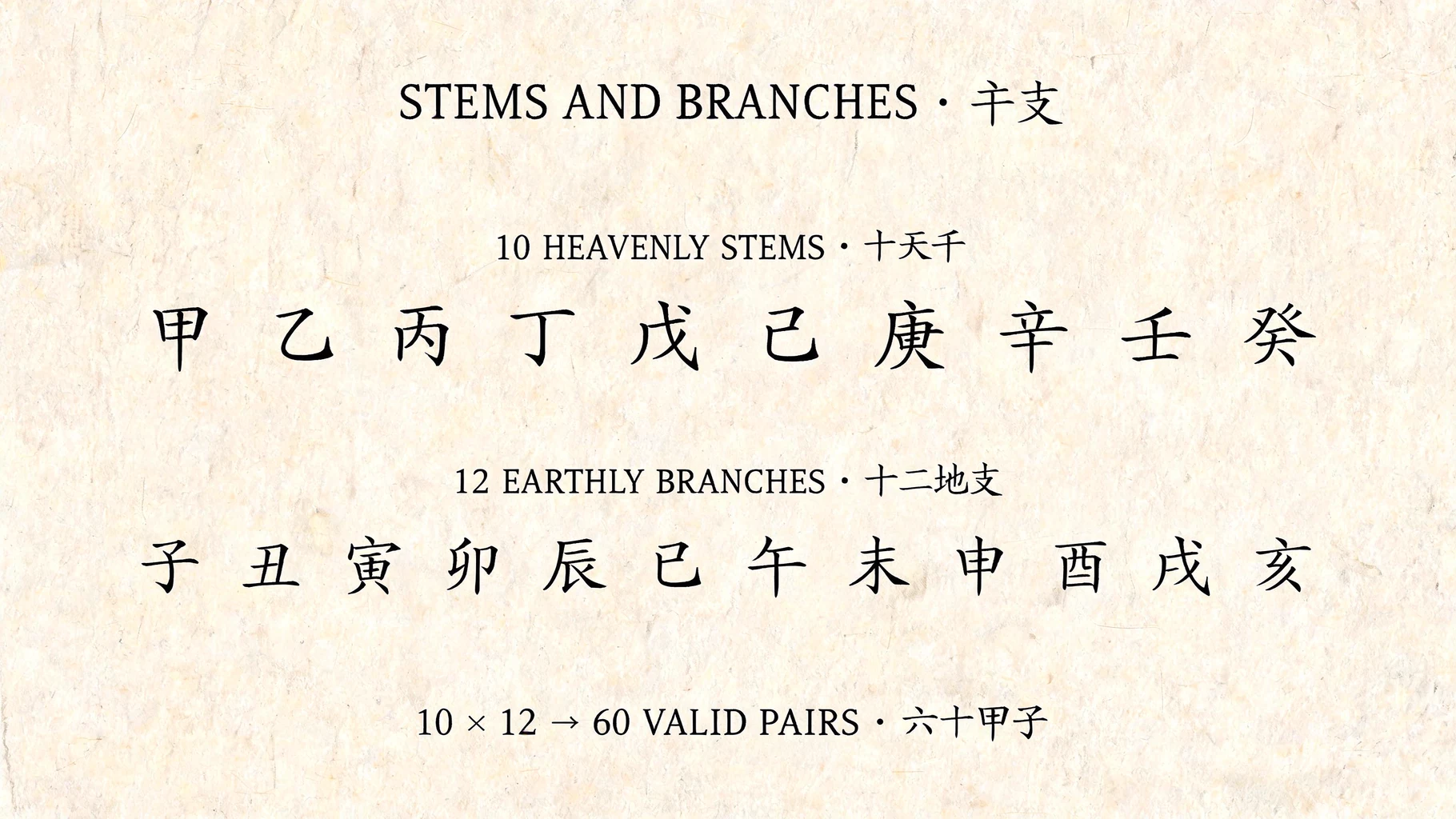
The eight boxes in a Saju chart are filled from two repeating alphabets. The ten Heavenly Stems sit on top. The twelve Earthly Branches sit below.
If the Four Pillars are four columns, Stems and Branches are the letters inside them. Fortunately, this alphabet has twenty-two characters, not twenty-two ways to ruin your week.
You do not need to memorize them all before continuing. First learn what kind of work each family does. The names will become familiar because they keep returning with jobs to do.
One pillar, two layers
Each pillar is a pair. A Heavenly Stem occupies the upper position and an Earthly Branch occupies the lower position. In a written chart, the four upper characters form the Stem row and the four lower characters form the Branch row.
The words "heavenly" and "earthly" come from the traditional calendar vocabulary. They do not mean that the top row is spiritual while the bottom row is stuck doing paperwork. Neither row is morally higher, and neither can be read alone.
Stems are directly visible. Branches carry additional contents called Hidden Stems. For that reason, many readers describe Stems as a more exposed layer and Branches as a denser, more rooted layer. Treat this as a useful reading convention, not a rule that everything above is public and everything below is secret.
A Stem and Branch in the same pillar also share the same polarity. Yang sits with Yang, and Yin sits with Yin. That small rule is the key to the sixty-pair calendar cycle we will meet shortly.
Heavenly Stems are the visible line
The ten Heavenly Stems, Cheongan (천간, 天干), are the Five Elements in their Yang and Yin forms.
| Order | Element | Yang Stem | Yin Stem |
|---|---|---|---|
| 1-2 | Wood | Gap (갑, 甲) | Eul (을, 乙) |
| 3-4 | Fire | Byeong (병, 丙) | Jeong (정, 丁) |
| 5-6 | Earth | Mu (무, 戊) | Gi (기, 己) |
| 7-8 | Metal | Gyeong (경, 庚) | Sin (신, 辛) |
| 9-10 | Water | Im (임, 壬) | Gye (계, 癸) |
The order matters. The cycle begins with Yang Wood, moves to Yin Wood, and continues through Fire, Earth, Metal, and Water. Yang comes first within each elemental pair.
Gap and Eul are both Wood, but they are not duplicates wearing different name tags. Gap is often pictured as a large tree, upright timber, or a force that establishes direction. Eul is often pictured as a vine, flower, or flexible plant that finds a route through its surroundings. The images help us remember modes of movement. They are not a license to declare every Gap person stubborn or every Eul person delicate.
Byeong Fire is commonly compared with the Sun, broad and visible. Jeong Fire resembles a lamp, candle, or concentrated flame. Mu Earth may evoke a mountain or a large expanse of land. Gi Earth often appears as cultivated soil, a garden bed, or earth that receives and reshapes what is placed in it.
Gyeong Metal can suggest ore, an axe, or forceful refinement. Sin Metal can suggest jewelry, a needle, or a precise edge. Im Water is compared with an ocean or great river, while Gye Water resembles rain, mist, or a spring. These metaphors are handles. Once you can hold the character, check the season, position, roots, and relationships before saying what it does.
One Stem will soon become more important than the others for orientation. The Stem above the Day Branch is the Day Master (일간, 日干). It is the reference point from which the chart’s Ten Gods are named. It is not the whole person, but it is where a reader begins the conversation.
Earthly Branches carry weather and rooms
The twelve Earthly Branches, Jiji (지지, 地支), move in a fixed order too.
| Order | Branch | Hanja | Animal | Polarity and primary element |
|---|---|---|---|---|
| 1 | Ja (자) | 子 | Rat | Yang Water |
| 2 | Chuk (축) | 丑 | Ox | Yin Earth |
| 3 | In (인) | 寅 | Tiger | Yang Wood |
| 4 | Myo (묘) | 卯 | Rabbit | Yin Wood |
| 5 | Jin (진) | 辰 | Dragon | Yang Earth |
| 6 | Sa (사) | 巳 | Snake | Yin Fire |
| 7 | O (오) | 午 | Horse | Yang Fire |
| 8 | Mi (미) | 未 | Goat | Yin Earth |
| 9 | Sin (신) | 申 | Monkey | Yang Metal |
| 10 | Yu (유) | 酉 | Rooster | Yin Metal |
| 11 | Sul (술) | 戌 | Dog | Yang Earth |
| 12 | Hae (해) | 亥 | Pig | Yin Water |
English books are inconsistent about Korean romanization. This book follows Qiora’s standard spellings. Two names become Sin in plain Roman letters: the Yin Metal Stem 辛 and the Monkey Branch 申. The Hanja and the chart row tell them apart.
A Branch is not simply its animal or primary element. It also holds a position in the year, a traditional two-hour block, and one or more Hidden Stems. Imagine a Branch as a room. The animal is the sign on the door. The primary element is the general atmosphere. The Hidden Stems are the people and objects already inside.
Branches often feel more complicated than Stems. A visible Stem says, "Here I am." A Branch says, "Come in, but take your shoes off. There is more going on."
The animals are memorable, which is both useful and dangerous
Most people meet the Branches through the twelve zodiac animals. "I was born in the Year of the Rabbit" is easier to say than "my Year Branch is Myo." The animal system is an excellent memory bridge.
It becomes misleading when the bridge is mistaken for the whole city.
Your Year Branch is one of four Branches. The Month, Day, and Hour Pillars each have another. Their positions ask different questions, and their relationships change how they behave. A Rabbit in the Year Branch and a Rabbit in the Day Branch use the same symbol in different rooms of the chart.
Nor does one animal create a complete personality profile. Myo is not meaningful only because rabbits seem gentle. It is Yin Wood, it belongs to the spring sequence, it stores Eul Wood, and it interacts with other Branches through combinations, clashes, harms, and other patterns. The cute ears are doing less theoretical work than social media would have you believe.
Korean culture also uses tti (띠), the birth-year animal, in everyday conversation. People may ask it to estimate age or mention compatibility. That social custom is part of the living culture around the Branches, but a full Saju reading never stops at the Year animal.
The Branches carry the year’s seasons
The Branch order can be read as a seasonal circuit.
- In, Myo, Jin belong to spring and the rise of Wood.
- Sa, O, Mi belong to summer and the height of Fire.
- Sin, Yu, Sul belong to autumn and the sharpening of Metal.
- Hae, Ja, Chuk belong to winter and the depth of Water.
Earth appears strongly in the transitional Branches Chuk, Jin, Mi, and Sul. They stand near seasonal turns and are sometimes called storage or grave Branches in traditional texts. Those names do not predict literal death. They describe how qi is gathered, transformed, and handed from one season to the next.
Seasonal placement is why the Month Branch matters so much. The same Stem behaves differently in the rising warmth of spring, the exposed heat of summer, the dry contraction of autumn, or the cold storage of winter. A metaphor without weather is only half dressed.
These month positions follow Solar Terms, not the first day printed on a Gregorian month and not the first day of a lunar month. We will give the season its own chapter rather than bury that essential fact in a table footnote.
Branch time is older than the clock on your phone
The twelve Branches also divide a day into traditional double hours. Ja centers on midnight, O centers on noon, and the other Branches continue around the twenty-four-hour cycle.
This does not mean that an Hour Pillar can always be selected by glancing at a generic two-hour chart. Qiora determines the Hour using True Solar Time after applying the relevant location and civil-time rules. Near a boundary, longitude and clock conventions can change which Branch is assigned.
The double-hour associations are still worth knowing because they show how one symbolic system links year, month, day, and hour. The animal names are only one role of the Branches. They are also coordinates in a cyclical calendar.
Ten and twelve meet in sixty valid pairs
At first, ten Stems multiplied by twelve Branches seems to promise 120 combinations. The calendar uses only pairs with matching polarity:
- Yang Stem with Yang Branch
- Yin Stem with Yin Branch
The first pair is Yang Wood Rat (甲子). The next is Yin Wood Ox (乙丑). Stems and Branches advance together in their fixed sequences. After the tenth pair, the Stem cycle restarts while the Branch cycle continues. Both return to their starting positions together after sixty steps.
This is the Sexagenary Cycle (육십갑자, 六十甲子), called Yukship Gapja in Korean. It supplies the valid Stem-Branch pairs for Years, Months, Days, and Hours. A complete pillar can be written in Qiora’s English style as polarity + element + animal, followed by the Hanja when first introduced.
The cycle is a calendar sequence, not a leaderboard. Pair sixty did not grind harder than pair one.
In Korea, the sixty-year return has a familiar cultural echo. A sixtieth birthday traditionally marks the completion of one full Ganji cycle, a return to the pair under which a person was born. Modern celebrations vary, but the calendar idea behind the milestone is beautifully literal: the two wheels have met again.
What a pair can and cannot tell you
Consider the first pair, 甲子.
- Gap 甲 is Yang Wood.
- Ja 子 is Yang Water and carries the Rat label.
- The Stem sits over the Branch as one pillar.
Water produces Wood, so the lower Branch can be described as supporting the Stem at the elemental level. That observation is useful. It is not a finished interpretation. We still need to know which pillar contains the pair, what season surrounds it, what is hidden inside the Branch, and how the other seven characters respond.
Reading the pair’s labels is like reading the title on a folder. You now know where to file it. You have not read every page inside.
Familiarity grows through repeated encounters
Beginners often stop here and try to memorize a complete atlas in one heroic evening. That is possible. It is also how Gap, Gyeong, Gye, and Gi end up sharing one exhausted mental drawer.
The tables work best as maps rather than entrance exams. A character first appears with a Korean reading, element, and polarity. It later gains new jobs: Day Master, Month Branch, root, member of a combination, or visitor in a Luck Pillar. Each encounter adds context without requiring the entire atlas to be memorized at once.
Repeated encounters create a richer understanding than isolated flash cards. Ja first appears as Rat and Yang Water. Later it becomes the cold center of winter, a container of Gye Water, a possible clash partner for O, and a particular room in a particular chart. The symbol does not change; the amount visible within it does.
The full Stems and Branches Atlas will remain nearby when you need spellings, element labels, animals, seasons, hour ranges, or Hidden Stems.
The next chapter asks one Stem to step forward. The Day Stem becomes the reference point for the entire chart: your Day Master.
Previous: The Five Elements Are Always Moving
Next: Meet Your Day Master